TonePerfect for English
Free English pronunciation test
Read 5 short words into your microphone. In about a minute you will see a score for every sound you said — and find out exactly which English sounds need your attention. Free, no account, on any phone or computer.
Get the mobile app
Scan with your phone to install
Record 5 words. Free, no signup — your browser does the recording, our engine does the listening.
think
Touch the bottom edge of your top teeth with your tongue tip and let the air flow over it. No voice, and the tongue never taps.
to use your mind
Tap to record
Free English accent test →·Check any English text →·Practice any English text →
Everything you need to actually sound right
Short daily practice built around the sounds you personally get wrong.
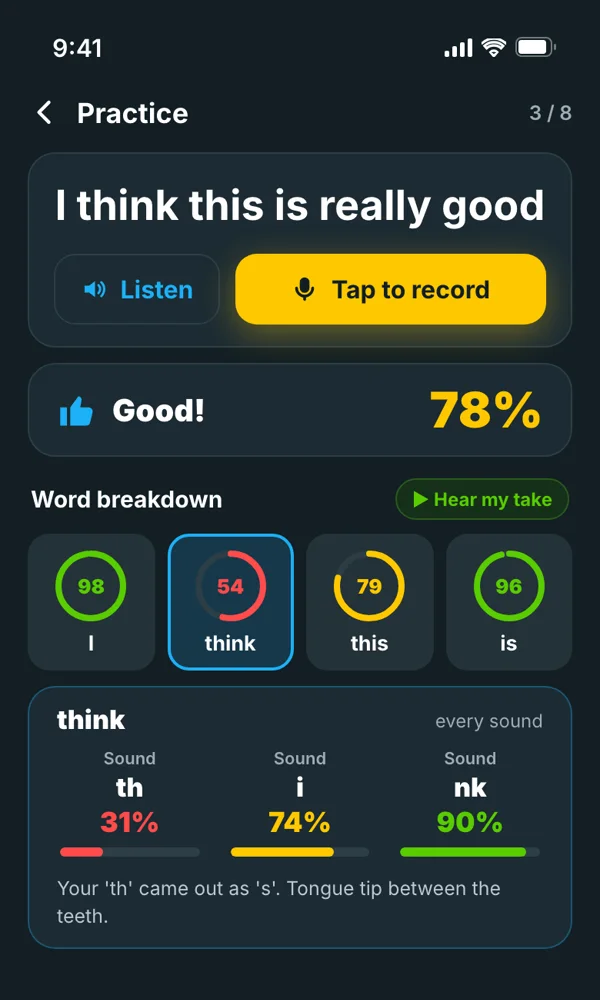
See every sound you get wrong
Each word is scored sound by sound, grouped by syllable, so you know exactly what to fix.
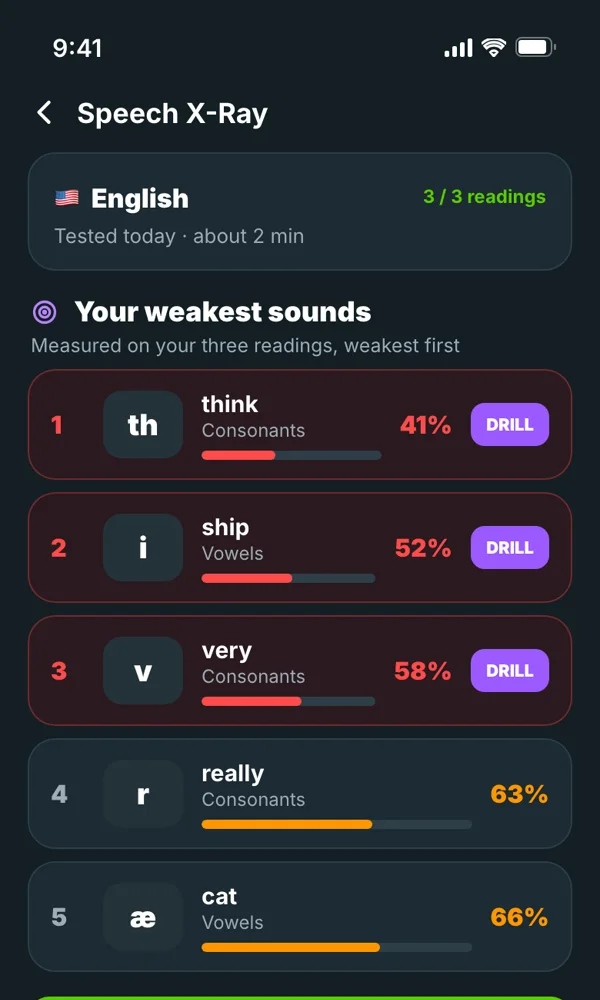
Find your weakest sounds in 2 minutes
A Speech X-Ray of three short readings ranks the sounds to fix first.
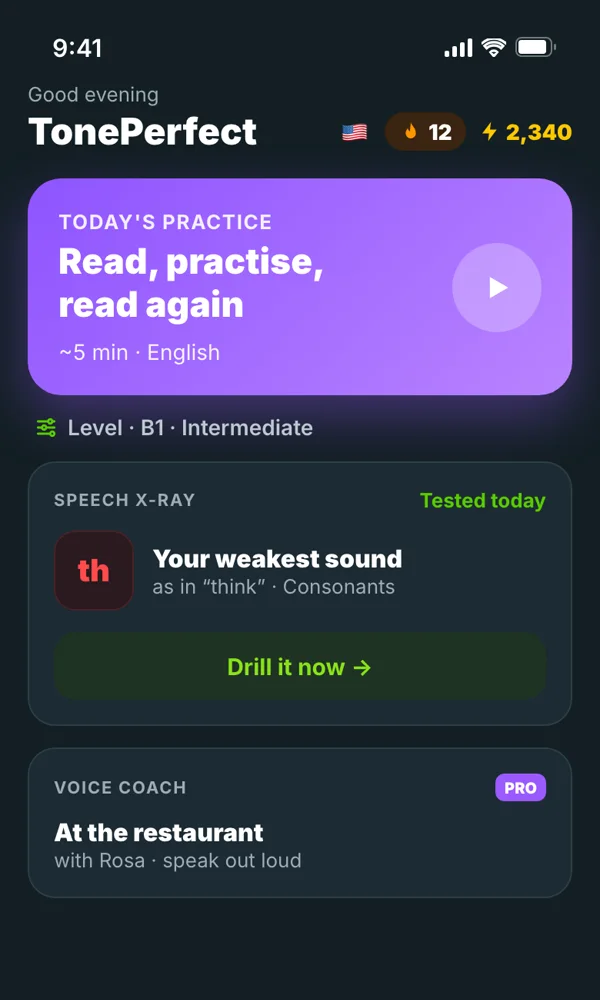
Five minutes a day
A short daily session built on the sounds you need most.
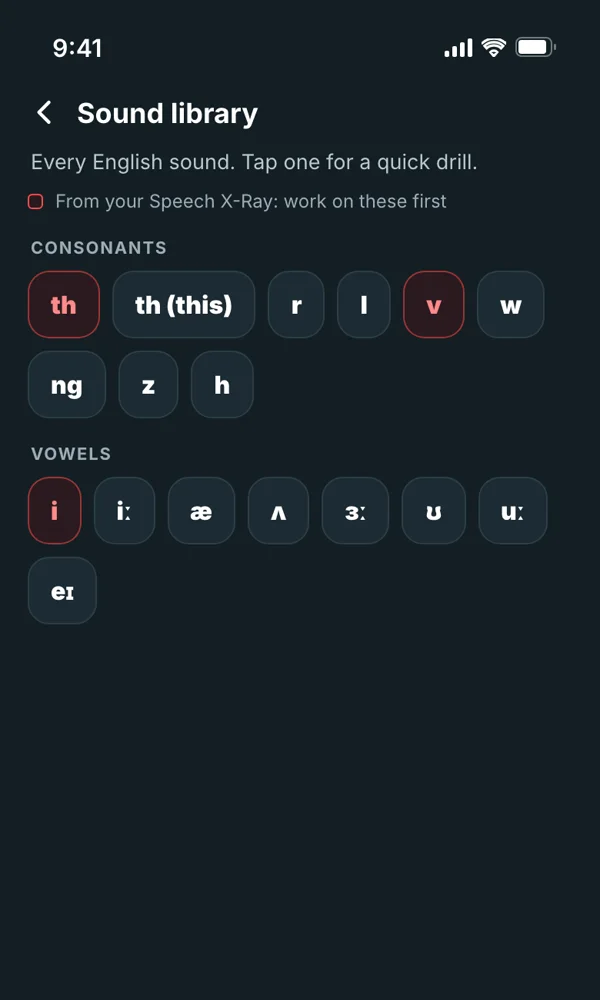
Drill any sound
A sound library for the whole language, with a one-tap drill for each sound.
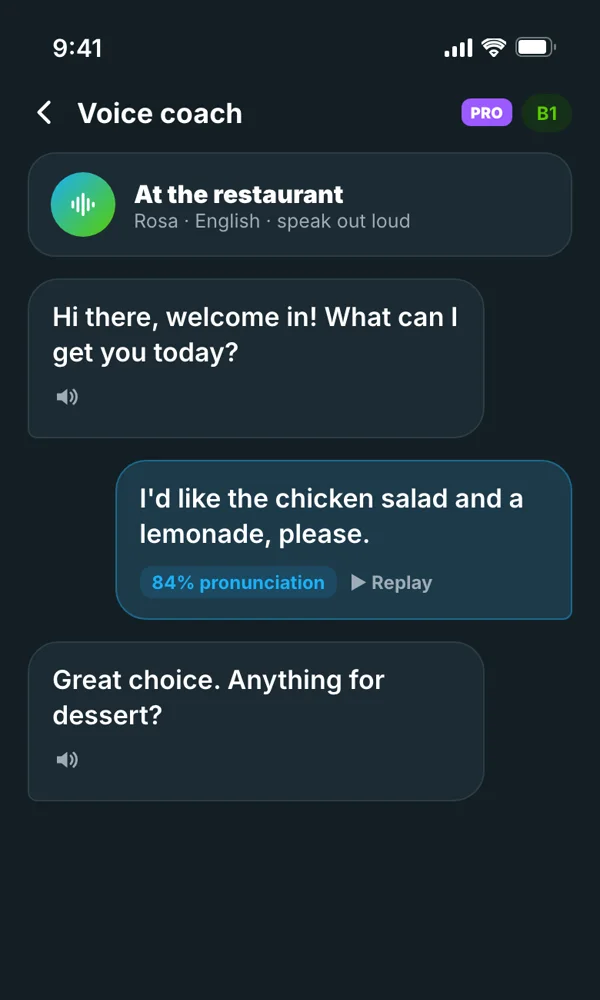
Speak in real situations
Role-play everyday situations out loud with an AI voice coach (Pro).
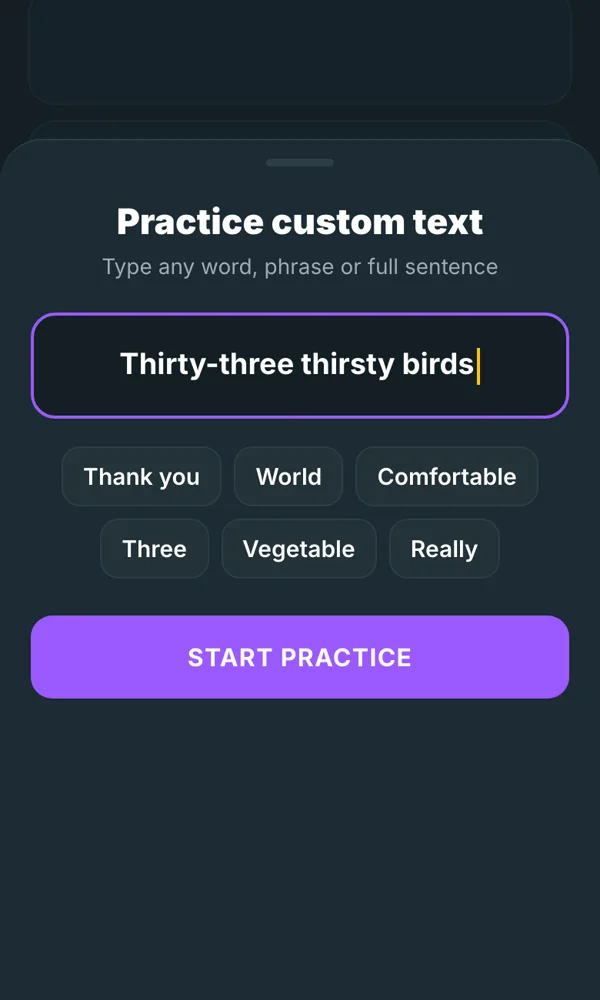
Practise any word or sentence
Type anything you want to say and get a score for every sound.
How it works
- 1
Record 5 words
Tap the microphone and read each word out loud. It takes about a minute, right in your browser.
- 2
AI checks every sound
Our speech engine listens to each sound inside each word — not just the word as a whole — and scores it.
- 3
See what to fix
You get a clear picture of which sounds are strong and which need work, with a tip for how to make each one. Then keep practicing in the app.
TonePerfect's English scoring runs on our own speech engine, and we validated it against human experts: a public research dataset of 2,500 recordings from 250 English learners, each rated by five human pronunciation raters. The engine's sound-by-sound judgments closely agree with those human ratings.
The sounds that decide your accent
The quiet 'th' (think)
The tongue tip touches the bottom edge of the top teeth and the air flows over it; no voice, and the tongue never taps.
The buzzing 'th' (this)
The same tongue-behind-the-teeth position as in 'think', with the voice buzzing through it.
The English 'r' (red)
The tongue curls back or bunches up in the middle of the mouth and touches nothing at all, while the lips round a little.
The 'l' sound (love)
The tongue tip touches the ridge behind the top teeth and the voice flows around the sides of the tongue.
The short vowel in 'sit'
Short and loose: the tongue sits a little lower than in 'see' and the whole mouth stays relaxed.
The long vowel in 'see'
Long and tight: the tongue is high and forward and the lips spread as if smiling.
Scores rank your own sounds against each other so you know what to drill first. They are not an accuracy certificate and not an exam grade.
What an English pronunciation test actually measures
Intelligible English is mostly a matter of individual sounds. Listeners forgive an accent easily; what makes them ask you to repeat is a sound that has been replaced by a neighbour — "sink" for "think", "berry" for "very", "sheep" for "ship", "wery" for "very". A useful pronunciation test therefore has to score below the word level, sound by sound, and tell you which specific sounds are being swapped, dropped or blurred.
This test uses five words chosen so that, between them, they cover the sounds most learners struggle with: the two "th" sounds, the English "r" and "l", the short and long "i" vowels, "v" against "w" and "b", and consonant clusters at the end of a word (the "-rld" of "world"). Each word is scored as a sequence of sounds against a native reference, so a single weak sound shows up on its own line rather than dragging down the whole word unseen.
What it does not measure is your accent. A Spanish or Indian or French accent is not an error, and this test does not try to make you sound like a newsreader. It measures whether each sound you produce is the sound an English listener expects — which is what decides whether you are understood.
How the score is calculated, and what a good score is
The engine aligns your recording to the expected sounds of the word, then rates how closely each sound you produced matches native productions of that sound. The scores you see (0–100) are per sound and per word; the word score is not an average that hides a problem, and the weakest sounds are ranked to the top so you can see what to work on first.
Read the numbers like this: 85 and above is a sound native listeners will not notice; 70–84 is clearly understood but audibly non-native — usually a vowel slightly off or a consonant a little weak; below 70 is a sound that is likely being heard as a different sound, and one such sound can undo an otherwise good sentence. Most learners get one or two sounds well below the rest. That is the useful result: those are the sounds to practise, and the rest can be left alone.
The scoring was checked against people, not just against itself: on a public research set of 2,500 recordings by 250 English learners, each rated by five human pronunciation experts, the engine’s sound-by-sound judgments closely track the human ratings. Two things still affect a single take — a noisy room and a very quiet microphone both lower scores — so if a result surprises you, record the word once more in a quiet place before you believe it.
Pronunciation test or accent test?
People search for both, and they are the same recorder with a different question. A pronunciation test asks "which sounds are wrong?" — it is the diagnostic. An accent test asks "how far am I from a native speaker overall?" and summarises the same per-sound results as a single picture. If you want to know what to practise, start here; if you want a one-number read on how you come across, take the accent test.
After the test: how to actually improve a sound
A low score tells you which sound; fixing it needs three more things. First, hear the contrast until you can reliably tell the two sounds apart — most learners who say "sheep" for "ship" also cannot hear the difference yet, and no amount of repeating fixes what you cannot hear. Second, learn the physical move: for "th", the tongue tip touches the top teeth; for the English "r", the tongue never touches anything; for "v", the top teeth rest on the lower lip. Third, record the same word again and watch the score move — the feedback loop is what makes practice stick.
Every sound this test scores has its own page with the mouth position, the words it hides in, and audio to compare against. For longer material, the practice page scores any English text you paste — a sentence from your presentation, a line from a song — sound by sound, the same way.
All English sounds, with audio →Practise your own English text →English pronunciation guides →
The mistakes each first language brings
Your first language predicts your weak sounds surprisingly well, because it decides which English contrasts you never had to hear. These are the patterns the test most often finds, by first language. Where the test exists in your own language, the link takes you there.
Spanish speakers
"b" and "v" merge ("bery" for "very"); "sh" becomes "ch" or "s" ("chip" for "ship"); an "e" appears before "s-" clusters ("eschool"); the short "i" of "ship" is said as the long "ee" of "sheep"; final consonants soften or drop; "th" comes out as "t" or "d" in Latin America and as a sound closer to the target in Spain.
Prueba de pronunciación en inglés →Portuguese speakers
Final "-l" turns into "w" ("Brazil" with a "w" ending); words ending in a consonant gain a small "ee" ("book-ee"); "th" becomes "t", "d" or "f"; the "r" at the start of a word is said in the throat, like the Portuguese "rr"; nasal vowels creep into words like "man" and "can".
French speakers
"th" becomes "s" or "z" ("sink", "zis"); the English "r" is replaced by the French uvular "r"; "h" is dropped ("appy") or added where it does not belong; word stress lands on the last syllable, French-style; "ee" and "i" ("sheep" / "ship") are hard to tell apart; final "-ed" and "-s" endings are swallowed.
Test de prononciation anglaise →German speakers
"w" becomes "v" ("vine" for "wine") and "v" sometimes becomes "f"; final "b, d, g" are devoiced to "p, t, k" ("bet" for "bed"); "th" becomes "s" or "z"; the "a" of "cat" drifts toward "e" ("ket"); "r" is either rolled or dropped; "ng" gains a hard "g" at the end ("sing-g").
Englischer Aussprachetest →Russian and Ukrainian speakers
"th" becomes "s", "z", "t" or "d"; "w" and "v" swap; the short "i" ("ship") and the "a" of "cat" have no equivalent and get replaced by neighbours; final voiced consonants are devoiced ("bet" for "bed", "back" for "bag"); "h" is said as a harder "kh"; the English "r" is rolled; vowels are shortened so "seat" and "sit" sound alike.
Тест английского произношения →Chinese speakers (Mandarin and Cantonese)
Final consonants drop or gain a vowel ("bag" → "ba" or "bag-uh"); "th" becomes "s" or "f"; "r" and "l" blur at the start of words; "v" becomes "w"; consonant clusters are simplified ("world" → "wold"); vowel length is uncertain ("sheep" / "ship"); syllables come out evenly stressed, which makes word stress hard to hear.
英语发音测试(简体)· 英語發音測試(繁體) →Japanese speakers
"r" and "l" are one sound; every consonant tends to gain a vowel ("strike" → "su-to-rai-ku"); "th" becomes "s" or "z"; "v" becomes "b"; "f" is a soft blown sound; "si" becomes "shi"; the short "i" / long "ee" and "a" / "u" distinctions are hard to hear; final "-ng" and consonant clusters are simplified.
英語発音テスト →Korean speakers
"f" and "p" merge ("coppee" for "coffee"), "v" and "b" too; "r" and "l" are one sound; "z" becomes "j" ("jero" for "zero"); "th" becomes "s" or "d"; a vowel is added after final consonants ("church-ee"); the "a" of "cat" and the "e" of "bed" are hard to keep apart; word stress is flat.
영어 발음 테스트 →Vietnamese speakers
Final consonants are unreleased or dropped ("cat" and "cap" sound alike); consonant clusters lose a sound ("st" → "s"); "th" becomes "t"; "sh" and "s" merge; "j" and "z" are hard; "p", "t", "k" at the start of a word lack the English puff of air; tone habits carry over into intonation.
Bài kiểm tra phát âm tiếng Anh →Arabic speakers
"p" becomes "b" ("bark" for "park"); "v" becomes "f"; the "e" of "bed" and the "i" of "bit" merge; a vowel splits consonant clusters ("s-i-treet"); "ng" gains a hard "g"; "ch" becomes "sh" in some dialects; the English "r" is tapped or rolled.
Hindi, Urdu and other South Asian languages
"w" and "v" become one sound between the two; "t" and "d" are said with the tongue curled back (retroflex), which English listeners hear strongly; "th" becomes an aspirated "t" or "d"; "z" becomes "j"; word stress falls on unexpected syllables; the "a" of "cat" and the "e" of "bed" merge.
Turkish speakers
"th" becomes "t" or "d"; "w" becomes "v"; the "a" of "cat" merges with "e"; vowel harmony reshapes unstressed vowels; a vowel is inserted into clusters at the start of words ("i-street"); final "-ng" gets a hard "g".
Questions
How does the test work?+
You record 5 common English words, one at a time. Each word targets a sound that many learners find hard — th, r and l, the two "i" vowels, v, and word endings. The AI scores every sound in every word and ranks your weakest sounds first.
What do the scores mean?+
Each sound gets its own score from 0 to 100. 85 and above is a sound listeners will not notice; 70–84 is understood but audibly non-native; below 70 is a sound that is probably being heard as a different sound. A low score on one sound does not mean your English is bad — it shows you where practice will pay off fastest.
Is this a British or American English test?+
The reference is standard American English, but the five test words are chosen so that the sounds being scored — th, r, l, the two "i" vowels, v, final clusters — are the same in General American and standard British English. The engine scores whether each sound is the expected English sound; it does not grade which accent you have.
Is it free? Do I need an account?+
The test is free and needs no account: open the page, allow the microphone, record. The TonePerfect app, which has a lesson and practice words for every English sound and tracks your progress, is free to start as well.
How accurate is an AI pronunciation test?+
Accurate enough to trust for the question it answers — which sounds are off. The engine was checked against a public research set of 2,500 recordings by 250 English learners, each rated by five human pronunciation experts, and its sound-by-sound judgments closely track those human ratings. A noisy room or a very quiet microphone will lower a single take, so record again in a quiet place if a result surprises you.
Can I test a whole sentence, or my own text?+
Yes. The practice page scores any English text you paste — a line from a presentation, an email you have to read aloud, a song — the same way, sound by sound.
Do I need special equipment?+
No. Any phone or computer with a microphone works. Your browser will ask for permission to record. A quiet room helps the AI hear you clearly.
What happens after the test?+
You see your results right away, sound by sound. To improve the weak ones, continue in the TonePerfect app: it has a lesson and practice words for every English sound, and tracks your progress as you go.
Practice English every day
The app drills the sounds this test flags, with thousands of words and instant feedback on every take.
Test your pronunciation
Free, with a score for every sound.