TonePerfect for Spanish·español
Spanish pronunciation checker: find out what’s holding you back
Record five common Spanish words. A speech-assessment engine scores every sound you make and ranks your sounds weakest-first — so you stop guessing and start drilling the right thing.
Get the mobile app
Scan with your phone to install
Record 5 words. Free, no signup — your browser does the recording, our engine does the listening.
perro
Flick the tongue tip against the ridge behind your upper teeth. For written rr, aim for a longer roll.
dog
Tap to record
Free Spanish pronunciation test·Free Spanish accent test·Check any Spanish text·Practice any Spanish text
Everything you need to actually sound right
Short daily practice built around the sounds you personally get wrong.
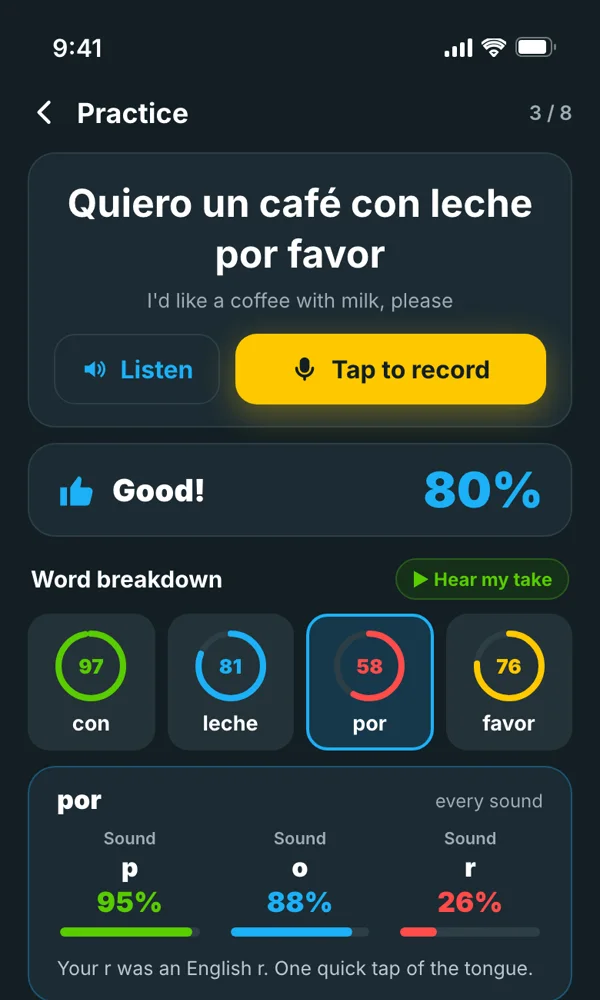
See every sound you get wrong
Each word is scored sound by sound, grouped by syllable, so you know exactly what to fix.
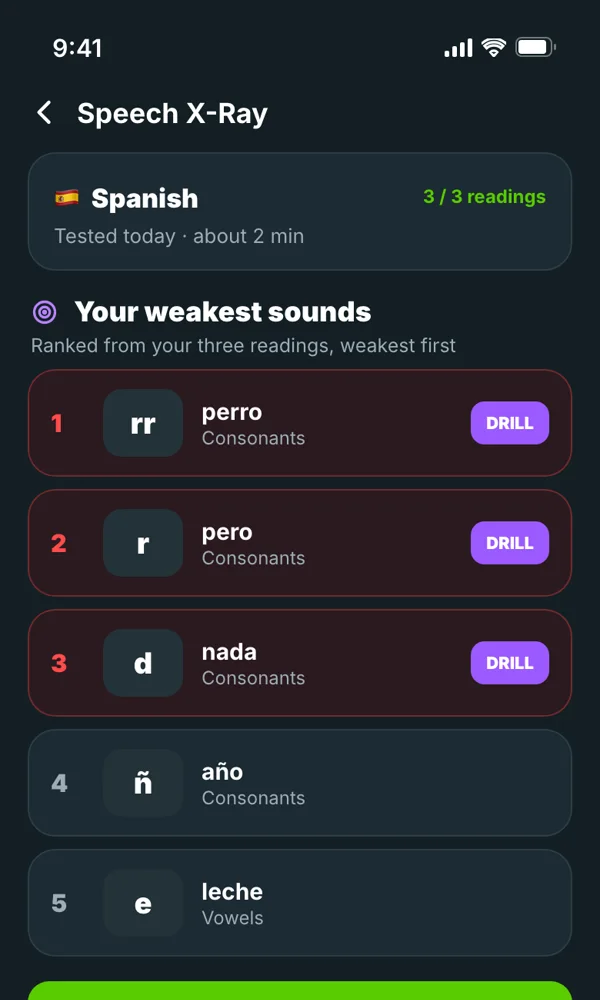
Find your weakest sounds in 2 minutes
A Speech X-Ray of three short readings ranks the sounds to fix first.
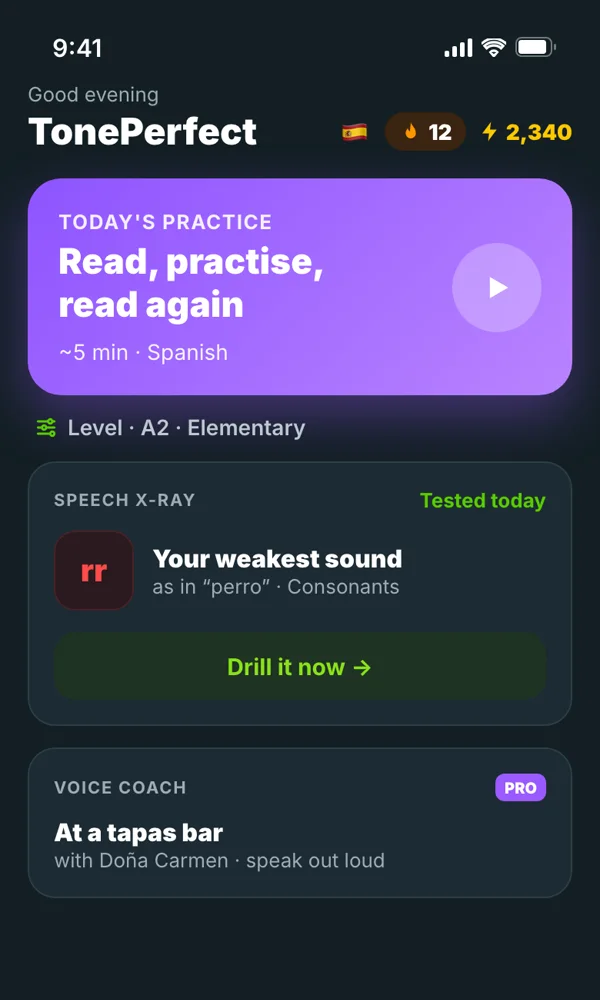
Five minutes a day
A short daily session built on the sounds you need most.
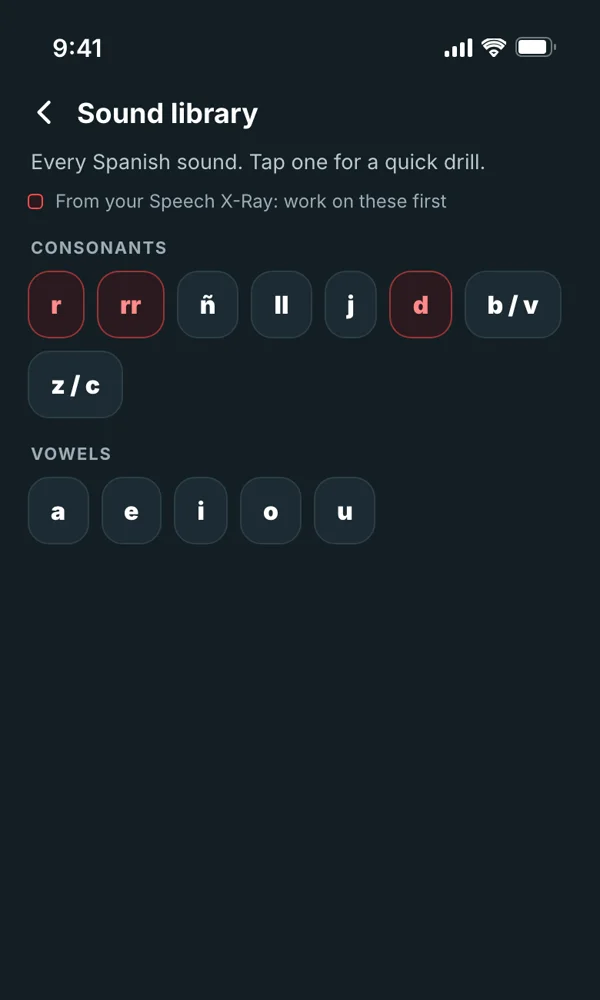
Drill any sound
A sound library for the whole language, with a one-tap drill for each sound.
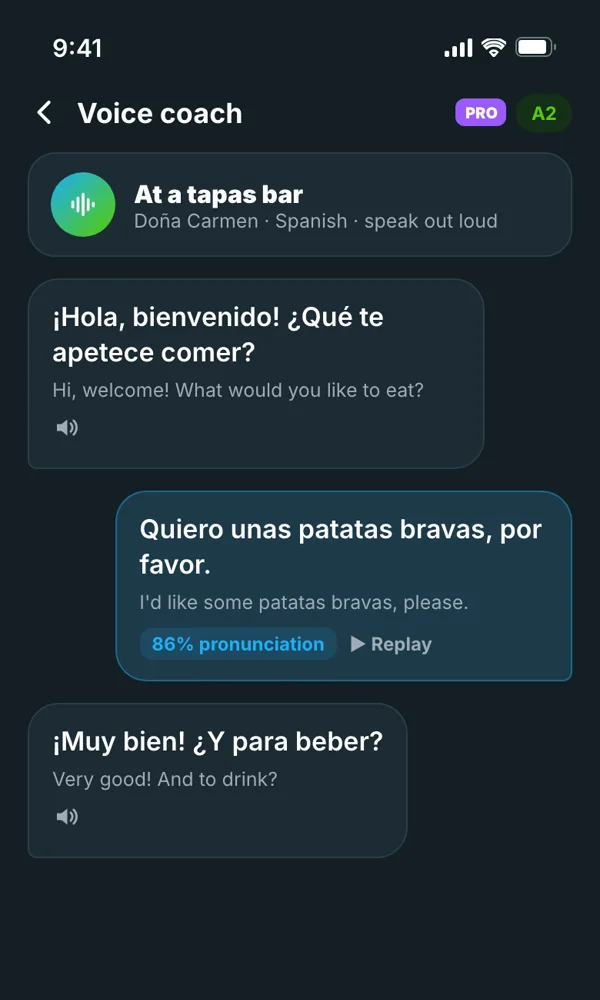
Speak in real situations
Role-play everyday situations out loud with an AI voice coach (Pro).
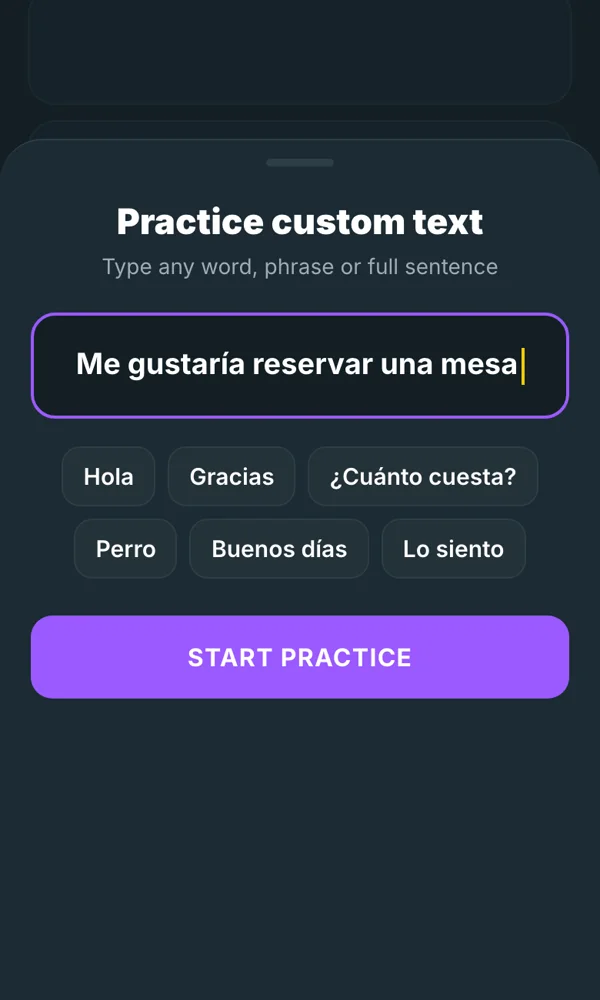
Practise any word or sentence
Type anything you want to say and get a score for every sound.
How it works
- 1
Record
Tap the mic and say the word. Your browser records a short clip — that's all it takes.
- 2
Get scored
A speech-assessment engine scores your recording word by word and sound by sound, in seconds.
- 3
Drill what's weakest
Your sounds come back ranked weakest-first. Pick the lowest one, read the articulation tip, record again. In the app, this loop runs across a full Spanish course.
How the scores work: every sound in the word is scored out of 100, you see all of them, and they are ranked weakest to strongest so you know what to drill next. What we won’t do is pretend to know which sound you said instead of the target — the engine returns scores, not a transcript.
The sounds that decide your accent
Sound chart →The tapped r (pero)
Spelled r (between vowels) · rr · r- (start of a word)
Flick the tongue tip once against the ridge behind the upper teeth — it is exactly the American 't' in 'water'. For written rr aim for a longer roll; the engine scores both here.
Common slip: You curl your tongue back and hold it as in English 'red'; instead flick the tip once against the ridge behind your upper teeth, like the tt in 'butter'.
Heard in
The r in clusters (tres)
Spelled r after a consonant (tres, creo) · r before a consonant (puerta) · -r (end of a word: hablar)
The same quick tongue-tap when r sits next to another consonant or closes a syllable: tres, puerta, hablar. Keep it short — never the English curled-back r.
Common slip: Next to another consonant you stretch it into the long English curled-back r; keep one quick tongue-tap on the ridge and move straight into the next sound.
Heard in
The ñ sound (niño)
Spelled ñ · n with a tilde (ñ)
Press the middle of the tongue against the roof of the mouth and say 'n' and 'y' at the same moment — like the 'ny' of 'canyon' fused into one sound.
Common slip: You say it as two sounds, n then y; press the middle of the tongue against the roof of the mouth so both happen in the same moment.
Heard in
The Spanish j sound (rojo)
Spelled j · g before e or i (gente, gigante) · x in a few names (México, Oaxaca)
A rough 'h' made by raising the back of the tongue until the air scrapes — stronger than English h; spelled j, or g before e/i.
Common slip: You soften it into a breathy English h; raise the back of the tongue toward the soft palate until you can hear the air scraping past it.
Heard in
The ll sound (calle)
Spelled ll · ll- (start of a word: llegar) · -ll- (between vowels: calle)
An 'l' and a 'y' pressed into one sound with the middle of the tongue on the roof of the mouth. Most speakers today just say 'y' here (yeísmo) — that is accepted too.
Common slip: Don't sound the two l's as an English l — press the middle of the tongue to the roof of the mouth, or say a plain 'y' as most speakers do.
Heard in
The y sound (yo)
Spelled y · y- (start of a word: yo, ya) · -y (end of a word: hay, muy) · ll (for speakers with yeísmo)
Like the 'y' in 'yes' but with a little friction — almost a gentle 'j' of 'jeep'; spelled y, or ll for most speakers.
Common slip: You harden it to the j of 'jump' or drop it to a bare vowel; hold the tongue close to the roof of the mouth for a buzzy 'y'.
Heard in
The b/v sound (boca)
Spelled b · v · b or v between vowels (saber, nueva)
Start words with a normal 'b'. Between vowels the lips barely close, so it comes out soft and buzzy — that's correct. The letters b and v are this same sound in Spanish.
Common slip: You put your top teeth on your lower lip for v; Spanish never does — use both lips for both letters, closing fully at the start, barely between vowels.
Heard in
The d sound (dos)
Spelled d · d between vowels (nada, cada) · -d (end of a word: usted, ciudad)
Tongue tip on the back of the upper teeth. Between vowels let it relax toward the soft 'th' of 'this': nada sounds close to 'na-tha'.
Common slip: You strike the ridge behind your teeth with a hard English d; touch the tongue tip to the back of the upper teeth, and relax toward 'th' between vowels.
Heard in
The five pure vowels (a, e, i, o, u)
Spelled a · e · i · o · u
Spanish has exactly five vowel sounds and none of them glide. a is a bright 'ah' that never relaxes to 'uh'; e is like 'bet' but tenser — never 'ay'; i is 'ee' with no glide; o stays one pure 'o' — never 'ow'; u is a short 'oo' with lips firmly rounded.
Common slip: English vowels glide into a second sound and go slack when unstressed; hold one fixed mouth position through each Spanish vowel, unstressed syllables included.
Heard in
The ch sound (mucho)
Spelled ch · ch- (start of a word: chico)
Exactly like 'ch' in 'church': a quick 't' released into 'sh'.
Common slip: In quick speech you let it slide into 'sh'; keep the tongue tip touching first so every one starts as a full t before it releases.
Heard in
The Castilian 'th' sound (cielo)
Spelled z · c before e or i (cielo, gracias) · -z (end of a word: vez, luz)
Tongue tip lightly between the teeth, like 'th' in 'think' — how much of Spain says c before e/i and z. Saying 's' there instead (Latin America) is equally correct; practice whichever accent you are aiming for.
Common slip: For a Castilian accent, rest the tongue tip lightly between the teeth as in 'think' instead of hissing an s — the seseo 's' is equally correct.
Heard in
p, t, k without the puff
Spelled p · t · c before a, o or u (casa, como) · qu before e or i (que, aquí) · k
English p, t, k carry a puff of air; Spanish releases them clean. For p, think of the p in 'span', not 'pan'. For t, touch the tongue tip to the back of the upper teeth, not the ridge. For k, release with no puff.
Common slip: You release p, t and k with a puff of air — hold it back as in 'span', and set t against your upper teeth, not the ridge.
Heard in
What usually goes wrong
The rolled r
You already own half of it. The single Spanish tap is the American 't' in 'water' — say 'pot of tea' fast and you've made a Spanish r. The long roll in perro takes practice: relax the tongue tip and let the airflow flutter it against the ridge. Drill pero and perro side by side; the engine scores the r in each, and it accepts a tap or a roll for both.
English vowel habits
English relaxes unstressed vowels into 'uh' — banana becomes buh-NAH-nuh. Spanish never does this. Every a, e, i, o, u keeps its full sound no matter where the stress falls. It's the one habit that makes English speakers sound foreign in every single word, and it shows up in your vowel scores immediately.
b and v
There is no separate v sound in Spanish. The letters b and v are the same sound: a normal 'b' at the start of a phrase, and a soft, buzzy one between vowels where the lips barely close. If you're carefully making an English 'v' in vida, you're adding a sound Spanish doesn't have.
Silent h, rough j
English speakers breathe on the wrong letter. The h in hola is silent — nothing at all. The j in rojo is the opposite: a rough 'h' made by raising the back of the tongue until the air scrapes, stronger than any English h. Flip the habit: h is nothing, j is friction.
Speed and linking
Spoken Spanish links words: 'mis amigos' comes out mi-sa-mi-gos, with vowels fusing across word boundaries. That's most of why natives sound fast. The fix isn't speaking faster — it's clean single words first. This test scores you word by word; once every sound holds up on its own, linking becomes a rhythm habit, not a pronunciation problem.
Everything the Spanish course gives you
Spanish runs on thirty-one sounds and five vowels that never relax, which means every one of them has to hold.
All 31 Spanish sounds
Each of Spanish's 31 sounds is scored separately in every word you record, so you can see which ones sit at the bottom of your list.
Tapped or rolled r
The r of pero, perro and tres is drilled in every position it takes. A single tap and a full roll are both accepted.
3,356 real words
3,356 Spanish words from everyday use — enough carriers that even the ñ and the scraping j show up often enough to train.
Review that keeps coming
Words return on a schedule built from your results. Whichever of the five pure vowels sits lowest is the one you will see most often.
Weakest sounds first
Daily practice is assembled from whatever scores lowest for you. If that is the j and the tapped r, that is what the next set carries.
Start with five words
Record perro, año, rojo, calle and hola in your browser, free, and get your Spanish sounds ordered weakest to strongest.
Practice anywhere, anytime
Available on every major platform. Your progress syncs seamlessly across all devices.
iOS App
Native iPhone and iPad experience.
Android App
Full-featured Android experience.
Web App
Practice instantly in your browser. No download needed.
Telegram Bot
Quick practice sessions right inside Telegram.
Simple, transparent pricing
Start free and upgrade when you're ready. No surprises.
Free
$0 forever
- At least one free guided practice session each day
- Daily workout
- Placement test
- Progress tracking
Premium
Most PopularCard prices above are for web checkout. App Store and Google Play prices may differ; your exact price and trial are shown before purchase.
- Unlimited assessments
- Spaced repetition reviews
- Custom text practice
- Advanced analytics
Questions
Is the Spanish pronunciation test free?+
Yes. The web test is free and runs in your browser, no download needed. The TonePerfect app is free to download and try; a premium subscription unlocks the full experience.
How does the scoring work — and how accurate is it?+
Your recording is scored by a speech-assessment engine, word by word and sound by sound — every phoneme gets its own score out of 100, and all of them are shown. They’re built for comparison rather than certification: which sounds drag your words down, and whether they improve with practice. The engine can’t tell you what sound you produced instead of the target, because it returns scores, not a transcript.
Which Spanish accent does it grade — Spain or Latin America?+
Neither one is 'the' accent. The engine is variant-aware: pronouncing c before e/i and z as the Castilian 'th' or as 's' (Latin America) are both scored as correct, and saying ll as 'y' (yeísmo — most speakers today) is accepted too. Practice whichever accent you're aiming for.
Does TonePerfect only do Spanish?+
No. TonePerfect started as a Mandarin tone coach and now covers 8 languages, including Spanish, English, French, German, Russian, Japanese, and Korean — 50,000+ learners so far. Spanish gets the same treatment Mandarin does: every recording scored sound by sound.
Do I need the app?+
The 5-word test runs right here in your browser. For the full Spanish experience — 3,000+ practice words scored the same way, an articulation tip for every Spanish sound, and progress tracking over time — you'll want the app. It's on iOS and Android, with a web version too.
How is this different from Duolingo?+
Duolingo is a general course: vocabulary, grammar, some speaking mixed in. TonePerfect is a pronunciation specialist. Every recording gets a sound-by-sound readout, every Spanish sound has a concrete articulation tip, and your practice is built around whatever scores lowest for you — not a fixed lesson track.
Practice Spanish every day
The app drills the sounds this test flags, with thousands of words and instant feedback on every take.
Learning Chinese? That's where TonePerfect started — see the full Mandarin course. Chinese pronunciation
Test your pronunciation
Free, with a score for every sound.