TonePerfect for Korean·한국어
Korean pronunciation checker: find out what’s holding you back
Record a few words. TonePerfect's AI scores every syllable and every sound, so you can see which Korean sounds score lowest for you — and drill exactly those instead of guessing.
Get the mobile app
Scan with your phone to install
Record 5 words. Free, no signup — your browser does the recording, our engine does the listening.
어머니
uh-muh-nee
mother
Tap to record
Free Korean pronunciation test·Free Korean accent test·Check any Korean text·Practice any Korean text
Everything you need to actually sound right
Short daily practice built around the sounds you personally get wrong.
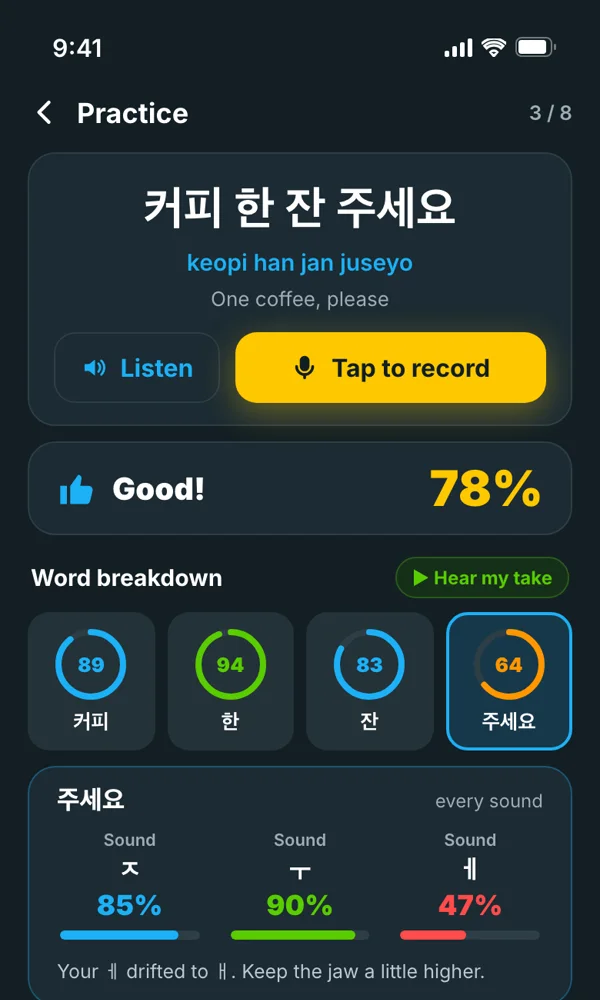
See every sound you get wrong
Each word is scored sound by sound, grouped by syllable, so you know exactly what to fix.
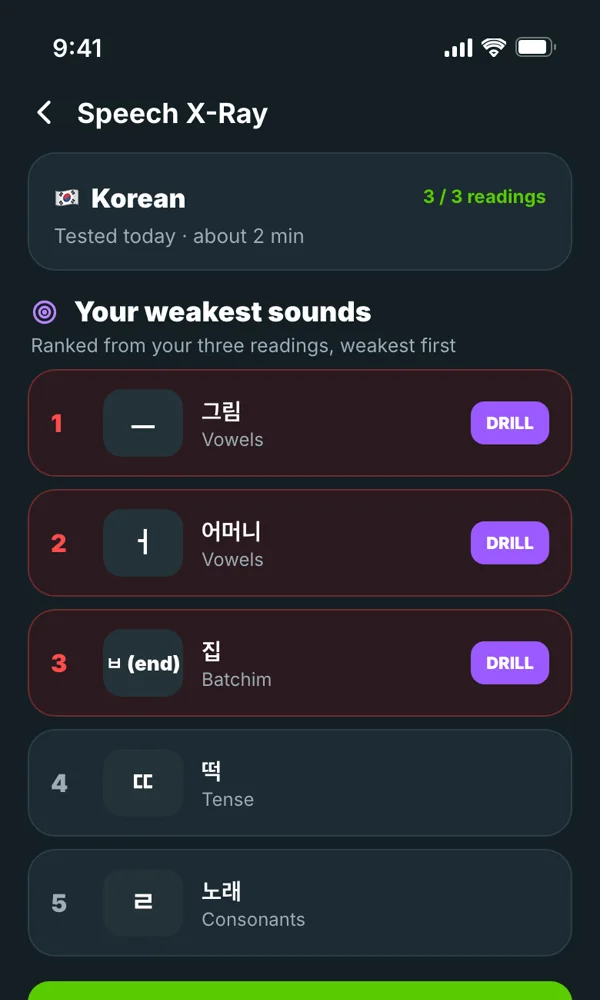
Find your weakest sounds in 2 minutes
A Speech X-Ray of three short readings ranks the sounds to fix first.
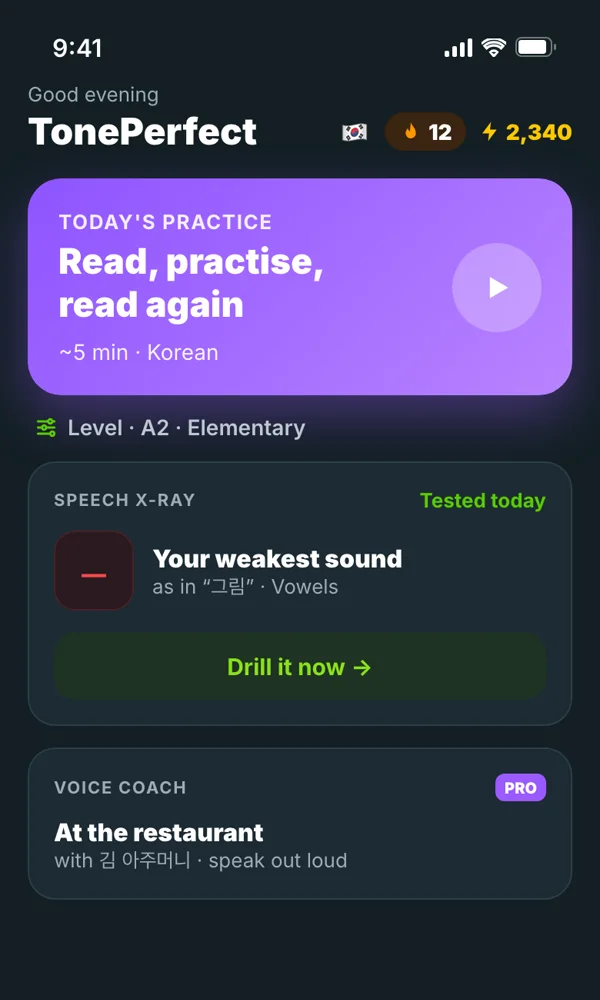
Five minutes a day
A short daily session built on the sounds you need most.
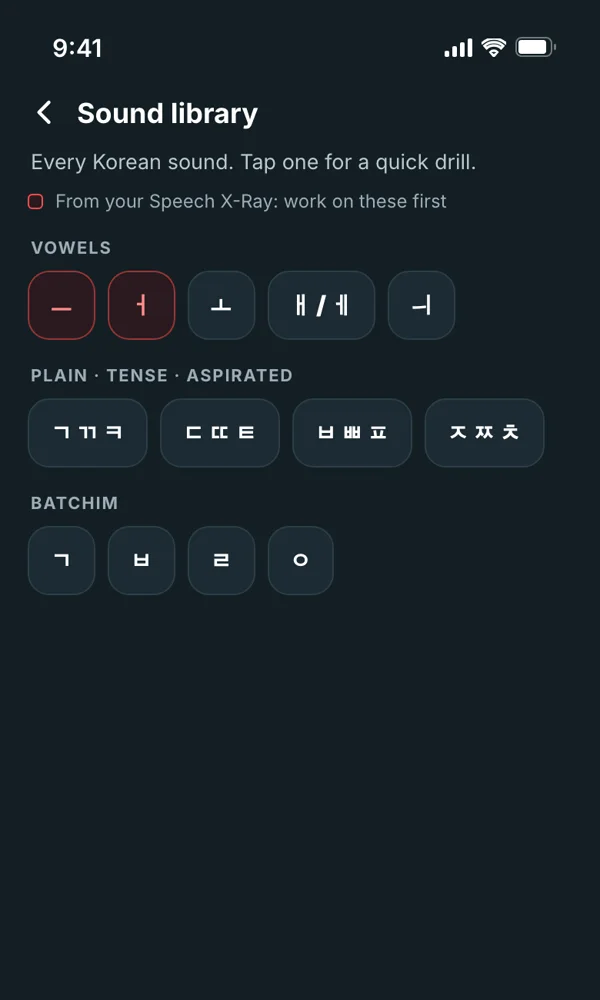
Drill any sound
A sound library for the whole language, with a one-tap drill for each sound.
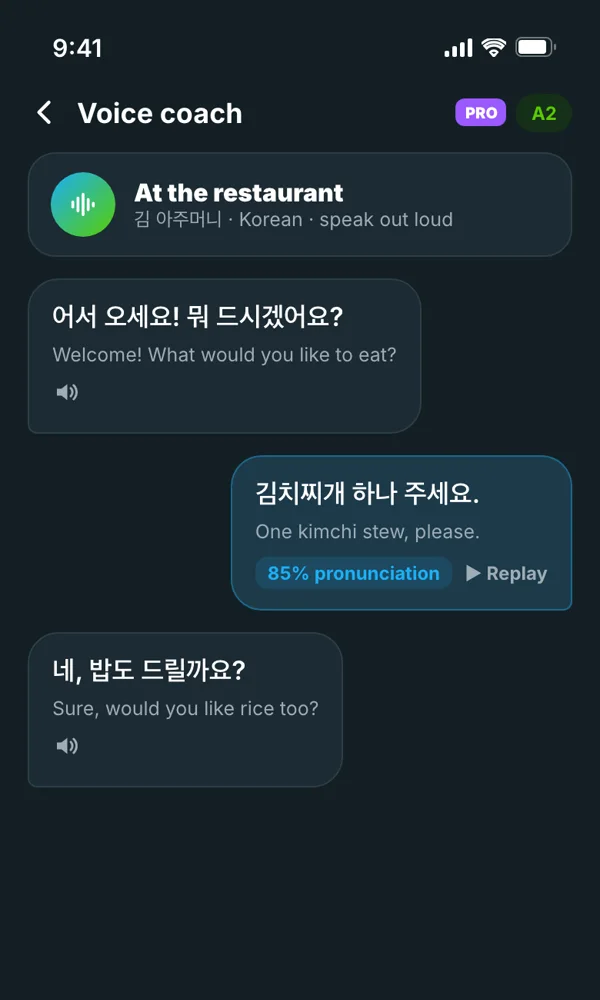
Speak in real situations
Role-play everyday situations out loud with an AI voice coach (Pro).
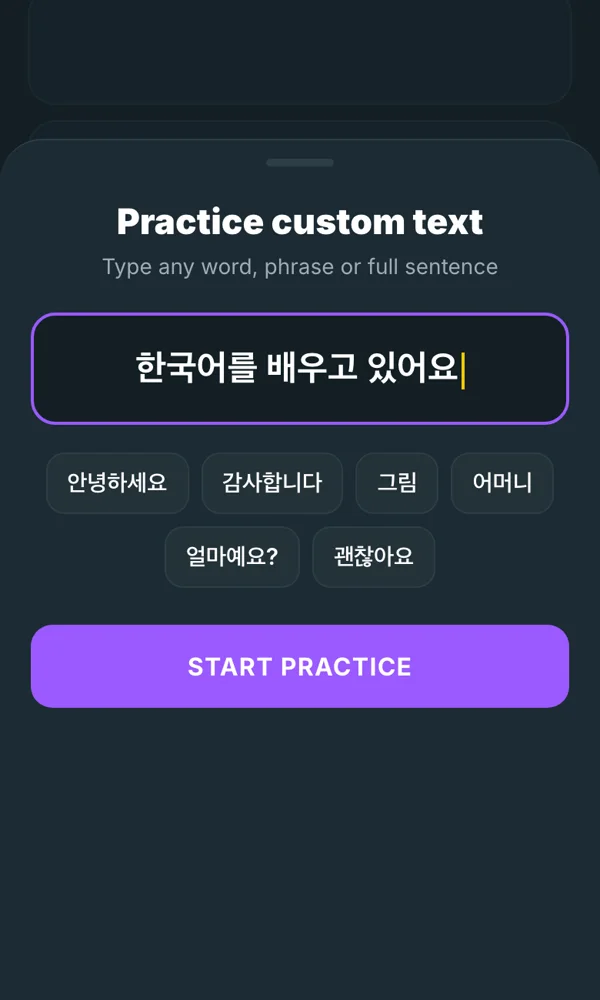
Practise any word or sentence
Type anything you want to say and get a score for every sound.
How it works
- 1
Record
Tap the mic and say the word shown. Real words from a 2,900-word Korean catalog — no minimal-pair trick syllables.
- 2
See every sound
The AI engine scores your take word-by-word and sound-by-sound, so you see exactly which syllable — and which sound inside it — pulled the score down.
- 3
Drill what's weakest
The app tracks your scores per sound across everything you record, ranks your sounds from strongest to weakest, and builds drills for the weak ones.
How to read the scores: they're built for comparison, not certification. A lower score on ㅓ than on ㅏ means ㅓ deserves your practice time; the numbers rank your sounds against each other and your past attempts against each other. The app doesn't guess what you said instead — it shows you where the score dropped, and gives you the mouth mechanics to fix it.
The sounds that decide your accent
Sound chart →Batchim — the cut-off endings
Spelled any consonant written under a syllable is a batchim (받침) · all final spellings collapse to seven sounds · ㄱ k / ㄴ n / ㄷ t · ㄹ l / ㅁ m / ㅂ p / ㅇ ng
Korean final consonants are stopped, not released. 책 ends with the tongue closed as for 'k' — never 'k-uh'. 집 ends with sealed lips. 옷 ends in a stopped 't', and the spellings ㅅ ㅆ ㅈ ㅊ ㅌ ㅎ all end with that same stopped 't'. Releasing the puff, or adding a little vowel after, is the single most common habit English speakers carry in.
Common slip: You release the final consonant and add a little vowel, so 책 comes out 'chaek-uh'; stop the tongue at the closure and leave it there.
Heard in
ㄹ batchim — the held 'l'
Spelled ㄹ in final position · -l · 물 mul · 말 mal
A final 'l' with the tongue tip curled up to touch the ridge behind the teeth — darker and longer than the tapped ㄹ between vowels. Hold the contact.
Common slip: You let the tongue tip flap the way it does between vowels; for a final ㄹ curl the tip up to the ridge and hold the contact.
Heard in
ㅇ batchim — the 'ng'
Spelled ㅇ in final position · -ng · 강 gang · 사랑 sarang · ㅇ at the start of a syllable is silent
The 'ng' of 'song'. Back of the tongue closes against the soft palate; the sound hums through the nose. Only ever at the end of a syllable.
Common slip: You add a hard 'g' at the end, as in English 'finger'; 강 hums through the nose and stops there, with no g released.
Heard in
ㅓ vs ㅗ
Spelled ㅓ · eo · ㅗ · o
ㅓ is an open 'uh/aw' — like the 'u' in 'cut' said with the mouth a bit more open, lips NOT rounded. ㅗ is a rounded 'o' as in 'go' but pure, no glide at the end. English merges both toward 'oh'; Korean keeps them as two different words (어 vs 오). The lips are the whole difference.
Common slip: You round your lips and turn ㅓ into ㅗ; keep the lips flat and the mouth open for ㅓ, because the lips are the whole difference.
Heard in
ㅡ — the vowel English lacks
Spelled ㅡ · eu · 으 as a standalone syllable
Say 'oo' but SPREAD the lips flat as if smiling. The tongue stays high and back while the lips refuse to round. There is no English substitute — this one you have to build from scratch.
Common slip: You substitute 'oo' or 'uh'; hold the tongue high and back as for 'oo', but spread your lips flat as if smiling.
Heard in
ㅢ — two beats in one
Spelled ㅢ · ui · 의 as a standalone syllable
Start from ㅡ (the flat-lipped 'oo') and glide quickly to 'ee' — two beats squeezed into one. Only at the start of words like 의사; elsewhere it reduces to plain 'e' or 'ee'.
Common slip: You stretch it into two syllables or flatten it to 'ee'; start at the flat-lipped ㅡ and glide to 'ee' inside one beat.
Heard in
ㄹ — between r and l
Spelled ㄹ · r at the start of a word · r between vowels · l in final position · 라디오 radio
Between vowels it is a quick tap of the tongue tip — like the tt in American 'butter', never a rolled or English 'r'. At the start of a word keep it a very light 'r/l'. And in final position it becomes the held, curled 'l' — one letter, two habits to build.
Common slip: You use the English 'r' with the tongue bunched back; between vowels flick the tip once against the ridge, like the tt in American 'butter'.
Heard in
Plain, aspirated, tense — the three-way contrast
Spelled ㄱ / ㄲ / ㅋ — g, kk, k · ㄷ / ㄸ / ㅌ — d, tt, t · ㅂ / ㅃ / ㅍ — b, pp, p · ㅈ / ㅉ / ㅊ — j, jj, ch · ㅅ / ㅆ — s, ss
Korean splits what English hears as one consonant into three: plain ㄱ (soft, no puff), aspirated ㅋ (strong burst of breath — feel it on your palm), and tense ㄲ (pressed and stiff, throat tight, no breath at all). Same for ㄷ/ㅌ/ㄸ, ㅂ/ㅍ/ㅃ, ㅈ/ㅊ/ㅉ, ㅅ/ㅆ. One honest note: at the start of a word, even native speech often hardens plain consonants toward tense — so the app can't reliably grade plain-vs-tense-vs-aspirated at the very start of a word. Practice the contrast in the middle of words, where it's clearest, and use aspiration (the puff) as your most trustworthy anchor.
Common slip: You make all three sound like an English 'k' with a puff; save the strong puff for ㅋ, keep ㄱ quiet, and press ㄲ tense and breathless.
Heard in
ㅅ — the light 's' that shifts
Spelled ㅅ · s · sh before ㅣ or a y-vowel · ㅆ · ss
A light, breathy 's' — softer than English 's', with a whisper of air through it. Before 'i' or a y-vowel it shifts toward 'sh' (시 sounds like 'shi'). Its tense twin ㅆ is a sharp, stiff hiss with no breathiness.
Common slip: You hiss a hard English 's' everywhere; keep ㅅ light and breathy, and let it slide toward 'sh' before ㅣ and the y-vowels.
Heard in
ㅔ/ㅐ — one sound, two spellings
Spelled ㅔ · e · ㅐ · ae · ㅞ / ㅙ / ㅚ — we
An 'e' as in 'bed'. Spellings ㅔ and ㅐ are pronounced the same by nearly all modern speakers — treat them as one sound and let spelling be a memory task. Same story for ㅞ/ㅙ/ㅚ: all three are 'we' as in 'wet'.
Common slip: You hunt for a difference between ㅔ and ㅐ; modern speech has none, so say 'e' as in 'bed' for both and memorize the spelling.
Heard in
연음 — sound-change rules
Spelled 연음 yeoneum · a final consonant moves onto a following vowel-initial syllable · 밥을 → 바블 · ㅎ between vowels fades: 좋아요 → 조아요
Korean words change shape when they meet. A batchim slides onto a following vowel (밥을 sounds like 바블), ㅎ between vowels nearly disappears (좋아요 sounds like 조아요), and consonant clusters assimilate. TonePerfect scores the surface pronunciation — what Koreans actually say — not the letter-by-letter spelling, so linked speech is graded as linked speech.
Common slip: You pronounce each syllable block exactly as written; let the final consonant slide onto the next vowel, so 밥을 comes out 바블.
Heard in
What usually goes wrong
Released endings
English releases its final consonants; Korean cuts them off. Saying 집 as 'jip-uh' or 책 with an audible 'k' puff turns one syllable into two. The fix is physical: close the mouth for the final consonant and simply stop. Batchim words are the fastest place to see your scores move.
Vowel pairs English merges
ㅓ vs ㅗ and ㅡ vs ㅜ are four vowels English folds into two. Both pairs differ mainly in the lips: ㅗ and ㅜ are firmly rounded, ㅓ and ㅡ are not. Get the lip habit wrong and 어 becomes 오 — a different word, not an accent.
ㄹ — neither r nor l
Between vowels ㄹ is a single quick tap, like the tt in American 'butter'. At the end of a syllable it's a held, curled 'l'. Reaching for the English 'r' — tongue pulled back, lips slightly rounded — is the most audible English-speaker habit in Korean.
Words that change shape
What's written isn't always what's said: 좋아요 sounds like 조아요, 밥을 like 바블. If you learned Korean from text, you may be pronouncing the spelling instead of the word. Recording yourself against surface pronunciation is how you catch it.
Rhythm and evenness
English crushes unstressed syllables; Korean gives each syllable roughly even weight. Stress-timing your Korean — HAM-nida instead of steady ham-ni-da — makes even correct sounds land wrong. Practice at an even pace before you practice fast.
Everything the Korean course gives you
Korean scored sound by sound, starting with the endings English speakers cannot stop releasing.
46 Korean sounds
All 46 consonant and vowel sounds the engine tracks are scored separately, so you can see which ones fall to the bottom of your list.
Batchim endings
집 and 책 end closed, not released. Final consonants are drilled as sounds in their own right, and they are the fastest place to see scores move.
2,936 real words
2,936 Korean words from everyday speech, scored on what Koreans actually say — 좋아요 as 조아요 — not on the letter-by-letter spelling.
Review that returns
Words come back at intervals your results set. If ㅡ sits at the bottom, the words carrying it show up long before the settled ones.
Weakest first
Daily practice is ordered by your lowest-scoring sounds. If ㅓ and ㅗ keep landing at the bottom, the next set is built from them.
Five words, free
Record 집, 어머니, 그림, 노래 and 커피 in your browser and get your Korean sounds ranked, weakest first.
Practice anywhere, anytime
Available on every major platform. Your progress syncs seamlessly across all devices.
iOS App
Native iPhone and iPad experience.
Android App
Full-featured Android experience.
Web App
Practice instantly in your browser. No download needed.
Telegram Bot
Quick practice sessions right inside Telegram.
Simple, transparent pricing
Start free and upgrade when you're ready. No surprises.
Free
$0 forever
- At least one free guided practice session each day
- Daily workout
- Placement test
- Progress tracking
Premium
Most PopularCard prices above are for web checkout. App Store and Google Play prices may differ; your exact price and trial are shown before purchase.
- Unlimited assessments
- Spaced repetition reviews
- Custom text practice
- Advanced analytics
Questions
Is it free?+
Yes — the test on this page is free, no account needed, and the app is free to download and try. Unlimited practice and the full course are premium.
How does the scoring work?+
A speech-assessment engine analyzes your recording and scores it word-by-word and sound-by-sound. Use the scores to compare: which of your sounds score lowest, and whether today's attempt beat yesterday's. That ranking is what tells you what to drill — we don't claim a certified accuracy percentage per sound, because no honest system can.
Will it help with my accent specifically?+
The feedback is per sound, so it adapts to whatever your weak sounds turn out to be. If you're coming from English, the usual suspects are batchim endings, ㅓ vs ㅗ, ㅡ, and ㄹ — but you'll see your own ranking, not a stereotype.
Do you support other languages?+
Yes — TonePerfect started with Mandarin Chinese tones and now covers 8 languages, including Korean, Japanese, Spanish, French, German, and Russian. The Korean course covers all 40+ sounds, batchim position included.
Do I need the app?+
The browser test gives you real scores on 5 words. The app is where the loop lives: a full sound library with mouth-position tips for every Korean sound, per-sound score tracking over time, and drills built from your weakest sounds.
How is this different from Duolingo?+
Duolingo teaches vocabulary and grammar with a light speaking check on top. TonePerfect does one thing: pronunciation. Every recording is scored sound-by-sound, every Korean sound has a how-to-make-it tip, and your practice queue is built from your own lowest-scoring sounds. Use it alongside whatever you use for grammar.
Practice Korean every day
The app drills the sounds this test flags, with thousands of words and instant feedback on every take.
Learning Chinese? That's where TonePerfect started — see the full Mandarin course. Chinese pronunciation
Test your pronunciation
Free, with a score for every sound.