TonePerfect for Russian·русский
Russian pronunciation checker: find out what’s holding you back
Record 5 words. Our AI analyzes every sound you make and shows which ones score lowest — free, right in your browser.
Get the mobile app
Scan with your phone to install
Record 5 words. Free, no signup — your browser does the recording, our engine does the listening.
быть
BIHT — 'beet' with the tongue pulled back
to be
Tap to record
Free Russian pronunciation test·Free Russian accent test·Check any Russian text·Practice any Russian text
Everything you need to actually sound right
Short daily practice built around the sounds you personally get wrong.
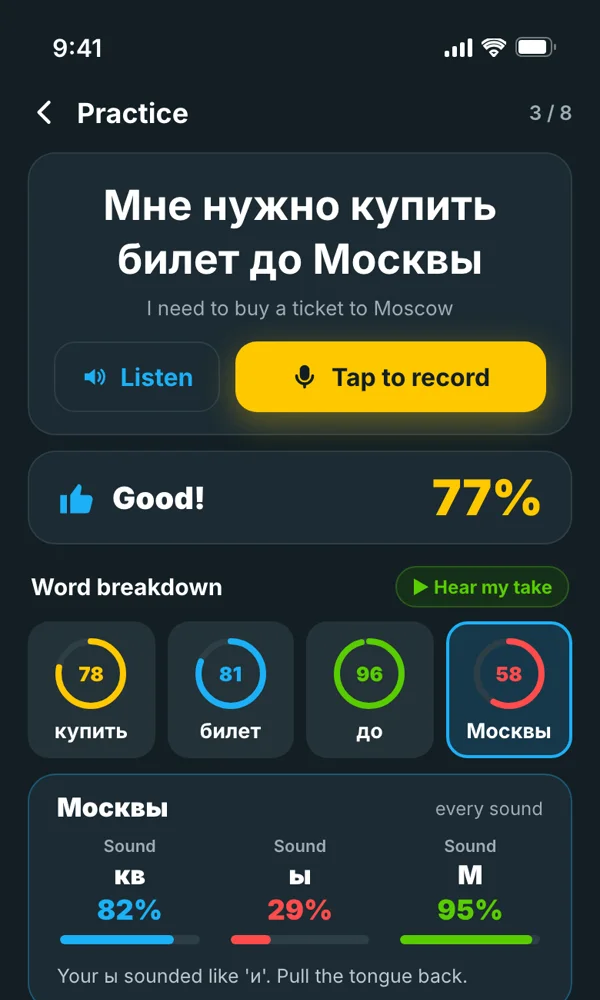
See every sound you get wrong
Each word is scored sound by sound, grouped by syllable, so you know exactly what to fix.
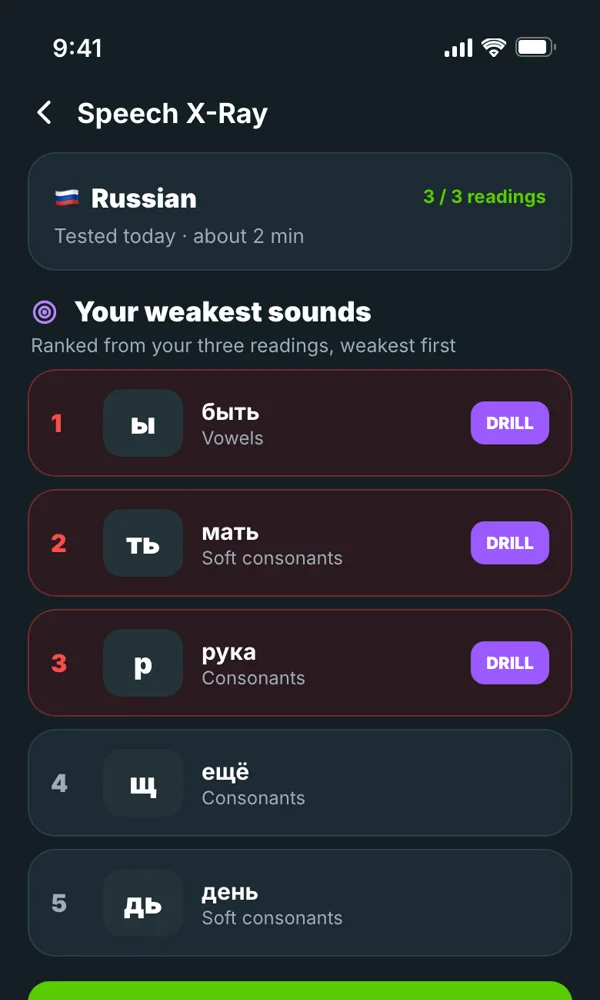
Find your weakest sounds in 2 minutes
A Speech X-Ray of three short readings ranks the sounds to fix first.
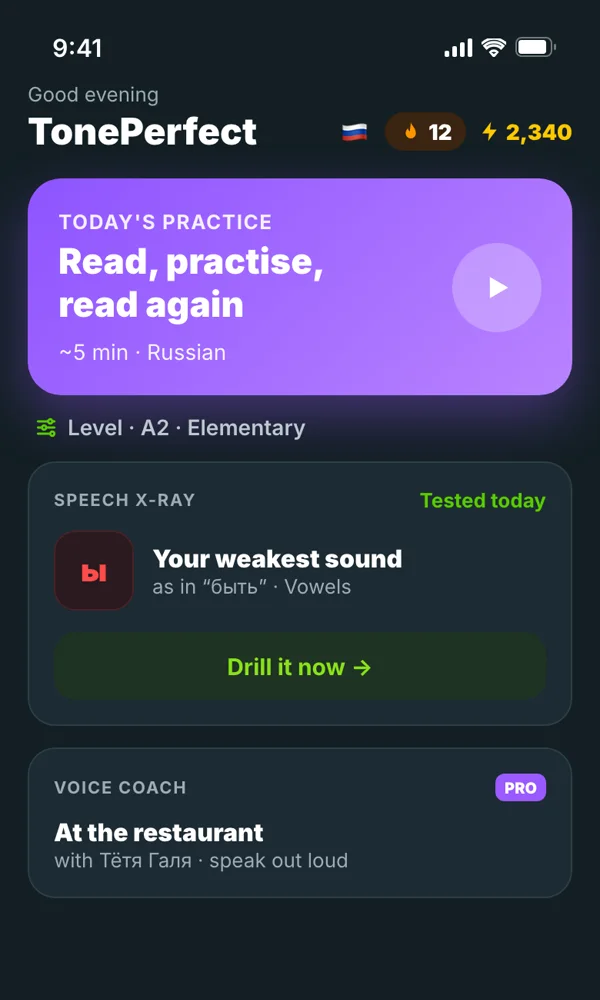
Five minutes a day
A short daily session built on the sounds you need most.
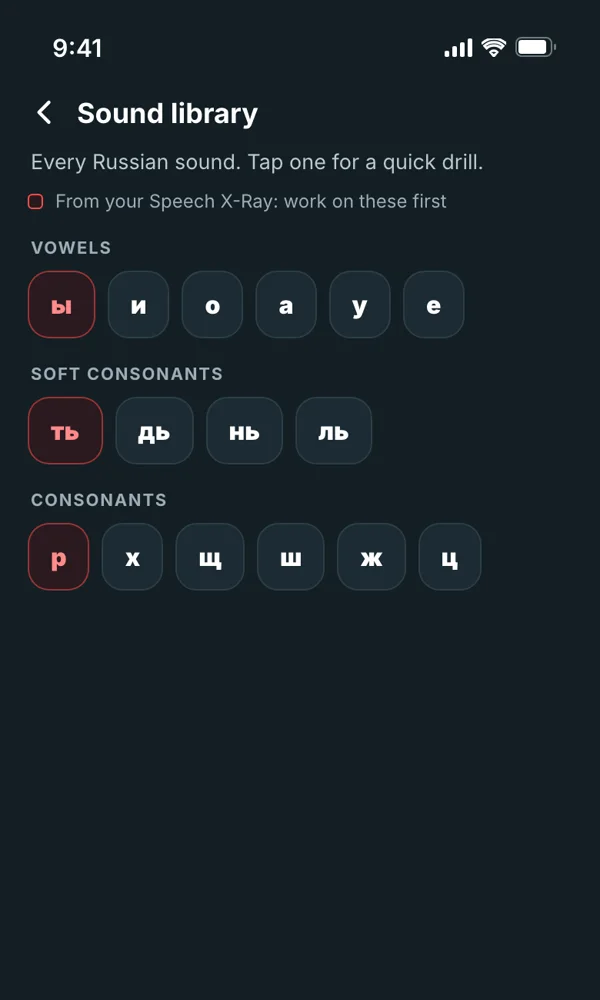
Drill any sound
A sound library for the whole language, with a one-tap drill for each sound.
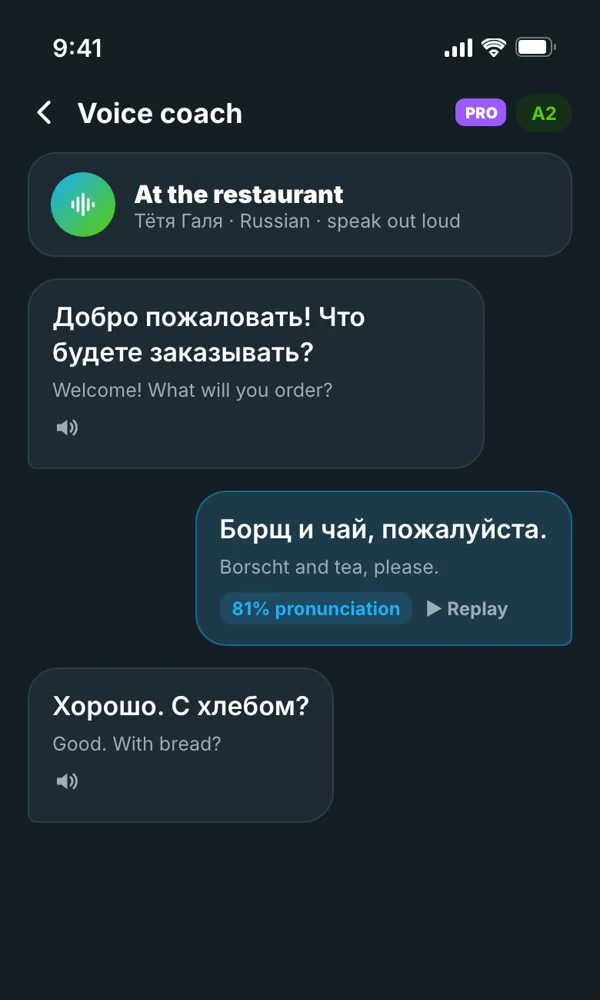
Speak in real situations
Role-play everyday situations out loud with an AI voice coach (Pro).
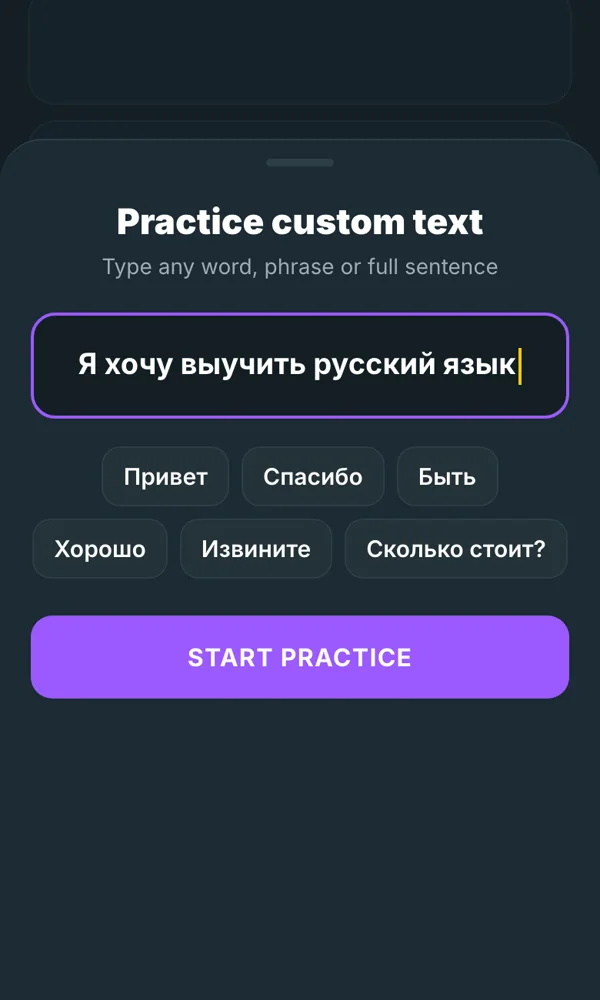
Practise any word or sentence
Type anything you want to say and get a score for every sound.
How it works
- 1
Record 5 Russian words in your browser — no download, no signup.
- 2
The AI breaks each word into its individual sounds and scores every one.
- 3
See which sounds rank lowest, then drill exactly those in the app.
Scoring runs on a commercial-grade speech-assessment engine that evaluates every sound in every word. Russian scores are relative: they rank your sounds against each other to locate your weak spots — no pass/fail bars and no invented accuracy percentages.
The sounds that decide your accent
Sound chart →the 'ы' sound (быть)
Spelled ы · и (after ж, ш, ц)
Say 'ee' but pull the whole tongue back and down slightly, lips relaxed (not smiling). It feels like 'ee' said in the throat. Try б-ы: быть, сыр, мы.
Common slip: You reach for a plain 'ee' and land on и instead; pull the whole tongue back and down, lips relaxed rather than smiling.
Heard in
soft (palatalized) consonants — брат vs брать
Spelled ь · и · е · я · ю · ё
Almost every Russian consonant comes in a hard and a soft version. For soft ть, the tongue tip stays at the teeth while the tongue body presses up to the palate; it can sound almost like a very light 'ts'. This is the difference between брат and брать.
Common slip: You say брать exactly like брат; keep the tongue tip at the teeth and press the tongue body up to the palate so a tiny 'y' fuses in.
Heard in
the rolled 'р' sound (раз)
Spelled р
Tap or roll the tongue tip against the ridge behind the teeth — like Spanish 'r'. Start by saying 'd-d-d' quickly and let the tip flutter. Never the English 'r'.
Common slip: You substitute the English 'r', which curls the tongue back; instead tap the tip against the ridge behind your teeth — say 'd-d-d' fast and let it flutter.
Heard in
the soft 'рь' sound (теперь)
Spelled рь · р (before я, е, ё, и, ю)
Roll the r while the tongue body squeezes up toward the palate — 'ry' in one sound. One of the hardest Russian sounds; start slow: ря, ри, рё.
Common slip: You roll the р with a flat tongue, so теперь comes out hard; squeeze the tongue body up toward the palate so 'ry' is one sound.
Heard in
the 'щ' sound (женщина)
Spelled щ
A LONG soft 'sh' with the tongue far forward — like 'fresh sheets' said quickly as one hiss. Never the hard, dark ш; hold it a beat longer.
Common slip: You flatten щ into the hard, dark ш; push the tongue far forward and hold the hiss a beat longer, like 'fresh sheets' run together.
Heard in
the 'ш' sound (школа)
Spelled ш
'sh' with the tongue pulled BACK and the lips slightly rounded — deeper and darker than English 'sh'. Always hard: ши sounds like 'shy', never 'shee'.
Common slip: You use the light English 'sh' and read ши as 'shee'; pull the tongue back, round the lips slightly, and keep it hard — 'shy'.
Heard in
the 'ч' sound (час)
Spelled ч
'ch' as in 'cheap', always soft in Russian — the tongue body stays high; ча sounds closer to 'chya'.
Common slip: You harden ч into the 'ch' of 'chop'; keep the tongue body high and soft, so ча comes out closer to 'chya'.
Heard in
the 'х' sound (хлеб)
Spelled х
A breathy sound where 'k' is made, but the air keeps flowing — like Scottish 'loch' or German 'Bach'. Don't replace it with English 'h' or 'k'.
Common slip: You swap х for an English 'h' or 'k'; hold the tongue where 'k' is made but keep the air flowing, as in Scottish 'loch'.
Heard in
unstressed о → а (молоко)
Spelled о (unstressed) · а (unstressed)
In everyday speech unstressed о is pronounced like а — молоко comes out closer to 'malako'. Open your mouth wide and relax the tongue low for that open а, as in 'father' but shorter.
Common slip: You pronounce every о as written, so молоко becomes 'moloko'; unstressed о is simply said as an open а — 'malako'.
Heard in
hard 'л' vs soft 'ль' (слово / только)
Spelled л · ль · л (before я, е, ё, и, ю)
The hard л is 'dark': tongue tip on the upper teeth while the back of the tongue bunches up — like the l in 'full', never the light l of 'leaf'. The soft ль is the opposite: a light l like the 'lli' in 'million', tongue body pressed to the palate.
Common slip: You use one English 'l' for both; bunch the tongue back for hard л, as in 'full', and press the tongue body to the palate for ль, as in 'million'.
Heard in
the 'ж' sound (жизнь)
Spelled ж
The voiced partner of ш — like the 's' in 'measure', but with the tongue further back. Always hard: жи sounds like 'zhy'.
Common slip: You soften жи toward 'zhee' with the tongue forward; pull it further back and keep ж hard, so жи sounds like 'zhy'.
Heard in
the 'ц' sound (лицо)
Spelled ц
't' and 's' fused into one crisp sound, like the end of 'cats'. Always hard, even before и: ци sounds like 'tsy'.
Common slip: You split ц into two sounds or drop the 't'; fuse them into one crisp 'ts' like the end of 'cats', hard even before и.
Heard in
What usually goes wrong
Soft vs hard consonants
Russian doubles its consonant inventory with palatalization: for each hard consonant there is a soft one, made by pressing the tongue body up to the palate. English has nothing like it, so learners flatten брат and брать into the same word. The fix is physical — hold the tongue tip at the teeth, raise the tongue body, and drill minimal pairs until the two feel like different sounds, not one sound with an accent.
The ы vowel
There is no English vowel anywhere near ы. Learners substitute 'ee' — which turns мы into ми and быть into бить, both real and different words. Say 'ee', then pull the whole tongue back and down with the lips relaxed; it should feel like 'ee' said in the throat. Drill it in быть, сыр, мы.
Mobile stress and vowel reduction
Russian stress is unpredictable, moves around inside a word's forms, and isn't marked in normal text. It also decides how vowels sound: unstressed о is pronounced like а, so хорошо comes out 'kharasho'. Learn each word's stress along with its spelling, and let the unstressed vowels relax — pronouncing every о as a full 'o' is a giveaway. One honest note: the scoring engine doesn't judge word stress, so use scores for sounds and your ear for stress.
Consonant clusters
Russian stacks consonants in ways English never does — здравствуйте opens with здр and hides вств in the middle (where the first в is silent). English speakers cope by inserting little vowels between them, which native ears catch instantly. Slow the cluster down, say it as one unbroken chain with no vowel leaks, then speed it back up.
Final devoicing
At the end of a word, voiced consonants turn voiceless: хлеб ends in 'p', год ends in 't'. That's not sloppy speech — it's the rule, and the scoring engine expects it. Saying a full English 'b' or 'd' at the end of a Russian word is a mistake in the other direction.
Everything the Russian course gives you
Russian doubles its consonant inventory with softness, and that is where the drills start.
43 Russian sounds
Every one of Russian's 43 sounds gets its own score in each word you record, ranked against the rest of your sounds.
Hard against soft
Брат and брать differ by one raised tongue body. Hard and soft consonants are drilled as separate sounds, because in Russian that is what they are.
2,998 real words
2,998 Russian words from everyday speech, clusters included — здравствуйте and its здр are exactly where English speakers leak extra vowels.
Review by interval
Words come back on a schedule your results set. If ы sits at the bottom of your list, быть and сыр return sooner than the rest.
Weakest sounds first
Practice is ordered by your own weak spots. If щ and the soft рь score lowest, they are what tomorrow's words are chosen to carry.
Five words to start
Record быть, рука, день, хорошо and ещё in your browser, free, and see which Russian sounds come out at the bottom.
Practice anywhere, anytime
Available on every major platform. Your progress syncs seamlessly across all devices.
iOS App
Native iPhone and iPad experience.
Android App
Full-featured Android experience.
Web App
Practice instantly in your browser. No download needed.
Telegram Bot
Quick practice sessions right inside Telegram.
Simple, transparent pricing
Start free and upgrade when you're ready. No surprises.
Free
$0 forever
- At least one free guided practice session each day
- Daily workout
- Placement test
- Progress tracking
Premium
Most PopularCard prices above are for web checkout. App Store and Google Play prices may differ; your exact price and trial are shown before purchase.
- Unlimited assessments
- Spaced repetition reviews
- Custom text practice
- Advanced analytics
Questions
Is the Russian pronunciation test free?+
Yes. The 5-word browser test is free and needs no account. The TonePerfect app is also free to try; a premium subscription unlocks the full Russian course.
How does the pronunciation checker work?+
You record a word, and a speech-assessment engine breaks your recording into individual sounds — every vowel and consonant, hard and soft — and scores each one. The scores are used to rank your sounds against each other: the ones that score lowest across words are where your practice pays off most. We don't dress that up as an exact accuracy percentage per sound, because that's not what the technology honestly supports.
Will this help me lose my accent in Russian?+
It shows you exactly which sounds score lowest — usually the handful doing most of the damage, like ы, the soft consonants, or the rolled р — and gives you concrete tongue-position instructions plus common words to drill them in. Focused drilling on your weakest sounds is the fastest route to a clearer accent. What it won't do is promise you'll sound native by a date.
Do you support languages other than Russian?+
Yes — TonePerfect started as a Mandarin Chinese tone trainer and now covers 8 languages, including English, Spanish, French, German, Japanese, and Korean. Over 50,000 learners use it.
Do I need the app, or is the website enough?+
The browser test gives you a real scored snapshot of 5 words. The app is where the actual training happens: full word and sentence practice, sound-by-sound feedback on everything you say, progress tracking over time, and drills built around your weakest sounds.
How is this different from Duolingo?+
Duolingo teaches vocabulary and grammar with pronunciation as a side note. TonePerfect does one thing: pronunciation. Every exercise is speaking, every recording is scored sound by sound, and the feedback tells you what to do with your tongue — not just 'try again'. Use both if you like; they don't overlap much.
Practice Russian every day
The app drills the sounds this test flags, with thousands of words and instant feedback on every take.
Learning Chinese? That's where TonePerfect started — see the full Mandarin course. Chinese pronunciation
Test your pronunciation
Free, with a score for every sound.