TonePerfect for Korean
Free Korean pronunciation test
Say 5 short, common Korean words — each one targets a sound English speakers tend to miss: a batchim ending, ㅓ, ㅡ, ㄹ, and an aspirated consonant. In under a minute you'll see, sound by sound, which ones scored lowest and what to work on first.
Get the mobile app
Scan with your phone to install
Record 5 words. Free, no signup — your browser does the recording, our engine does the listening.
어머니
uh-muh-nee
mother
Tap to record
Free Korean accent test →·Check any Korean text →·Practice any Korean text →
Everything you need to actually sound right
Short daily practice built around the sounds you personally get wrong.
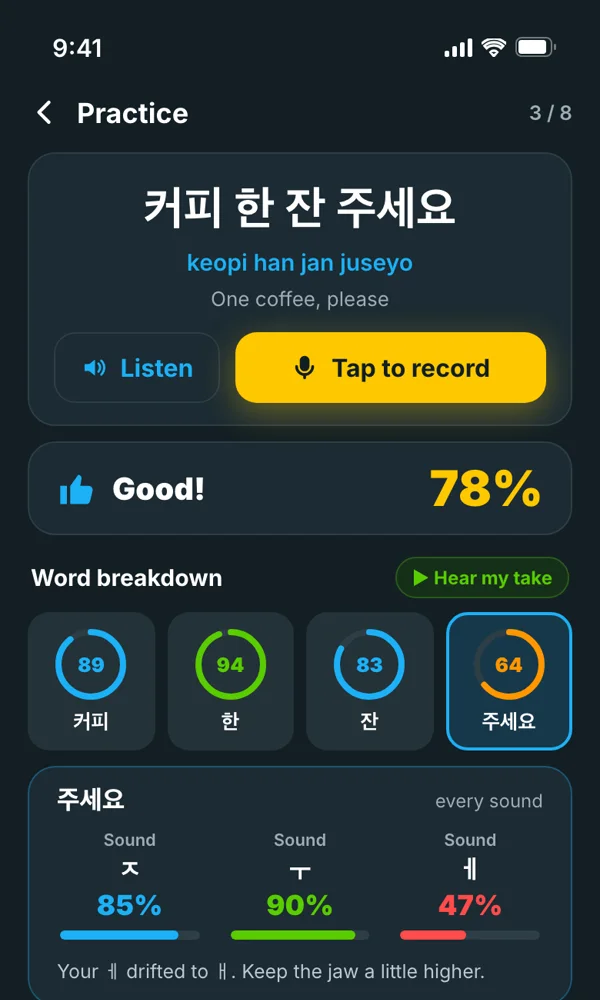
See every sound you get wrong
Each word is scored sound by sound, grouped by syllable, so you know exactly what to fix.
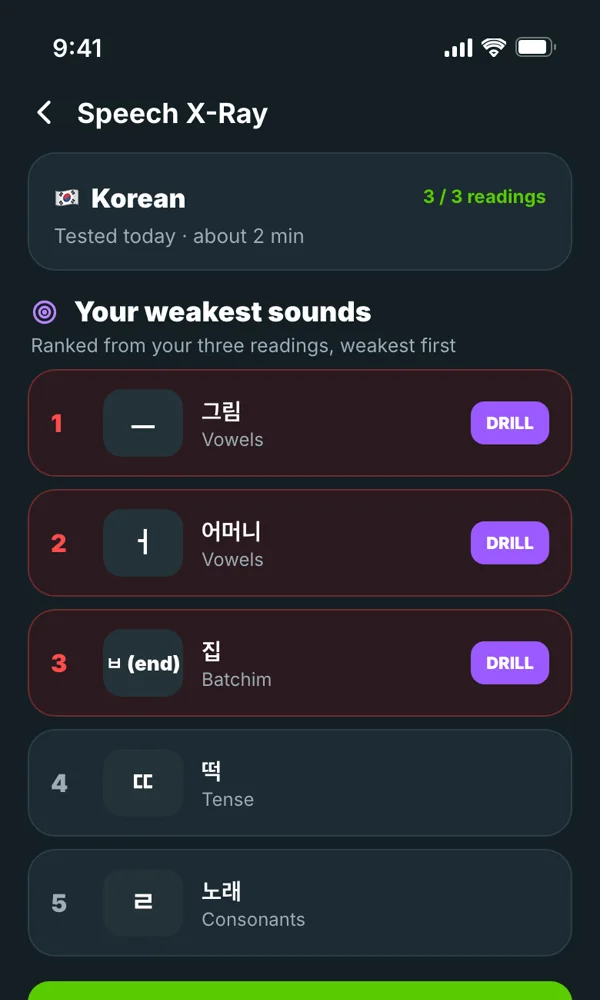
Find your weakest sounds in 2 minutes
A Speech X-Ray of three short readings ranks the sounds to fix first.
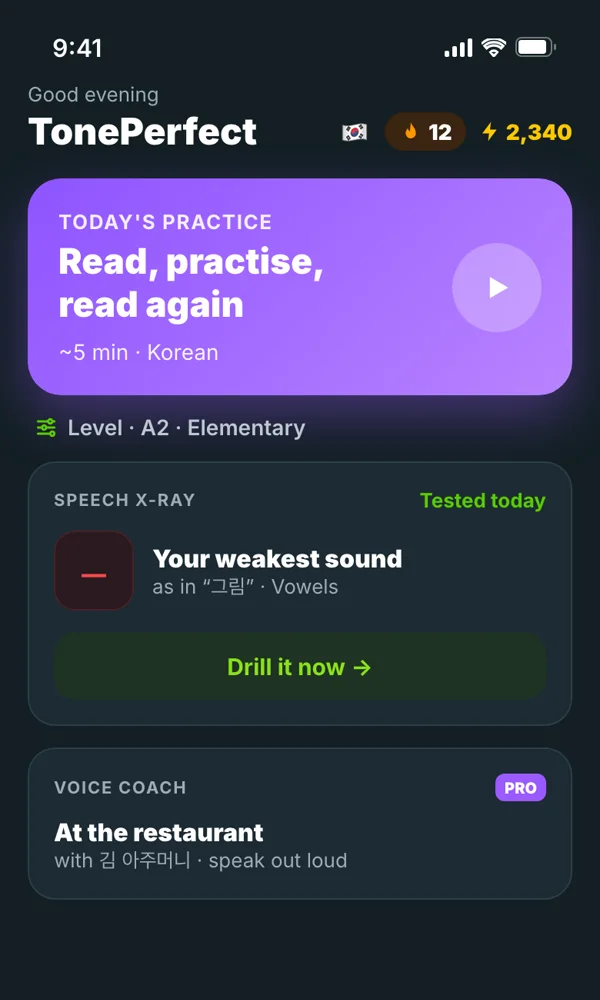
Five minutes a day
A short daily session built on the sounds you need most.
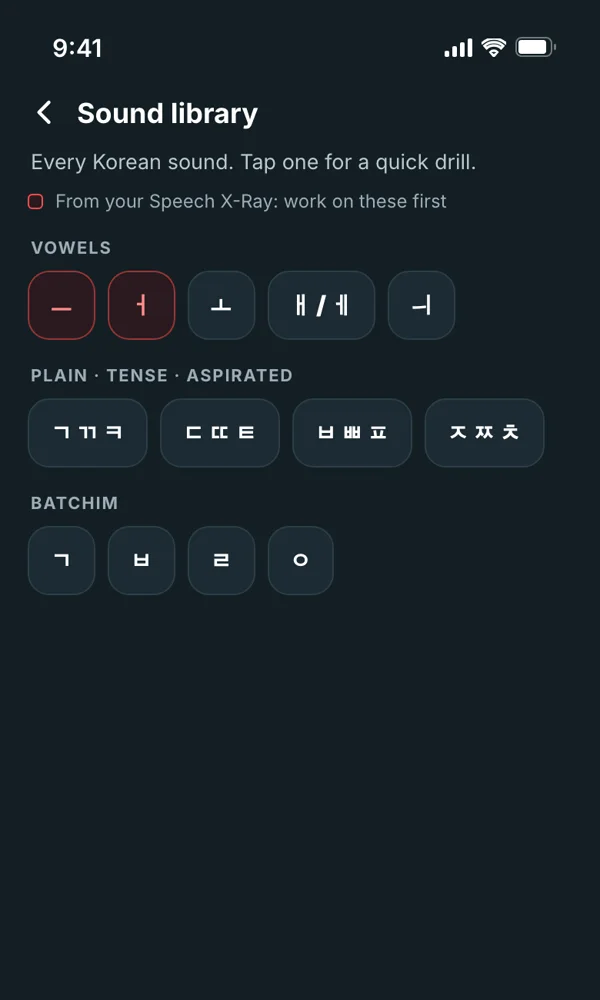
Drill any sound
A sound library for the whole language, with a one-tap drill for each sound.
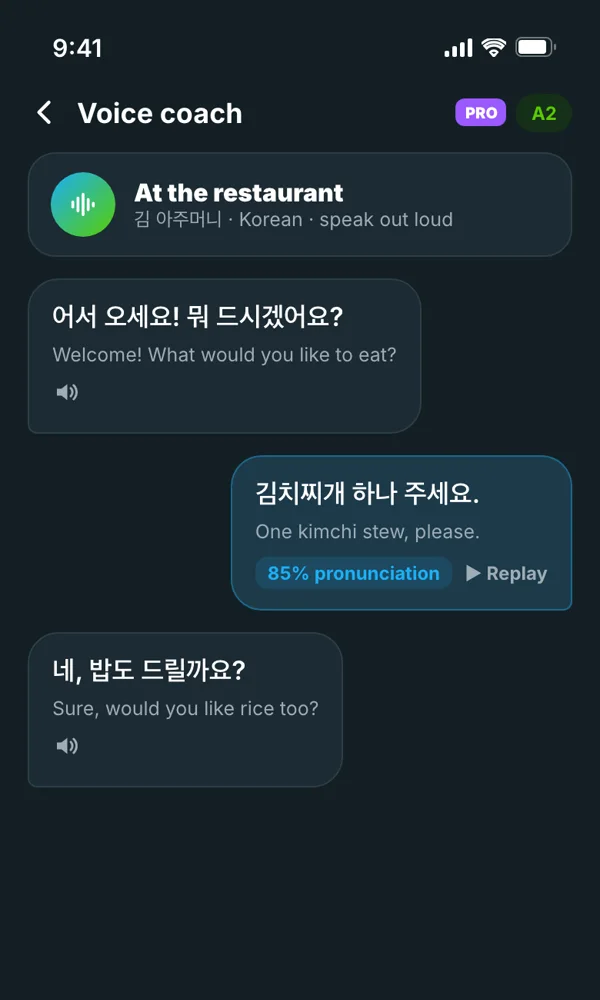
Speak in real situations
Role-play everyday situations out loud with an AI voice coach (Pro).
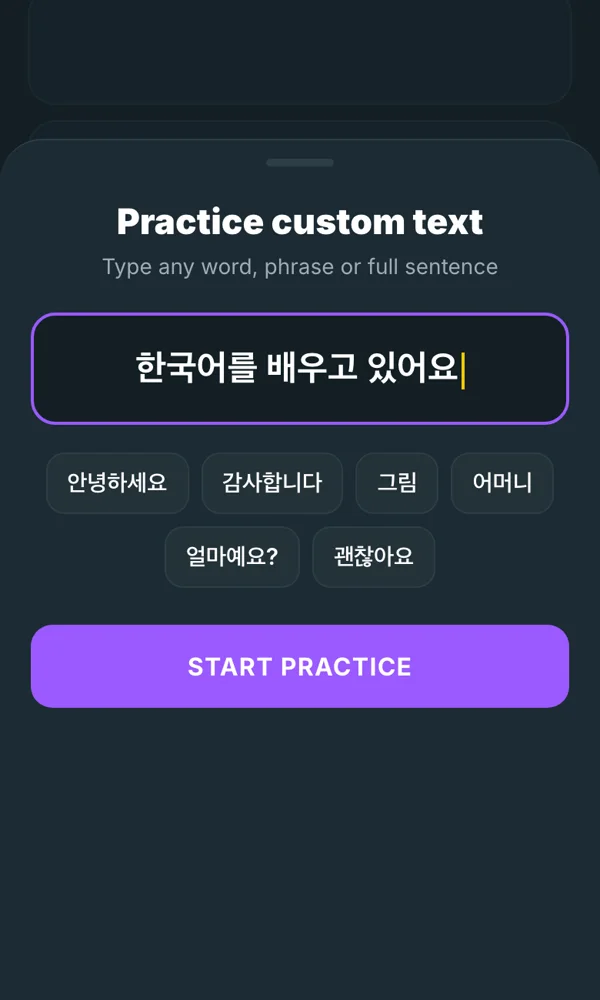
Practise any word or sentence
Type anything you want to say and get a score for every sound.
How it works
- 1
Record
Tap the mic and say the word shown. Real words from a 2,900-word Korean catalog — no minimal-pair trick syllables.
- 2
See every sound
The AI engine scores your take word-by-word and sound-by-sound, so you see exactly which syllable — and which sound inside it — pulled the score down.
- 3
Drill what's weakest
The app tracks your scores per sound across everything you record, ranks your sounds from strongest to weakest, and builds drills for the weak ones.
How to read the scores: they're built for comparison, not certification. A lower score on ㅓ than on ㅏ means ㅓ deserves your practice time; the numbers rank your sounds against each other and your past attempts against each other. The app doesn't guess what you said instead — it shows you where the score dropped, and gives you the mouth mechanics to fix it.
The sounds that decide your accent
Batchim — the cut-off endings
Korean final consonants are stopped, not released. 책 ends with the tongue closed as for 'k' — never 'k-uh'. 집 ends with sealed lips. 옷 ends in a stopped 't', and the spellings ㅅ ㅆ ㅈ ㅊ ㅌ ㅎ all end with that same stopped 't'. Releasing the puff, or adding a little vowel after, is the single most common habit English speakers carry in.
ㄹ batchim — the held 'l'
A final 'l' with the tongue tip curled up to touch the ridge behind the teeth — darker and longer than the tapped ㄹ between vowels. Hold the contact.
ㅇ batchim — the 'ng'
The 'ng' of 'song'. Back of the tongue closes against the soft palate; the sound hums through the nose. Only ever at the end of a syllable.
ㅓ vs ㅗ
ㅓ is an open 'uh/aw' — like the 'u' in 'cut' said with the mouth a bit more open, lips NOT rounded. ㅗ is a rounded 'o' as in 'go' but pure, no glide at the end. English merges both toward 'oh'; Korean keeps them as two different words (어 vs 오). The lips are the whole difference.
ㅡ — the vowel English lacks
Say 'oo' but SPREAD the lips flat as if smiling. The tongue stays high and back while the lips refuse to round. There is no English substitute — this one you have to build from scratch.
ㅢ — two beats in one
Start from ㅡ (the flat-lipped 'oo') and glide quickly to 'ee' — two beats squeezed into one. Only at the start of words like 의사; elsewhere it reduces to plain 'e' or 'ee'.
Scores rank your own sounds against each other so you know what to drill first. They are not an accuracy certificate and not an exam grade.
Questions
How long does the test take?+
About a minute. Five words, one recording each, instant results. You can re-record any word to try to beat your score.
What exactly is measured?+
Each recording is scored by an AI speech-assessment engine, word-by-word and sound-by-sound. The result ranks the sounds within your own attempt — showing which scored lowest — rather than issuing a pass/fail verdict or an accuracy certificate.
Do I need to sign up?+
No. The test runs in your browser with no account. You only need to allow microphone access when your browser asks.
What happens after the test?+
You'll see your lowest-scoring sounds with a concrete tip for each — what to do with your lips, tongue, and breath. To actually train them, the app builds drills from your weak sounds and tracks whether your scores climb over time.
Practice Korean every day
The app drills the sounds this test flags, with thousands of words and instant feedback on every take.
Test your pronunciation
Free, with a score for every sound.