TonePerfect for German·Deutsch
German pronunciation checker: find out what’s holding you back
Record five German words. TonePerfect's AI scores every word, sound by sound, and shows you which sounds score lowest — so you know exactly what to drill.
Get the mobile app
Scan with your phone to install
Record 5 words. Free, no signup — your browser does the recording, our engine does the listening.
nicht
For the soft ch, say a long 'y' as in 'yes' but push more air and switch the voice off — the air hisses gently over the middle of the tongue.
not
Tap to record
Free German pronunciation test·Free German accent test·Check any German text·Practice any German text
Everything you need to actually sound right
Short daily practice built around the sounds you personally get wrong.
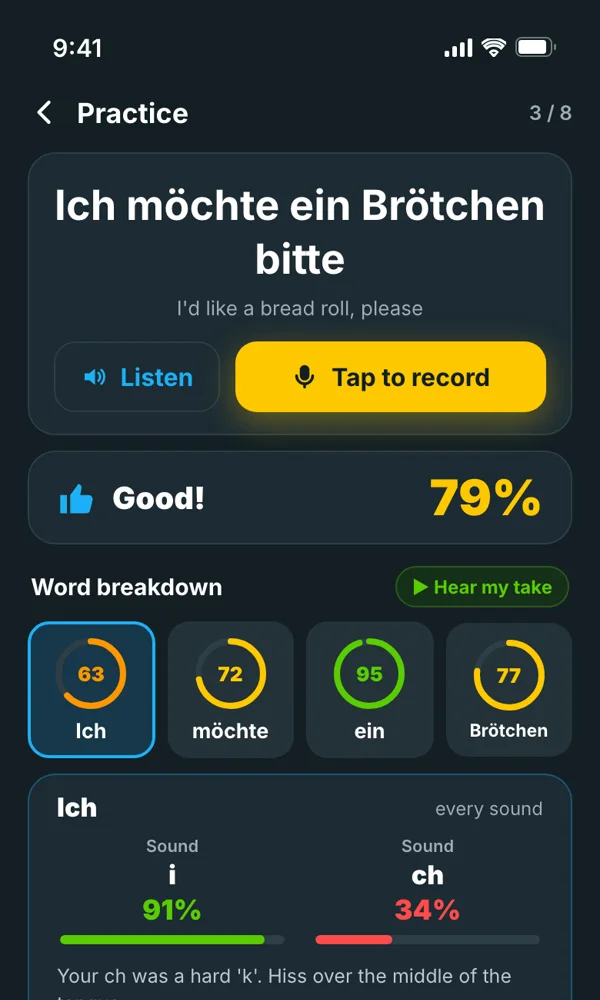
See every sound you get wrong
Each word is scored sound by sound, grouped by syllable, so you know exactly what to fix.
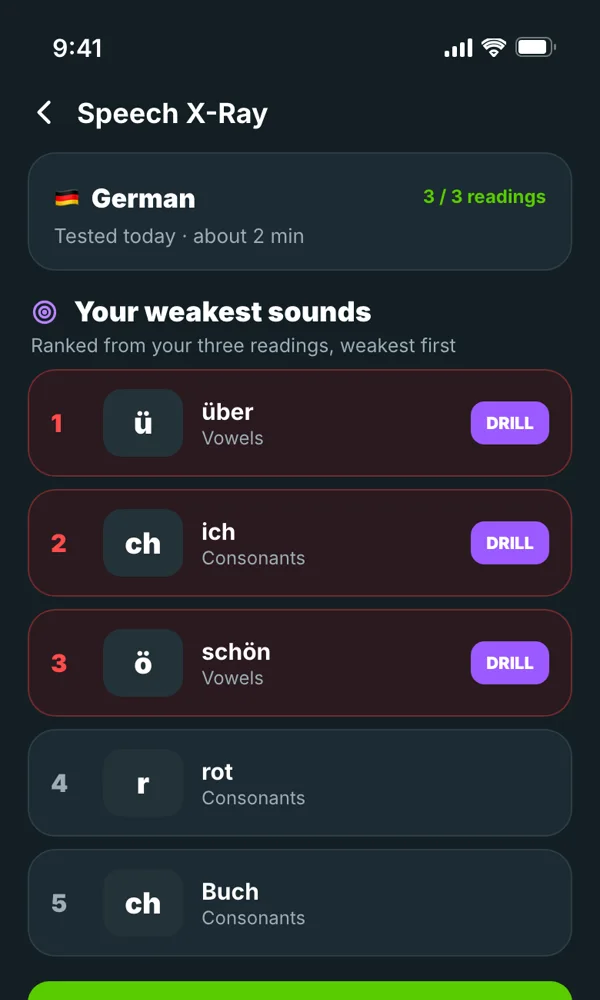
Find your weakest sounds in 2 minutes
A Speech X-Ray of three short readings ranks the sounds to fix first.
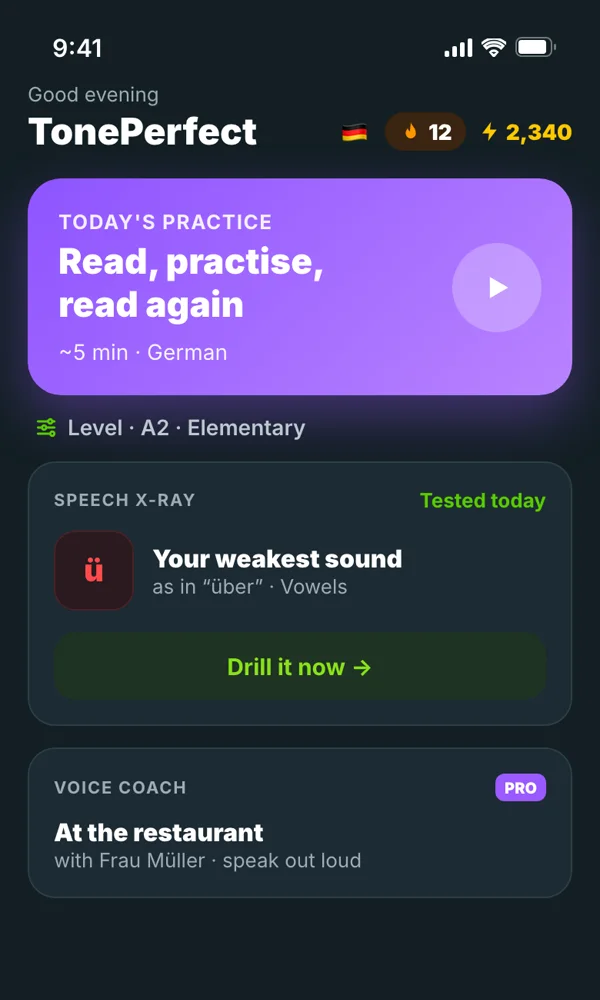
Five minutes a day
A short daily session built on the sounds you need most.
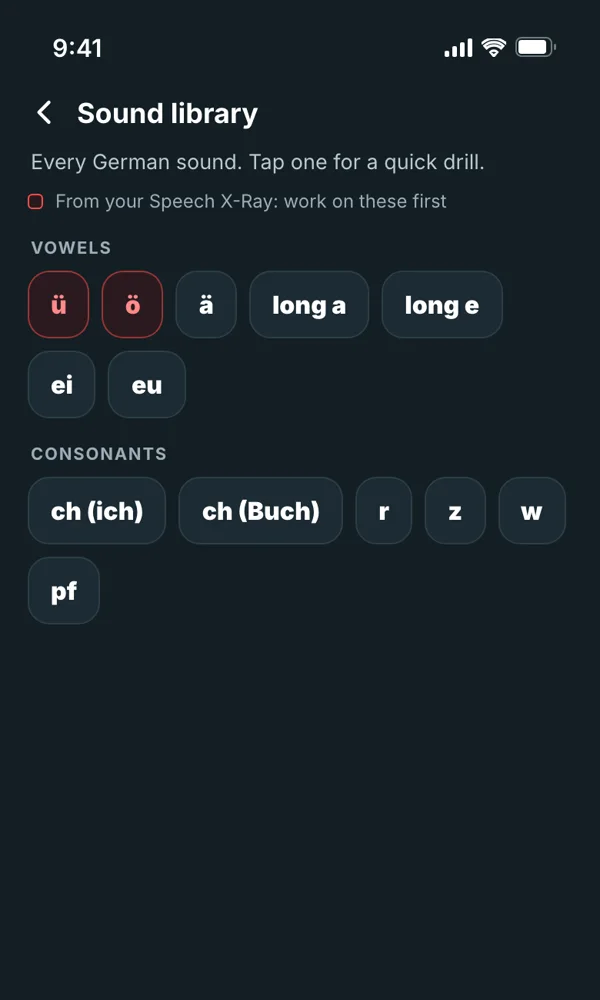
Drill any sound
A sound library for the whole language, with a one-tap drill for each sound.
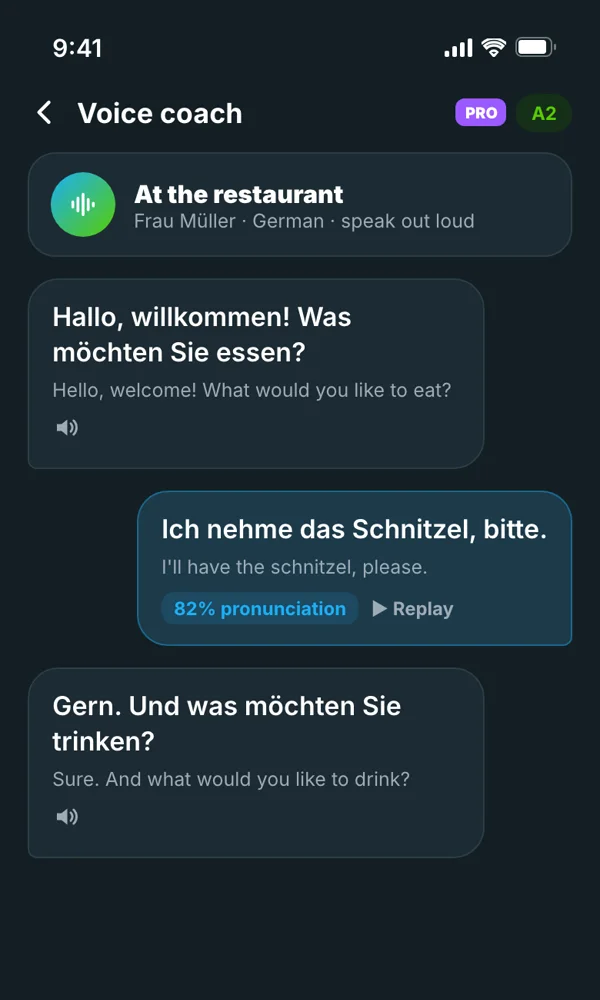
Speak in real situations
Role-play everyday situations out loud with an AI voice coach (Pro).
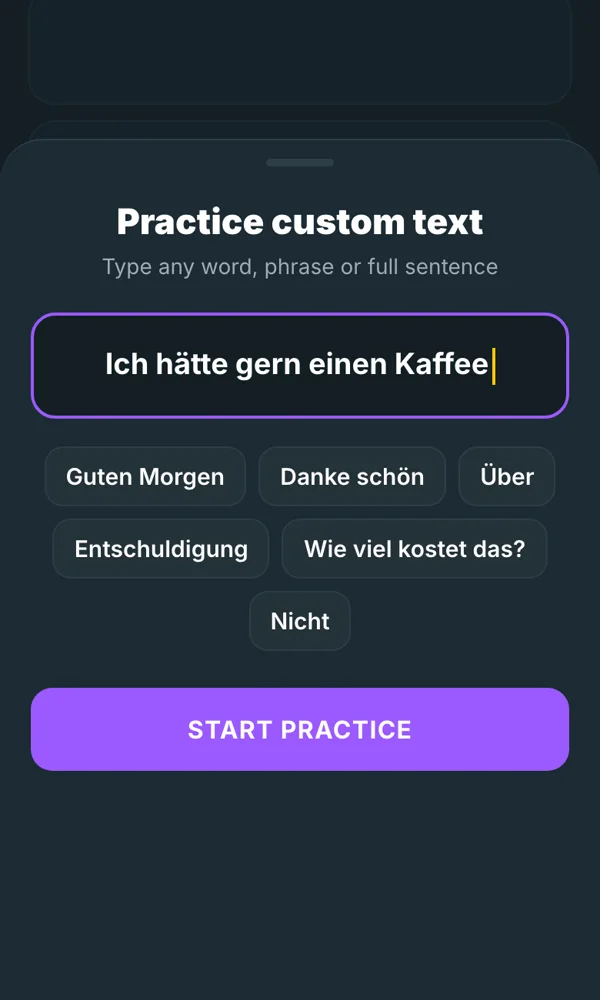
Practise any word or sentence
Type anything you want to say and get a score for every sound.
How it works
- 1
Record
Say five German words into your mic, right in the browser. No signup needed to try it.
- 2
Get scored
A speech-assessment engine scores each word and each sound in it against its reference model of standard German, in seconds.
- 3
Drill what scores lowest
Your results rank your sounds from strongest to weakest. Open the app to drill the weak ones with hand-written tips and hundreds of scored words per sound.
How the scores work: every sound in the word is scored out of 100, and you see all of them. The numbers are built for comparison — which of your sounds score lowest, and whether one climbs when you re-record it. They are built for comparison, so read a 72 as “weaker than your 91” rather than as a certified accuracy figure.
The sounds that decide your accent
Sound chart →The long ü (über)
Spelled ü in an open syllable or before one consonant (über, Bücher, müde) · üh (früh, kühl, Mühe) · y in words from Greek (Typ, anonym, Analyse) · ue where the umlaut is unavailable (Mueller, Duesseldorf)
Say the long 'ie' of 'Liebe' and, keeping the tongue exactly there, round the lips into a tight circle as for whistling: über, früh, Bücher.
Common slip: You pull the tongue back and say "oo" as in "food". Keep the tongue forward where "ee" lives and round only the lips, tight as for whistling.
Heard in
The short ü (fünf)
Spelled ü before two consonants (fünf, müssen, Glück) · ü in a closed syllable (München, zurück, dünn) · y before a consonant cluster (System, Symbol, Gymnasium)
Say the short 'i' of 'bitte' and round the lips while the tongue stays forward: fünf, müssen, Glück. Shorter and looser than the ü in 'über'.
Common slip: You let it slide to the flat-lipped "i" of English "bit". Keep the tongue forward but round the lips into a small circle, and keep it short.
Heard in
The long ö (schön)
Spelled ö in an open syllable or before one consonant (schön, hören, Öl) · öh (Söhne, fröhlich) · -eur in words from French (Friseur, Ingenieur) · oe where the umlaut is unavailable (Goethe, Schroeder)
Say the long 'e' of 'gehen' and keep the tongue there while rounding the lips forward. Hold it long and steady: schön, hören.
Common slip: You round the lips but let the tongue drift back toward "oh". Say the long "e" of "gehen" first, then round the lips without moving the tongue.
Heard in
The short ö (möchte)
Spelled ö before two consonants (möchte, können, öffnen) · ö in a closed syllable (Wörter, Töchter, zwölf) · oe where the umlaut is unavailable (Loeffler, Oetker)
Say the short 'e' of 'Bett' and, without moving the tongue, round the lips into a small circle. The lip rounding is what makes it ö.
Common slip: You say the English "uh" of "but" and let the lips relax. Start from the short "e" of "Bett" and round the lips — the tongue never moves.
Heard in
The soft ch (nicht)
Spelled ch after e, i, ä, ö, ü (nicht, echt, möchte) · ch after ei, eu, äu (leicht, euch, Bäuche) · ch after l, n, r (Milch, manche, durch) · -ig at the end of a word (richtig, wenig, König) · -chen at the end of a word (Mädchen, bisschen)
Say a long 'y' as in English 'yes' but push more air and switch the voice off: the middle of the tongue rises high near the front and the air hisses gently over it. Comes after e, i, ä, ö, ü and in the -ig ending.
Common slip: You reach for English "sh" and pull the tongue back. Keep it where the "y" of "yes" sits, high and forward, and switch the voice off.
Heard in
The hard ch (Buch)
Spelled ch after a (machen, Nacht, acht) · ch after o or u (noch, Buch, suchen) · ch after au (auch, brauchen, Bauch)
The back of the tongue rises toward the roof of the mouth — the 'k' place — but instead of blocking the air it lets it scrape through. Comes only after a, o, u, au.
Common slip: You harden it into "k" and block the air. Set the tongue in the "k" place but leave a gap so the air scrapes through instead of stopping.
Heard in
The German r (rot)
Spelled r at the start of a word (rot, Reise, richtig) · r before a vowel (Frau, drei, hören) · rr between vowels (Herr, Karriere, sperren) · rh in loanwords (Rhythmus, Rhein)
Made at the BACK of the mouth: the tongue back approaches the soft palate or uvula and the voice flows with a slight rasp, like a very gentle gargle. Never the English curled-tongue r, and never a strong roll.
Common slip: You curl the tongue tip back for the English r. Leave the tip down and make the sound at the back of the mouth, like a gentle gargle.
Heard in
The vocalized r (Vater)
Spelled -er in an unstressed ending (Vater, immer, wieder) · the unstressed prefixes ver-, er-, zer-, her- (verstehen, erklären) · r after a long vowel at the end of a syllable (mehr, Uhr, vier) · r before a consonant after a long vowel (fährt, Bart, Wort)
At the end of a syllable, German r melts into a short, dark 'ah'-like vowel: 'Vater' ends in a relaxed open sound, not a consonant. Let the tongue drop — do not curl it.
Common slip: You finish the word with a full consonant r. Let it melt into a short dark "ah" instead — "Vater" ends in a vowel, tongue flat and uncurled.
Heard in
The German w (Wasser)
Spelled w anywhere in a word (Wasser, wieder, zwei) · v in loanwords (Vase, November, Klavier) · qu, which is k plus this sound (Quelle, Qualität, bequem)
Top teeth on the lower lip as in 'Frau', but the voice buzzes through. German w is always this buzzing sound — never the English rounded-lips w.
Common slip: You round the lips into an English "w". Rest the top teeth on the lower lip as for "f" and let the voice buzz straight through.
Heard in
The German z (zwei)
Spelled z anywhere in a word (zwei, Zeit, Arzt) · tz after a short vowel (jetzt, sitzen, Platz) · -tion and -zion endings (Nation, Station, Portion) · c before e or i in older loanwords (Celsius, Cäsar)
German z is t + s said together, released as one crisp sound at the front of the mouth. It is never the buzzing English z: zwei, Zeit, jetzt.
Common slip: You say the buzzing English z. Press the tongue for "t" and release it straight into "s" — one crisp sound at the front of the mouth.
Heard in
Final devoicing (und, Tag)
Spelled -b at the end of a word or syllable, said as p (halb, ab, gibt) · -d at the end of a word or syllable, said as t (und, Hand, Kind) · -g at the end of a word or syllable, said as k (Tag, Weg, Berg) · b, d, g before a consonant inside a word (lebt, sagt, Jugend) · not -ig, which takes the soft ch instead (richtig, König)
At the end of a word, German b, d, and g always switch to their voiceless partners: final b is said as 'p', final d as 't', and final -g in words like 'Tag' as 'k'.
Common slip: You hold the voice on through the last consonant, as English does. Switch it off: "und" ends like t, "Tag" like k, "halb" like p.
Heard in
The fresh vowel start (Arbeit)
Spelled any word beginning with a vowel or umlaut (Arbeit, immer, ähnlich) · a stressed vowel-initial syllable after a prefix (be-antworten, ver-einen) · the second half of a compound beginning with a vowel (Spiegel-ei, Tor-einfahrt) · a vowel-initial word right after a consonant (am Abend, ein Ende)
German words and syllables that begin with a vowel start with a tiny catch in the throat, like the small stop in 'uh-oh'. Close the vocal cords briefly, then release straight into the vowel — never glide in from the word before.
Common slip: You link straight across as in English "an apple". Close the throat for a split second before the vowel, like the catch in "uh-oh", then release.
Heard in
What usually goes wrong
The umlauts: ü and ö
Neither vowel exists in English. Both are built the same way: put your tongue in a familiar front-vowel position — 'ie' for ü, 'e' for ö — then round your lips without letting the tongue move. Most learners move the tongue back as they round, which turns ü into 'u' and ö into 'o'. Record yourself and see which of the four umlaut vowels (long and short ü, long and short ö) scores lowest.
The two ch sounds
German ch is two different sounds, and the spelling doesn't tell you which — the vowel before it does. After a, o, u, au it's the hard scrape of 'Buch' at the back of the mouth. After everything else, and in the -ig ending, it's the soft hiss of 'nicht' made high and forward, like a voiceless 'y'. Swapping them is instantly noticeable; drilling word pairs like 'machen' vs 'nicht' trains the switch.
One letter, two r sounds
Before a vowel, German r is a gentle rasp at the back of the mouth — nothing like the English curled-tongue r. At the end of a syllable, it isn't a consonant at all: it melts into a short dark vowel, so 'Vater' and 'mehr' end open. Learners who carry the English r into German get flagged on both patterns. Drill 'rot' for the back-of-mouth r and 'Vater' for the vowel ending.
Final devoicing
German never ends a word on a voiced b, d, or g. 'und' ends in 't', 'gibt' has a 'p' in it, 'Tag' ends in 'k'. Keeping the English voiced ending sounds subtly off on hundreds of common words. The fix is mechanical — same mouth position, voice off — and it shows up quickly once you start scoring word endings.
Stress in long words and compounds
German builds long words out of short ones, and the first part of a compound usually carries the main stress. Getting the stress wrong makes a correctly-pronounced word hard to follow. Practice long items slowly, land hard on the stressed syllable, and let the endings — the quiet final -e of 'bitte', the vocalized r of '-er' — stay small and relaxed.
Everything the German course gives you
German pronunciation drilled where it actually goes wrong: the umlauts, the two ch sounds, and the r that stops being a consonant.
44 German sounds
All 44 German sounds are scored on their own, so one bad vowel in an otherwise good word does not hide behind a single number.
Umlauts and both ch
Long and short ü and ö, plus the hard scrape of Buch against the soft hiss of nicht. Four umlaut vowels, two ch sounds, all drilled apart.
3,177 real words
3,177 German words from everyday use, including the word endings where b, d and g quietly turn into p, t and k.
Spaced review
Words return at intervals your own scores set. If the soft ch is scoring below the hard one, nicht comes back long before Buch.
Weakest first
Your daily set is rebuilt around whatever scores lowest — the vocalized r at the end of Vater, or the clean vowel start of Arbeit.
Five words, free
Say nicht, Buch, über, rot and zwei in your browser. Five words is enough to rank the German sounds you should work on first.
Practice anywhere, anytime
Available on every major platform. Your progress syncs seamlessly across all devices.
iOS App
Native iPhone and iPad experience.
Android App
Full-featured Android experience.
Web App
Practice instantly in your browser. No download needed.
Telegram Bot
Quick practice sessions right inside Telegram.
Simple, transparent pricing
Start free and upgrade when you're ready. No surprises.
Free
$0 forever
- At least one free guided practice session each day
- Daily workout
- Placement test
- Progress tracking
Premium
Most PopularCard prices above are for web checkout. App Store and Google Play prices may differ; your exact price and trial are shown before purchase.
- Unlimited assessments
- Spaced repetition reviews
- Custom text practice
- Advanced analytics
Questions
Is the German pronunciation test free?+
Yes. The browser test is free and doesn't require an account. The app is free to download and try; a premium subscription unlocks the full practice library.
How does the scoring work?+
You record a word, and a speech-assessment engine scores it word by word and sound by sound against its reference model of standard German. Every phoneme gets its own score out of 100 and all of them are shown. Those numbers are built for comparison rather than certification: they tell you which sounds score lowest for you and whether practice is moving them, not an official accuracy grade.
Can it fix my accent?+
It shows you where to work. The engine doesn't produce a transcript, so it won't claim you said one sound instead of another — but it reliably surfaces which sounds score lowest, and every sound comes with a hand-written tip explaining exactly how to make it. Learners drill their lowest-ranked sounds and re-record to check progress.
What other languages does TonePerfect support?+
Eight courses: Mandarin Chinese (where TonePerfect started), English, Spanish, French, German, Russian, Japanese, and Korean. Over 50,000 learners use the app.
Do I need the app?+
The browser test covers five words. The app has the full German course: hundreds of scored words, per-sound drills, listening exercises, and progress tracking across sessions. The test hands you straight into it.
How is this different from Duolingo?+
Duolingo teaches vocabulary and grammar with occasional speaking checks. TonePerfect does one thing: pronunciation. Every exercise records your voice, scores every sound, and tells you what to drill next. Use it alongside whatever you use for vocabulary.
Practice German every day
The app drills the sounds this test flags, with thousands of words and instant feedback on every take.
Learning Chinese? That's where TonePerfect started — see the full Mandarin course. Chinese pronunciation
Test your pronunciation
Free, with a score for every sound.