TonePerfect for Japanese·日本語
Japanese pronunciation checker: find out what’s holding you back
Record 5 common words. An AI speech engine scores each one mora by mora and shows you which sounds score lowest — so you know exactly what to drill first.
Get the mobile app
Scan with your phone to install
Record 5 words. Free, no signup — your browser does the recording, our engine does the listening.
ひとり
For り, tap the tongue once, quickly, against the ridge behind the upper teeth — between an English l and r, close to the quick d in American "water".
one person; alone
Tap to record
Free Japanese pronunciation test·Free Japanese accent test·Check any Japanese text·Practice any Japanese text
Everything you need to actually sound right
Short daily practice built around the sounds you personally get wrong.
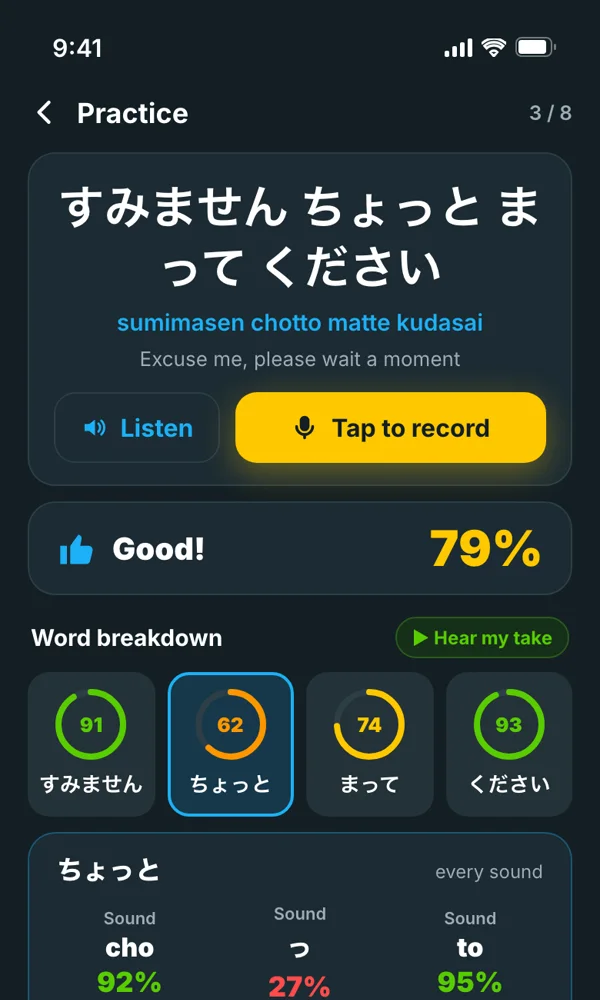
See every sound you get wrong
Each word is scored sound by sound, grouped by syllable, so you know exactly what to fix.
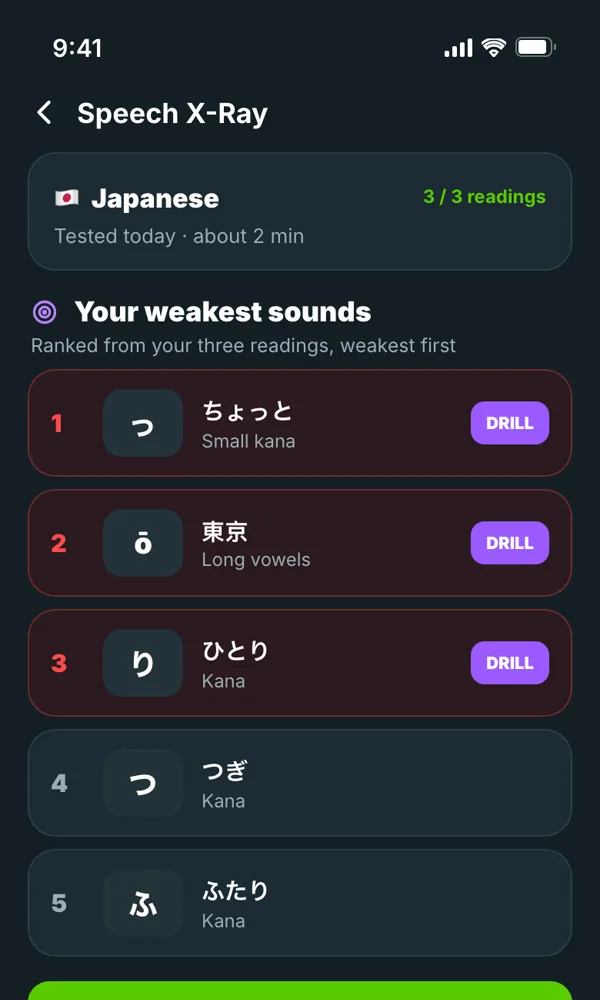
Find your weakest sounds in 2 minutes
A Speech X-Ray of three short readings ranks the sounds to fix first.
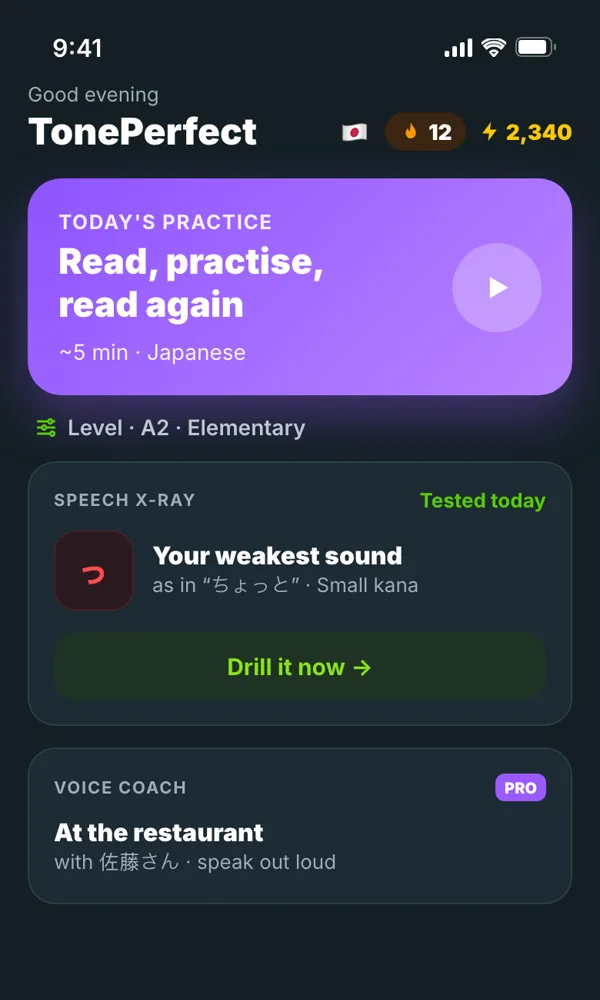
Five minutes a day
A short daily session built on the sounds you need most.
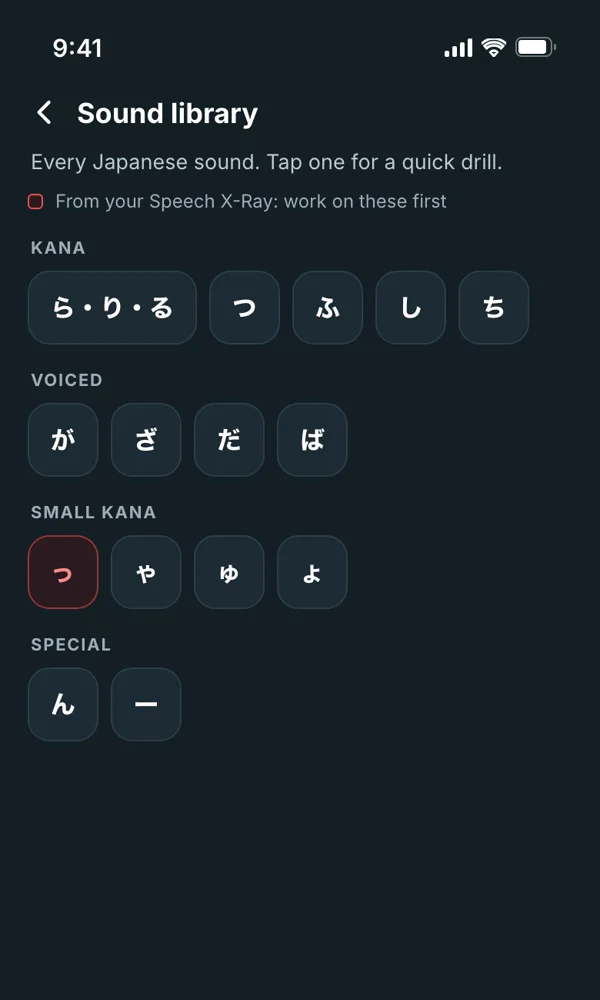
Drill any sound
A sound library for the whole language, with a one-tap drill for each sound.
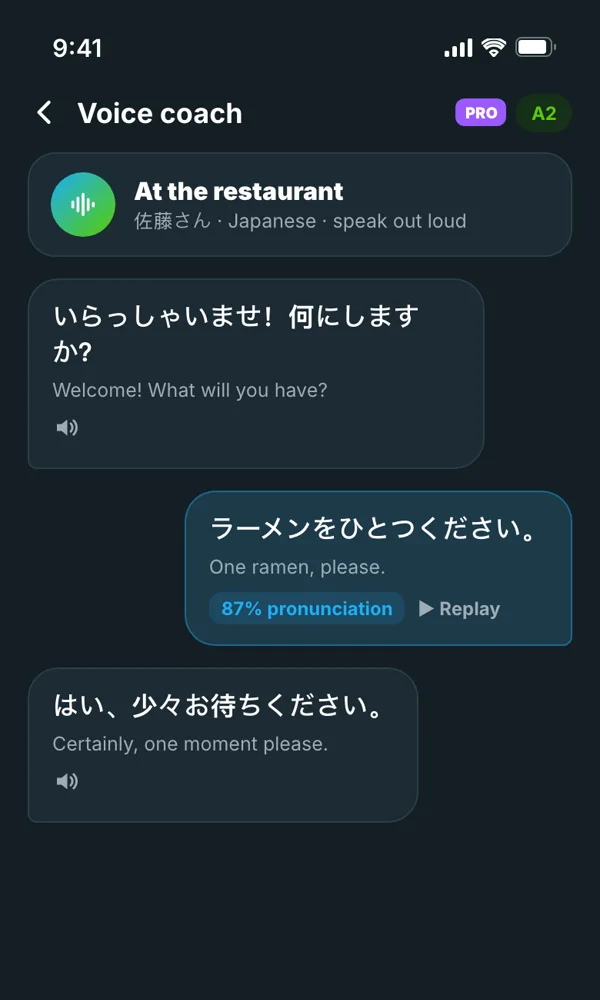
Speak in real situations
Role-play everyday situations out loud with an AI voice coach (Pro).
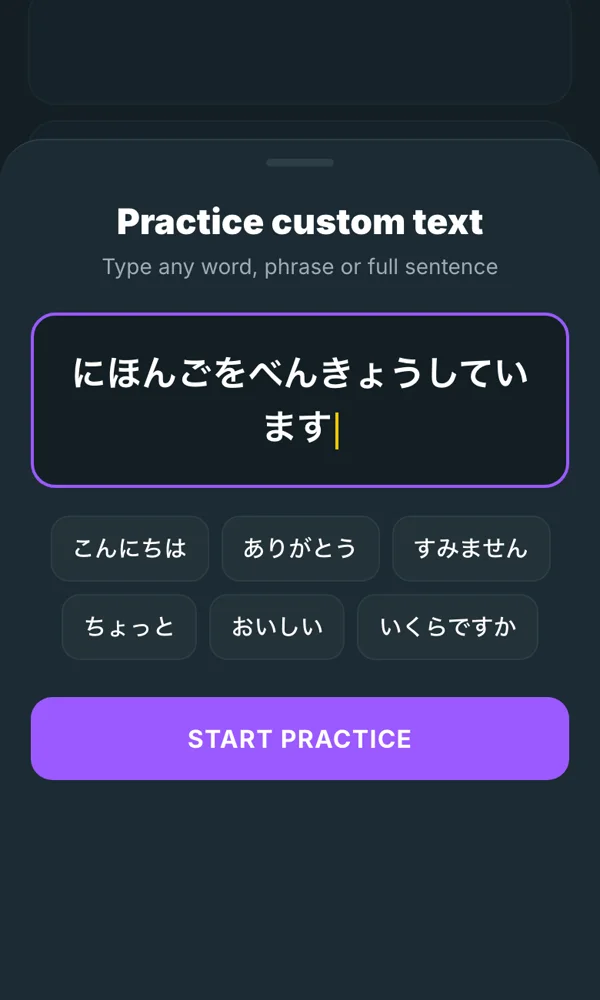
Practise any word or sentence
Type anything you want to say and get a score for every sound.
How it works
- 1
Record 5 words
Tap the mic and read each word aloud. It runs in your browser — no download, no account.
- 2
Get scored mora by mora
A speech-assessment engine scores every word you say, mora by mora, in seconds.
- 3
See what to drill first
Your sounds come back ranked, lowest first. Take the weakest into the app and drill them with real words until the ranking moves.
How the scores work: every mora in the word is scored out of 100, you see all of them, and they are ranked weakest-first so you know what to drill. What we don’t do is turn them into a JLPT level, or tell you which sound you produced instead of the target — the engine returns scores, not a transcript.
The sounds that decide your accent
Sound chart →The r-flap: ら・り・る・れ・ろ
Spelled ら · り · る · れ · ろ · ra / ri / ru / re / ro
Tap the tongue once, quickly, against the ridge behind the upper teeth — between an English l and r, close to the quick d in American "water". Never roll it, never curl the tongue back.
Common slip: English speakers reach for an r and curl the tongue back; instead tap the tongue tip once against the ridge behind your upper teeth, like the d in "water".
Heard in
つ (tsu)
Spelled つ · ツ · tsu
A quick t that melts straight into "su" — the "ts" of "cats" at the START of a beat. Don't drop the t and don't say "su".
Common slip: English speakers drop the t and say "su". Keep the "ts" of "cats", but put it at the START of the beat, not the end.
Heard in
ふ (fu)
Spelled ふ · フ · fu · hu
Blow air softly between almost-closed lips, like gently blowing out a candle. NOT an English f — the teeth never touch the lip.
Common slip: English speakers bite the lower lip for an f; keep the teeth off the lip and blow softly between almost-closed lips, like blowing out a candle.
Heard in
Long vowels: おう・おお・ええ・いい
Spelled ああ · おう · おお · ー (katakana) · ō / ou
A long vowel is the same vowel held for one extra full beat — がっこう is ga-k-ko-o, four beats. Keep the vowel pure while you hold it; don't let お drift toward "ou".
Common slip: English speakers cut the long vowel short, so おう lands in one beat; hold the same pure vowel for two full beats instead of gliding it toward "oh-oo".
Heard in
Small っ (the held beat)
Spelled っ · ッ · kk / tt / pp / ss
A held, silent beat: get your mouth ready for the NEXT consonant and hold it closed for one full beat — がっこう has a real beat of silence in the middle. For す/し it is a held hiss instead.
Common slip: English speakers rush straight past っ; set your mouth for the next consonant and hold it silently for one full beat — がっこう has real silence in the middle.
Heard in
ん (the standalone n)
Spelled ん · ン · n · n'
A full beat of nasal hum on its own. Before b, p or m it sounds like "m"; before k or g like "ng"; elsewhere like "n". Whatever the color, give it its whole beat.
Common slip: English speakers glue ん onto the next syllable; give the nasal hum its own full beat, even though its color shifts toward "m" or "ng" before certain consonants.
Heard in
う (the flat u)
Spelled う · ウ · u
Like "oo" in "food" but with the lips relaxed and almost flat, not rounded or pushed forward.
Common slip: English speakers round and push the lips forward as in "food"; keep the lips relaxed and almost flat while holding the same tongue position.
Heard in
Devoiced u and i
Spelled す · し · く · です (desu) · ます (masu)
Between voiceless consonants and at the end of words, u and i often go silent: です comes out "des'", します comes out "shimas'". Whisper the vowel rather than voicing it fully — a loud "desu" sounds robotic.
Common slip: English speakers voice every written vowel, so です comes out "de-su"; whisper the u instead and let it land as "des".
Heard in
Mora timing
Spelled each kana = one beat · ん = one beat · っ = one beat · small ゃ・ゅ・ょ = no beat of its own
Japanese runs on a metronome: every kana gets one equal beat, including ん, small っ, and the second half of a long vowel. Don't stress one syllable and swallow the rest like English does.
Common slip: English speakers stretch one syllable and rush the others; give every kana the same length instead, like a metronome — ありがとう is five even beats.
Heard in
Small ゃ・ゅ・ょ
Spelled ゃ · ゅ · ょ · ャ・ュ・ョ · kya / kyu / kyo
Not a beat of its own: it fuses with the kana before it into ONE beat — きゃ is "kya" in a single beat, never "ki-ya".
Common slip: English speakers split きゃ into "ki-ya", adding a beat; fuse the two kana into one beat, gliding straight from the consonant into "ya".
Heard in
し (shi)
Spelled し · シ · shi · si
Close to English "she", but with the tongue flatter and the lips unrounded — softer than an English sh.
Common slip: English speakers round the lips for an English "sh"; keep the lips unrounded and the tongue flatter, so it lands as a softer "she".
Heard in
ひ (hi)
Spelled ひ · ヒ · hi
A hissier h made with the middle of the tongue high, near the roof of the mouth — like the h in "hue".
Common slip: English speakers use the throaty h of "hot"; raise the middle of the tongue toward the roof of the mouth for the hissier h of "hue".
Heard in
What usually goes wrong
You stress syllables. Japanese counts beats.
English squeezes and stretches syllables around stress. Japanese gives every mora — every kana, including ん and the silent small っ — exactly one beat. Say ひとり as "hi-TOH-ri" and a Japanese ear hears the rhythm break before it hears any single sound. Fixing timing improves everything at once.
Vowel length changes the word
おばさん (obasan) is your aunt. おばあさん (obāsan) is your grandmother. One held beat is the entire difference. English ears are trained to ignore vowel length, so this is invisible until someone measures it — hold the long vowel for a full extra beat, same pure vowel, no glide.
The r that is neither r nor l
ら・り・る・れ・ろ start with a single quick tap of the tongue behind the upper teeth — close to the fast d in American "water". An English r sounds heavy and curled; an l sounds held. The tap touches once and releases. It shows up in する, いる, ある — you cannot avoid it for even one sentence.
The small っ is a sound made of silence
ちょっと has a full, deliberate beat of silence in the middle. Skip it and you said a different word; hold it too long and the rhythm breaks. Close your mouth in the position of the next consonant, hold one beat, release. がっこう, ずっと, やっぱり — everyday words depend on it.
Katakana words are the trap, not the freebie
コーヒー looks like "coffee" but it isn't — it's ko-o-hi-i, four even beats with two long vowels and a Japanese ひ. Borrowed words feel safe precisely because you already know them in English, so your English habits ride in untouched. Treat every katakana word as a Japanese word that happens to look familiar.
Everything the Japanese course gives you
Japanese scored kana by kana — every slot the engine hears, ん and the small っ included.
All 77 kana
Each of the 77 kana the engine tracks is scored on its own, so you can see which ones sit lowest across everything you have recorded.
Beats, not stress
おばさん and おばあさん are different words separated by one held beat. Long vowels and the small っ are drilled as full units, never as decoration.
3,000 real words
3,000 Japanese words from everyday use, katakana loanwords included — the ones that look familiar and carry your English habits straight in.
Spaced review
Words return at intervals your scores set. If ふ or つ are scoring lowest, the words carrying them come back sooner than the rest.
Weakest kana first
Your daily set is assembled from your lowest-scoring kana. If that is ら・り・る・れ・ろ, that is what the next words are built from.
Five words, free
Say ひとり, つぎ, 東京, ちょっと and ふたり in your browser and get your kana ranked weakest to strongest, before you install anything.
Practice anywhere, anytime
Available on every major platform. Your progress syncs seamlessly across all devices.
iOS App
Native iPhone and iPad experience.
Android App
Full-featured Android experience.
Web App
Practice instantly in your browser. No download needed.
Telegram Bot
Quick practice sessions right inside Telegram.
Simple, transparent pricing
Start free and upgrade when you're ready. No surprises.
Free
$0 forever
- At least one free guided practice session each day
- Daily workout
- Placement test
- Progress tracking
Premium
Most PopularCard prices above are for web checkout. App Store and Google Play prices may differ; your exact price and trial are shown before purchase.
- Unlimited assessments
- Spaced repetition reviews
- Custom text practice
- Advanced analytics
Questions
Is the Japanese pronunciation test free?+
Yes. The 5-word browser test is completely free, no account needed. The app is free to download and try; a premium tier unlocks the full drill library and unlimited practice.
How does the scoring actually work?+
You record a word; a speech-assessment engine scores it word by word and mora by mora, and every mora gets its own score out of 100. TonePerfect shows you those numbers and ranks them weakest-first so you know what to practise. What it won’t tell you is which sound you said instead of the target: the engine returns scores, not a transcript, so any tool claiming that is guessing. And no score here is a JLPT level.
Does it teach pitch accent?+
Not yet, and we won't pretend otherwise. Japanese pronunciation has two layers: the sounds and rhythm (vowel length, gemination, mora timing), and pitch accent (はし rising vs. falling). TonePerfect's Japanese coaching currently covers the first layer — the one that makes you hard to understand when it's wrong. We don't score or grade pitch accent, and no score you see reflects it.
What other languages does TonePerfect support?+
Eight: Mandarin Chinese (where we started — 50,000+ learners), English, Spanish, French, German, Russian, Japanese, and Korean. One app, same recording-and-feedback loop in each.
Do I need the app, or is the website enough?+
The website gives you the 5-word test and your ranked results. The app is where the actual work happens: a drill library built from 3,000 real Japanese words covering all 77 morae, daily practice that tracks which sounds are moving, and word-by-word feedback on everything you record.
How is this different from Duolingo?+
Duolingo teaches you Japanese; TonePerfect fixes how you sound saying it. It's a specialist tool: every exercise is speaking, every word you say gets scored, and the app keeps pointing you at your lowest-scoring sounds. Use it alongside whatever you use for grammar and vocabulary.
Practice Japanese every day
The app drills the sounds this test flags, with thousands of words and instant feedback on every take.
Learning Chinese? That's where TonePerfect started — see the full Mandarin course. Chinese pronunciation
Test your pronunciation
Free, with a score for every sound.