TonePerfect for English
Free English accent test
Record 5 words. Free, no signup — your browser does the recording, our engine does the listening.
think
Touch the bottom edge of your top teeth with your tongue tip and let the air flow over it. No voice, and the tongue never taps.
to use your mind
Tap to record
Free English pronunciation test →·Check any English text →·Practice any English text →·American accent test →
How strong is your accent in English? Record five words and get a per-sound score in under a minute. The test is the same engine the app uses; it ranks your sounds against each other so you know what to fix first.
Get the mobile app
Scan with your phone to install
Everything you need to actually sound right
Short daily practice built around the sounds you personally get wrong.
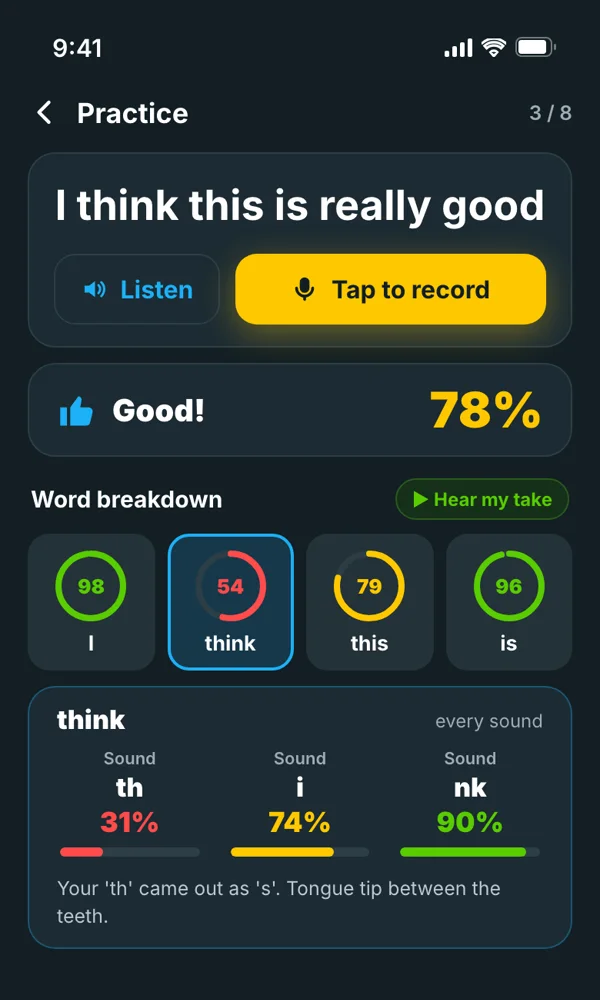
See every sound you get wrong
Each word is scored sound by sound, grouped by syllable, so you know exactly what to fix.
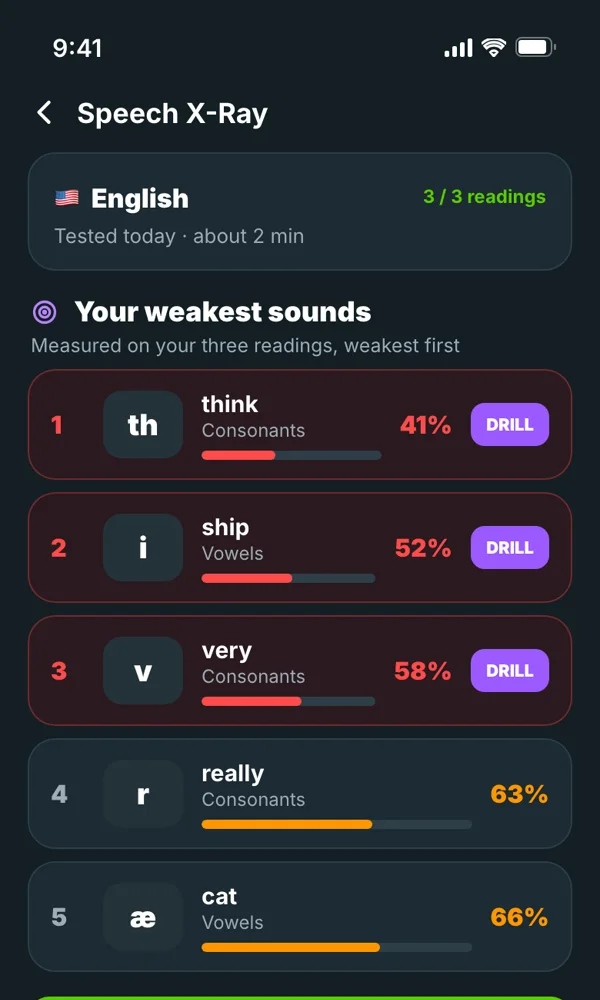
Find your weakest sounds in 2 minutes
A Speech X-Ray of three short readings ranks the sounds to fix first.
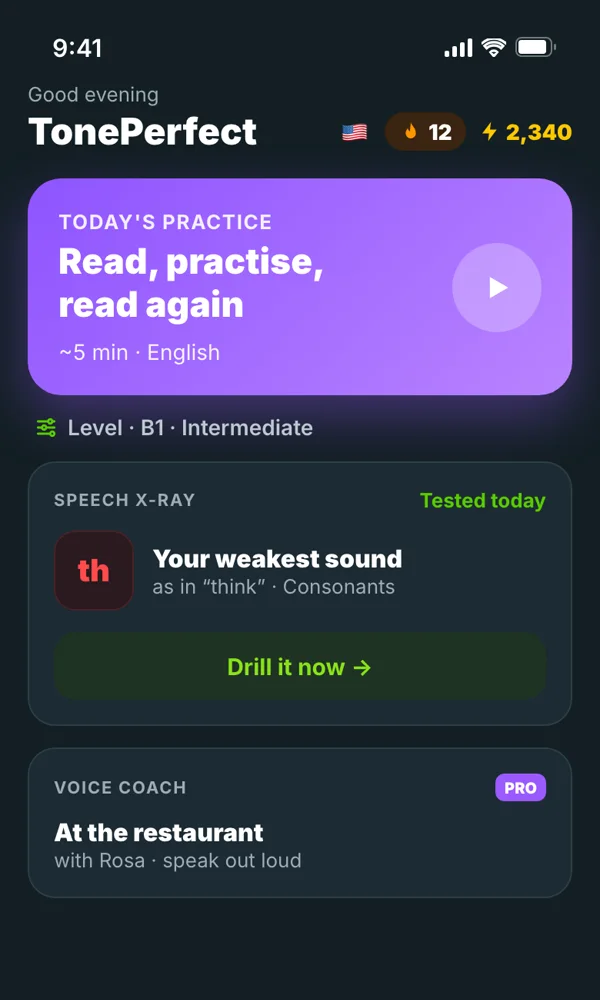
Five minutes a day
A short daily session built on the sounds you need most.
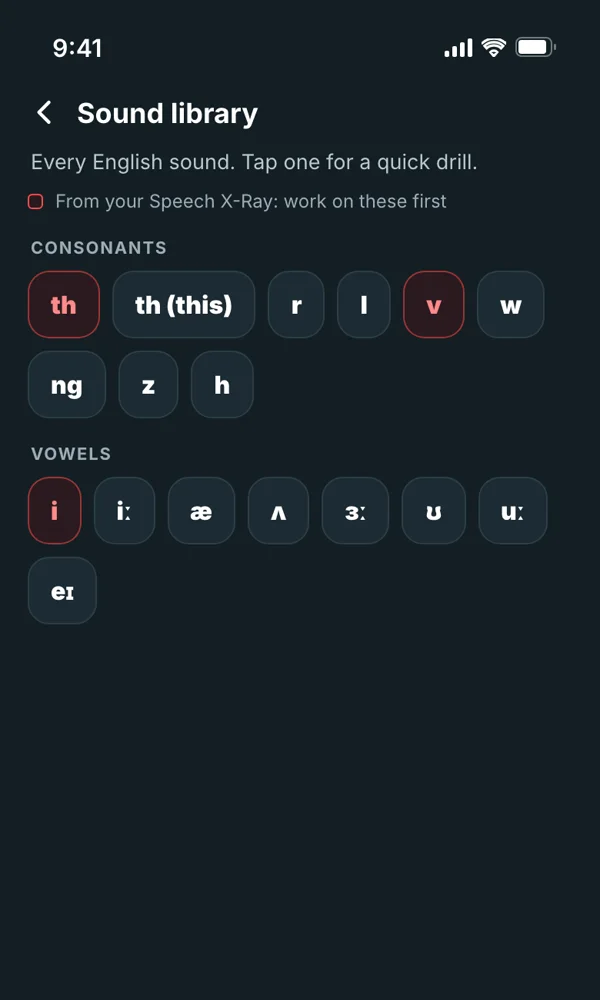
Drill any sound
A sound library for the whole language, with a one-tap drill for each sound.
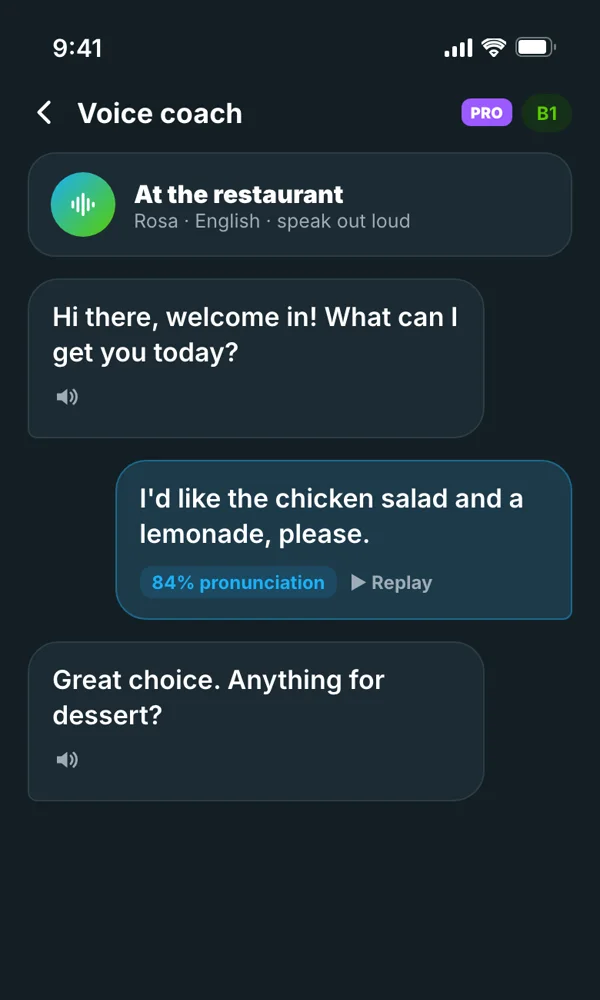
Speak in real situations
Role-play everyday situations out loud with an AI voice coach (Pro).
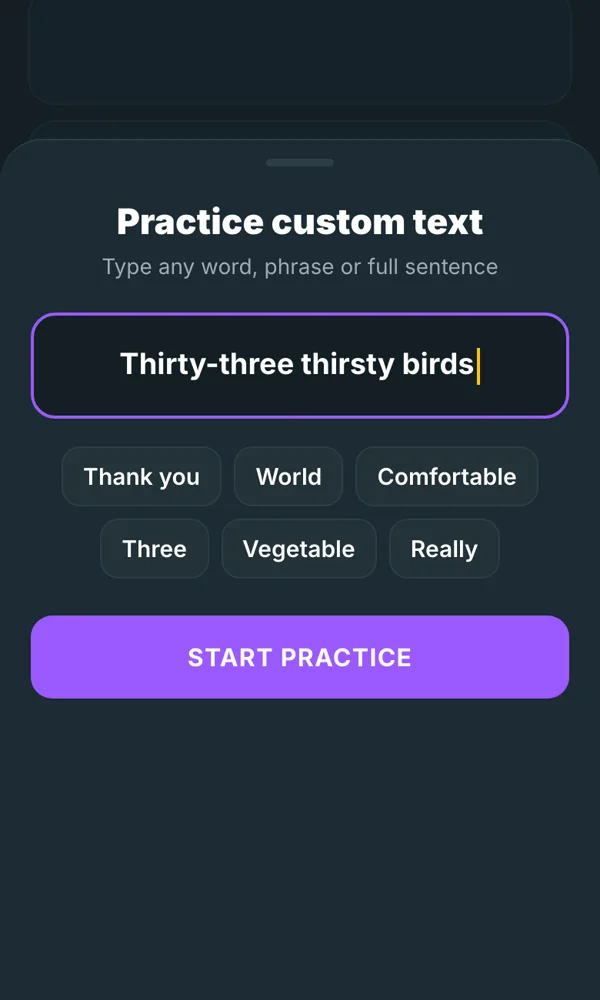
Practise any word or sentence
Type anything you want to say and get a score for every sound.
What an accent test measures
An accent is the sum of the sounds you substitute from your first language. The test listens to each sound in the five words, scores how close it is to a native model, and lists the ones that drift furthest. It is not a certificate and it does not grade grammar or vocabulary, only the sounds.
What gives an English accent away
Listeners decide you have an accent from a handful of sounds, not from your whole speech. The usual giveaways are the two th sounds ("think", "this") said as t, d, s, z or f; r and l swapped or merged; the short i of "ship" said as the long ee of "sheep"; v, w and b used interchangeably; and final consonants dropped or softened, so "world" ends without its d.
Rhythm and melody are part of an accent too: English squeezes unstressed syllables into a quick "uh" (the schwa) and stresses one syllable per word hard. This test does not grade sentence melody. It scores five words, each built around one of those sounds, because they are the substitutions listeners notice first and the ones you can fix one at a time.
What each of the five words reveals
"Think" checks the quiet th: if it comes back as t ("tink") or s ("sink"), this is often the most noticeable sound in your accent. "Really" makes you switch from r to l inside one word, which is where an r/l merge shows. "Ship" checks the short i; if it scores low, you are probably saying "sheep". "Very" checks a clean v made with the teeth on the lower lip, not a w or a b. "World" packs an r-coloured vowel and the ending "-rld" into one syllable, so it catches both a missing r and a dropped final d.
Read the result as a ranking. After the fifth word the test orders your words from weakest to strongest and names the sound behind the weakest one, which is where practice pays off fastest. A low score on one word does not mean your English is bad: it points at the sound that word was chosen to test.
The accent your first language brings
Your first language predicts your accent remarkably well, because it decides which English contrasts you never had to hear. Spanish and Portuguese speakers most often merge ship/sheep and b/v and add a vowel before "s" ("eschool"). Russian and Ukrainian speakers tend to replace th with s or z, use a rolled r, and merge the two i vowels. German speakers often say w as v ("wery") and devoice final consonants ("dok" for "dog"). French speakers drop the h and stress the last syllable.
Japanese and Korean speakers usually find r and l hardest, and add a vowel after final consonants; Korean speakers also merge f/p and v/b. Chinese and Vietnamese speakers most often drop or blur final consonants and replace th with s or f. Arabic speakers commonly merge p with b and v with f. Speakers of Hindi, Urdu and other South Asian languages often merge v and w and use a tapped r. The test page in your own language explains the results in your language.
Prueba de acento en inglés →Тест на акцент в английском →英語なまりテスト →영어 억양 테스트 →Kiểm tra giọng tiếng Anh →英文口音測試 →Englisch-Akzenttest →Test d'accent en anglais →
American or British: which accent is the test checking?
The reference is standard American English, but the five words were chosen so that the sounds being scored are the same in General American and standard British English. The test does not tell you which accent you have, and it does not score you down for sounding British, Australian or Indian. It scores how close each word comes to what an English listener expects to hear.
That is also the honest answer to "how strong is my accent": the ranking shows which of these sounds give your first language away, word by word. It is not a certificate or an exam grade, and it does not measure grammar, vocabulary or fluency.
How to reduce your accent after the test
Work on one sound at a time, starting with your lowest score. Learn where the tongue and lips go (each guide below has a mouth-position tip and audio), then practise the sound in minimal pairs: think/sink, light/right, ship/sheep, very/berry. Record yourself saying the pair and listen back, or let the checker score it, until both words sound different.
Then put the sound back into real words and sentences you actually use. Ten minutes a day on one sound beats an hour on everything at once. Take the test again after a week: if your weakest sound has moved up, move on to the next one.
How to pronounce th →R vs L →Ship vs sheep →Word stress and the schwa →Check any English sentence →
How it works
- 1
Record 5 words
Tap the microphone and read each word out loud. It takes about a minute, right in your browser.
- 2
AI checks every sound
Our speech engine listens to each sound inside each word — not just the word as a whole — and scores it.
- 3
See what to fix
You get a clear picture of which sounds are strong and which need work, with a tip for how to make each one. Then keep practicing in the app.
TonePerfect's English scoring runs on our own speech engine, and we validated it against human experts: a public research dataset of 2,500 recordings from 250 English learners, each rated by five human pronunciation raters. The engine's sound-by-sound judgments closely agree with those human ratings.
The sounds that decide your accent
The quiet 'th' (think)
The tongue tip touches the bottom edge of the top teeth and the air flows over it; no voice, and the tongue never taps.
The buzzing 'th' (this)
The same tongue-behind-the-teeth position as in 'think', with the voice buzzing through it.
The English 'r' (red)
The tongue curls back or bunches up in the middle of the mouth and touches nothing at all, while the lips round a little.
The 'l' sound (love)
The tongue tip touches the ridge behind the top teeth and the voice flows around the sides of the tongue.
The short vowel in 'sit'
Short and loose: the tongue sits a little lower than in 'see' and the whole mouth stays relaxed.
The long vowel in 'see'
Long and tight: the tongue is high and forward and the lips spread as if smiling.
Scores rank your own sounds against each other so you know what to drill first. They are not an accuracy certificate and not an exam grade.
Questions
How does the test work?+
You record 5 common English words, one at a time. Each word targets a sound that many learners find hard — th, r and l, the two "i" vowels, v, and word endings. The AI scores every sound in every word and ranks your weakest sounds first.
What do the scores mean?+
Each sound gets its own score from 0 to 100. 85 and above is a sound listeners will not notice; 70–84 is understood but audibly non-native; below 70 is a sound that is probably being heard as a different sound. A low score on one sound does not mean your English is bad — it shows you where practice will pay off fastest.
Is this a British or American English test?+
The reference is standard American English, but the five test words are chosen so that the sounds being scored — th, r, l, the two "i" vowels, v, final clusters — are the same in General American and standard British English. The engine scores whether each sound is the expected English sound; it does not grade which accent you have.
Is it free? Do I need an account?+
The test is free and needs no account: open the page, allow the microphone, record. The TonePerfect app, which has a lesson and practice words for every English sound and tracks your progress, is free to start as well.
How accurate is an AI pronunciation test?+
Accurate enough to trust for the question it answers — which sounds are off. The engine was checked against a public research set of 2,500 recordings by 250 English learners, each rated by five human pronunciation experts, and its sound-by-sound judgments closely track those human ratings. A noisy room or a very quiet microphone will lower a single take, so record again in a quiet place if a result surprises you.
Can I test a whole sentence, or my own text?+
Yes. The practice page scores any English text you paste — a line from a presentation, an email you have to read aloud, a song — the same way, sound by sound.
Do I need special equipment?+
No. Any phone or computer with a microphone works. Your browser will ask for permission to record. A quiet room helps the AI hear you clearly.
What happens after the test?+
You see your results right away, sound by sound. To improve the weak ones, continue in the TonePerfect app: it has a lesson and practice words for every English sound, and tracks your progress as you go.
Practice English every day
The app drills the sounds this test flags, with thousands of words and instant feedback on every take.
Test your pronunciation
Free, with a score for every sound.