TonePerfect for English·English
English pronunciation checker: find out what’s holding you back
Record 5 short words. Our AI listens to every single sound you make and shows you which ones need work — th, r, l, vowels, word endings and more.
Get the mobile app
Scan with your phone to install
Record 5 words. Free, no signup — your browser does the recording, our engine does the listening.
think
Touch the bottom edge of your top teeth with your tongue tip and let the air flow over it. No voice, and the tongue never taps.
to use your mind
Tap to record
Free English pronunciation test·Free English accent test·Check any English text·Practice any English text
Everything you need to actually sound right
Short daily practice built around the sounds you personally get wrong.
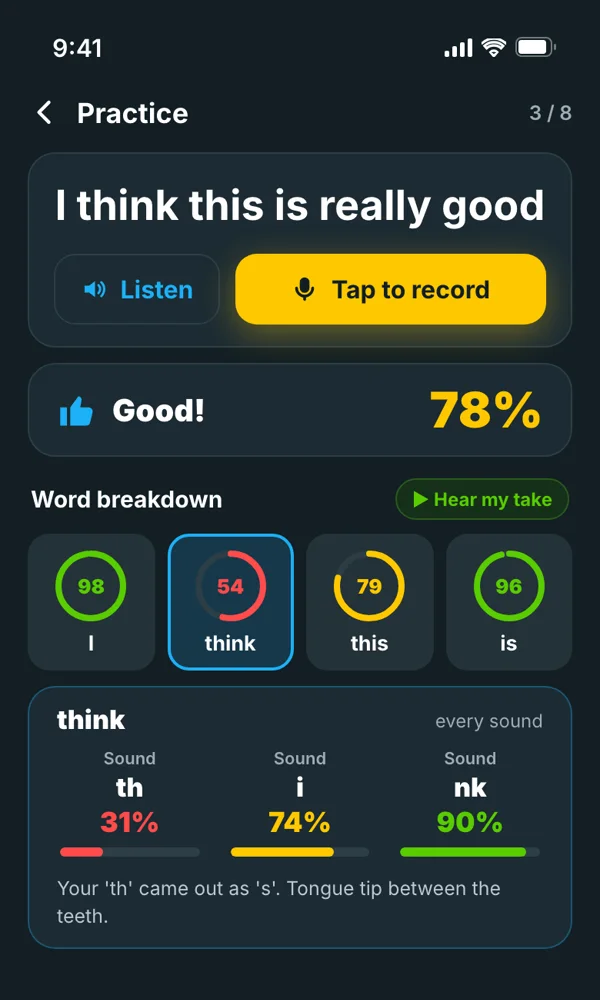
See every sound you get wrong
Each word is scored sound by sound, grouped by syllable, so you know exactly what to fix.
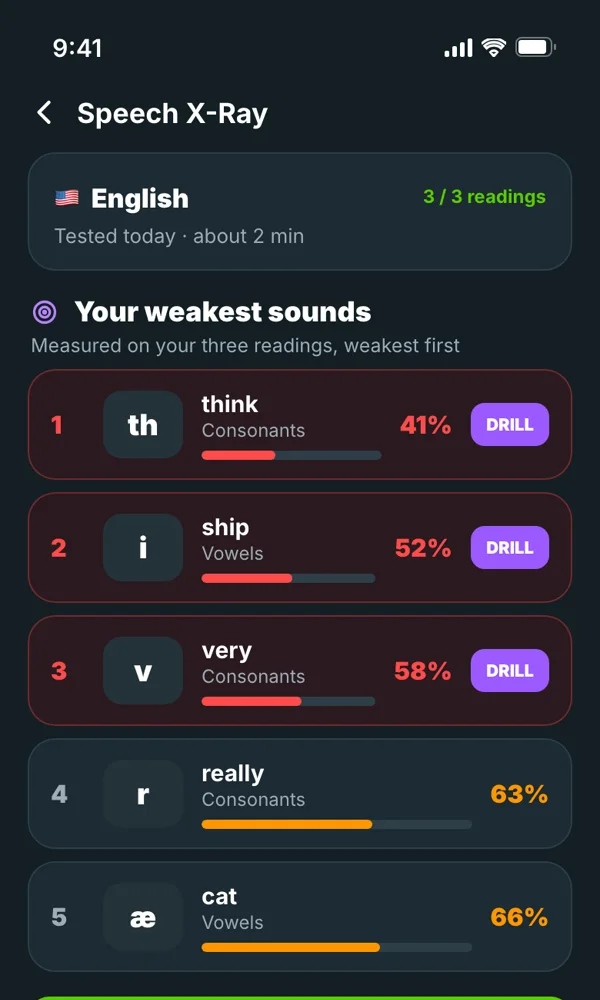
Find your weakest sounds in 2 minutes
A Speech X-Ray of three short readings ranks the sounds to fix first.
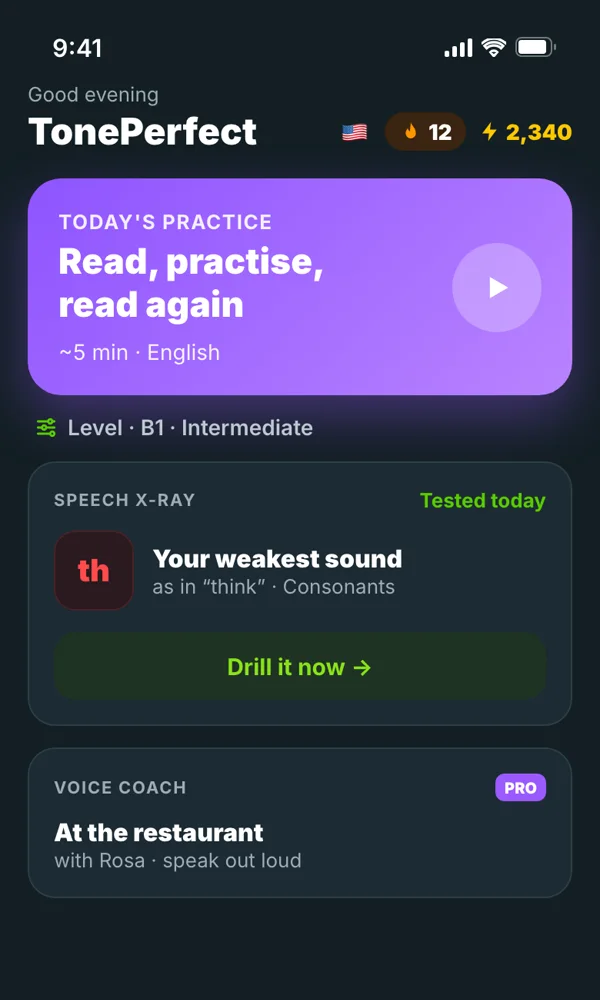
Five minutes a day
A short daily session built on the sounds you need most.
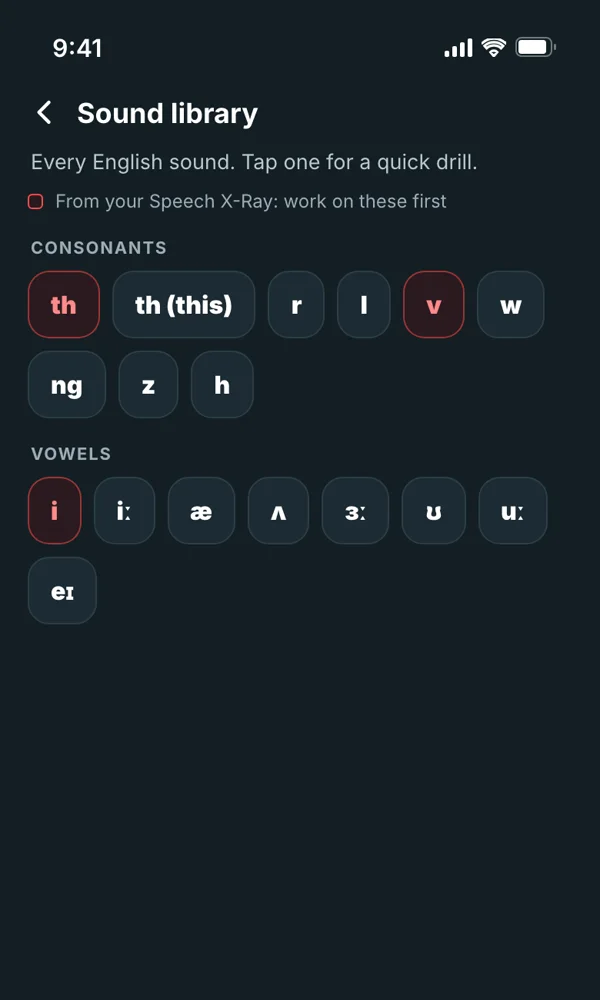
Drill any sound
A sound library for the whole language, with a one-tap drill for each sound.
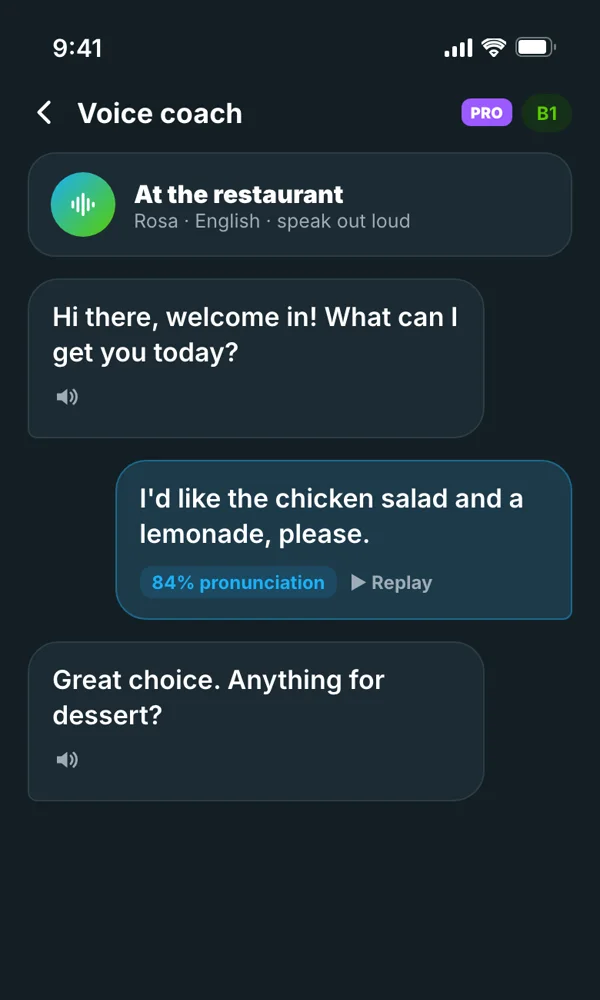
Speak in real situations
Role-play everyday situations out loud with an AI voice coach (Pro).
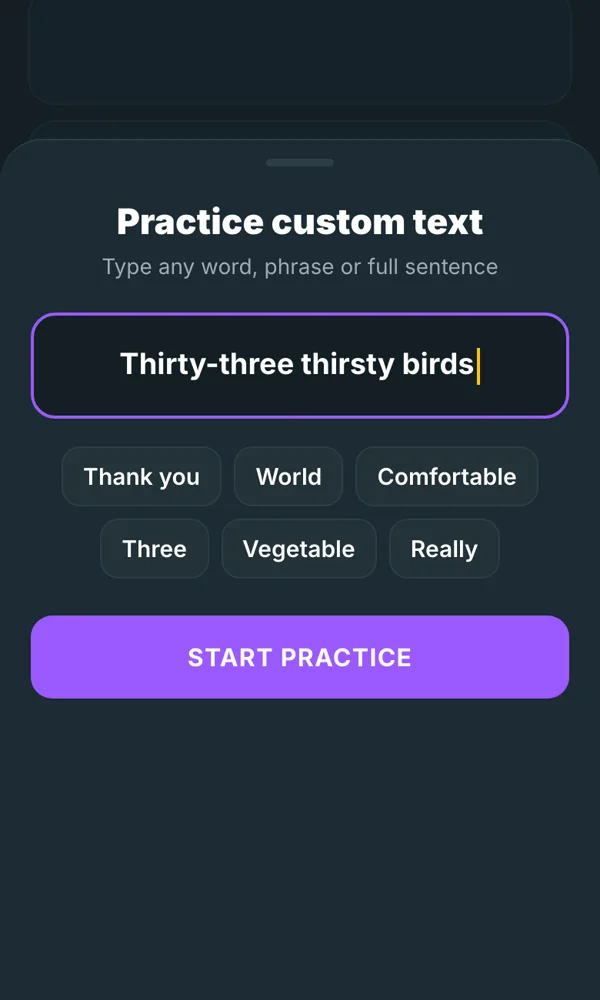
Practise any word or sentence
Type anything you want to say and get a score for every sound.
How it works
- 1
Record 5 words
Tap the microphone and read each word out loud. It takes about a minute, right in your browser.
- 2
AI checks every sound
Our speech engine listens to each sound inside each word — not just the word as a whole — and scores it.
- 3
See what to fix
You get a clear picture of which sounds are strong and which need work, with a tip for how to make each one. Then keep practicing in the app.
TonePerfect's English scoring runs on our own speech engine, and we validated it against human experts: a public research dataset of 2,500 recordings from 250 English learners, each rated by five human pronunciation raters. The engine's sound-by-sound judgments closely agree with those human ratings.
The sounds that decide your accent
Sound chart →The quiet 'th' (think)
Spelled th
The tongue tip touches the bottom edge of the top teeth and the air flows over it; no voice, and the tongue never taps.
Common slip: Many learners replace it with s, t, or f; keep the tongue tip lightly touching the bottom edge of your top teeth and let the air flow over it.
Heard in
The buzzing 'th' (this)
Spelled th · th in the, this, that, they · th between vowels (mother, other)
The same tongue-behind-the-teeth position as in 'think', with the voice buzzing through it.
Common slip: Many learners say z, d, or v instead; use the same tongue-behind-the-teeth position as in think, but let your voice buzz through it.
Heard in
The English 'r' (red)
Spelled r · rr · wr (write, wrong) · rh (rhythm)
The tongue curls back or bunches up in the middle of the mouth and touches nothing at all, while the lips round a little.
Common slip: Many learners tap or trill the tongue; instead curl it back or bunch it in the middle of your mouth so it touches nothing, with lips slightly rounded.
Heard in
The 'l' sound (love)
Spelled l · ll · le at the end (little, table)
The tongue tip touches the ridge behind the top teeth and the voice flows around the sides of the tongue.
Common slip: Many learners blend l with r; press your tongue tip firmly on the ridge behind your top teeth and let the voice escape around the sides.
Heard in
The short vowel in 'sit'
Spelled i (sit, big) · y (gym, system) · e (English, pretty) · ui (build, guilt)
Short and loose: the tongue sits a little lower than in 'see' and the whole mouth stays relaxed.
Common slip: Many learners stretch it into the long vowel of see; keep it short and loose, with the tongue a little lower and the mouth relaxed.
Heard in
The long vowel in 'see'
Spelled ee · ea · e_e (these, complete) · ie (piece, field) · y at the end (happy, city) · i (machine, ski)
Long and tight: the tongue is high and forward and the lips spread as if smiling.
Common slip: Many learners cut it short toward sit; hold it longer, push the tongue high and forward, and spread your lips as if you were smiling.
Heard in
The vowel in 'cat'
Spelled a in closed syllables (cat, hand, map) · a before a double consonant (happy, rabbit)
The jaw drops low while the tongue stays forward; it is the widest, flattest of the front vowels.
Common slip: Many learners use the vowel of bed instead; drop your jaw low while keeping the tongue forward, so the mouth is wide and flat.
Heard in
The 'w' sound (we)
Spelled w · wh (what, when) · u after q (queen, quick) · o (one, once)
Round the lips into a small circle, then slide straight into the vowel; the lips move, the teeth stay away from the lip.
Common slip: Many learners let the top teeth touch the lower lip, turning we into a v; round your lips into a small circle and slide straight into the vowel.
Heard in
The 'v' sound (van)
Spelled v · ve at the end (give, love) · f in of
Top teeth on the lower lip as in 'fun', but the voice buzzes through the gap and the sound can be held.
Common slip: Many learners replace it with w or f; rest your top teeth on your lower lip and let the voice buzz through the gap so you can hold the sound.
Heard in
The quiet vowel in 'about' (schwa)
Spelled a, e, i, o, u in unstressed syllables · a (about, sofa) · e (problem, taken) · o (today, lesson) · u (support, album) · ou (famous, nervous)
The smallest, quietest vowel in English: the mouth barely moves and the tongue simply rests in the middle.
Common slip: Many learners give the unstressed syllable its full spelling vowel; instead let the mouth barely move and the tongue rest in the middle, short and quiet.
Heard in
The 'er' vowel (bird, better)
Spelled er · ir · ur · or unstressed (doctor, color) · ear (learn, earth) · ar unstressed (dollar, sugar)
The tongue bunches or curls back in the middle of the mouth without touching anything, and the r quality runs through the whole vowel.
Common slip: Many learners either drop the r or trill it; in American English, bunch or curl the tongue and keep that r quality running through the whole vowel.
Heard in
The 'ng' sound (sing)
Spelled ng · n before k (think, bank) · n before g (finger, English)
The back of the tongue rests on the roof of the mouth and the voice goes out through the nose; nothing is released at the end.
Common slip: Many learners add a hard g or finish on an n; rest the back of your tongue on the roof of your mouth and release nothing at the end.
Heard in
What usually goes wrong
The two 'th' sounds
English has a quiet 'th' (think) and a buzzing 'th' (this). Very few languages have either one. Both use the same position — tongue tip against the top teeth, air flowing over it — and the tongue never taps. The only difference: in 'this' the voice buzzes, in 'think' it does not.
Vowel pairs your language may merge
English has more vowels than most languages, so pairs like 'ship'/'sheep', 'cat'/'bed' and 'cup'/'cat' can collapse into one sound. The fix is usually not the tongue — it is how open, how long and how relaxed the vowel is. 'See' is long and tight with spread lips; 'sit' is short and loose.
Word stress and the schwa
In English, one syllable in a word is strong and the rest often shrink to the schwa — the quiet vowel in 'about', where the mouth barely moves. If you give every syllable full weight, words sound careful but foreign. Learning to relax the weak syllables matters as much as any single sound.
Final consonants and clusters
Many languages rarely end words with consonants, but English does it constantly — and stacks them: 'world' ends in rld, 'friend' in nd. Dropped endings change meaning, so it pays to say every final sound, even quietly. In 'sing', the 'ng' ends with nothing released at all.
Spelling is not sound
English spelling is a poor guide to pronunciation. The same letters can be different sounds ('read' now vs 'read' yesterday), and different letters the same sound. That is why TonePerfect scores what you actually say, sound by sound, instead of asking you to trust the spelling.
Everything the English course gives you
English drilled where it actually breaks: the two th sounds, the vowel pairs your language merges, and the consonant clusters it stacks at the ends of words.
41 English phonemes
Every one of English's 41 phonemes is scored on its own, and the scoring is validated against human expert ratings on the speechocean762 corpus.
The two th sounds
The quiet th of think and the buzzing th of this share one tongue position and differ only by voice. Few languages have either; both get their own drills.
4,163 real words
4,163 English words from everyday use, including the final clusters most languages never stack — the rld of world, the nd of friend.
Spaced review
Words return on a schedule your scores set. The short vowel of sit comes back sooner than the ng of sing once that one is holding.
Weakest first
Daily practice is ordered by your own lowest sounds. If that is the r, the schwa, or the vowel in cat, that is what you get.
Five words, free
Say think, really, ship, very and world in your browser. Five words is enough to rank which English sounds need the work first.
Practice anywhere, anytime
Available on every major platform. Your progress syncs seamlessly across all devices.
iOS App
Native iPhone and iPad experience.
Android App
Full-featured Android experience.
Web App
Practice instantly in your browser. No download needed.
Telegram Bot
Quick practice sessions right inside Telegram.
Simple, transparent pricing
Start free and upgrade when you're ready. No surprises.
Free
$0 forever
- At least one free guided practice session each day
- Daily workout
- Placement test
- Progress tracking
Premium
Most PopularCard prices above are for web checkout. App Store and Google Play prices may differ; your exact price and trial are shown before purchase.
- Unlimited assessments
- Spaced repetition reviews
- Custom text practice
- Advanced analytics
Questions
Is the pronunciation test free?+
Yes. The test on this page is free and runs in your browser. The TonePerfect app is also free to try; a premium plan unlocks the full practice experience.
How accurate is the AI scoring?+
We validated the English engine against human experts. On a public research dataset — 2,500 recordings from 250 English learners, each scored by five human raters — the engine's per-sound judgments matched the human ratings with an accuracy (AUC) of 0.906, where 1.0 would be perfect agreement. In short: when it flags a sound, human experts usually flag it too.
Will it make me sound American or British?+
That is not the goal. TonePerfect checks whether each sound is clear, and does not grade your accent or push you toward one identity. The feedback is based on a standard American reference, but the aim is speech people understand easily — you choose your own accent goal.
Does TonePerfect work for other languages?+
Yes. TonePerfect started with Mandarin Chinese tones and now covers 8 languages, including Spanish, French, German, Russian, Japanese and Korean — all with the same sound-by-sound feedback approach.
Do I need to install the app?+
Not for the test — it runs in your browser. For daily practice you will want the app (iOS and Android): it has full lessons for every English sound, listening drills, and progress tracking, and it also works on the web.
How is TonePerfect different from ELSA Speak or other pronunciation apps?+
We will not make claims about other apps. What TonePerfect does: it scores every individual sound in every word, tells you how to physically make each sound, and its English scoring is validated against human expert ratings. It is also one platform for 8 languages, so the same approach works if you ever learn Chinese, Spanish or Japanese too.
Practice English every day
The app drills the sounds this test flags, with thousands of words and instant feedback on every take.
Learning Chinese? That's where TonePerfect started — see the full Mandarin course. Chinese pronunciation
Test your pronunciation
Free, with a score for every sound.