TonePerfect for German
Free German accent test
Record 5 words. Free, no signup — your browser does the recording, our engine does the listening.
nicht
For the soft ch, say a long 'y' as in 'yes' but push more air and switch the voice off — the air hisses gently over the middle of the tongue.
not
Tap to record
Free German pronunciation test →·Check any German text →·Practice any German text →
How strong is your accent in German? Record five words and get a per-sound score in under a minute. The test is the same engine the app uses; it ranks your sounds against each other so you know what to fix first.
Get the mobile app
Scan with your phone to install
Everything you need to actually sound right
Short daily practice built around the sounds you personally get wrong.
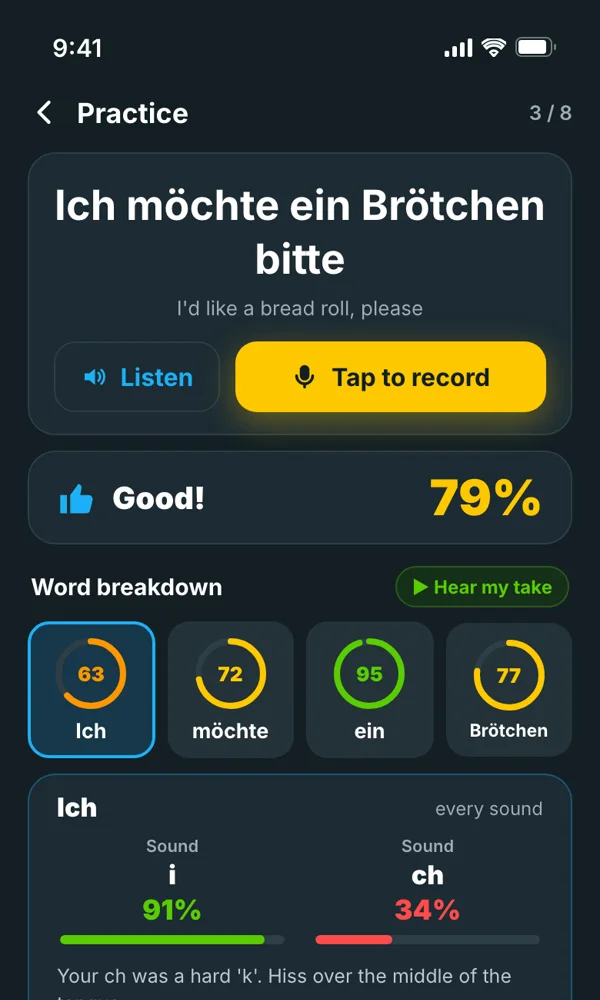
See every sound you get wrong
Each word is scored sound by sound, grouped by syllable, so you know exactly what to fix.
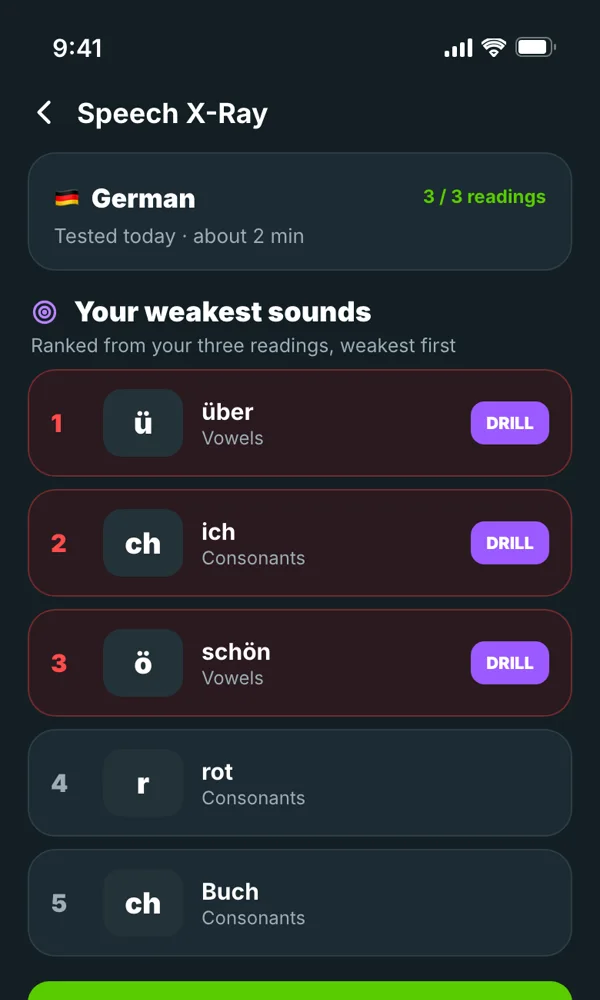
Find your weakest sounds in 2 minutes
A Speech X-Ray of three short readings ranks the sounds to fix first.
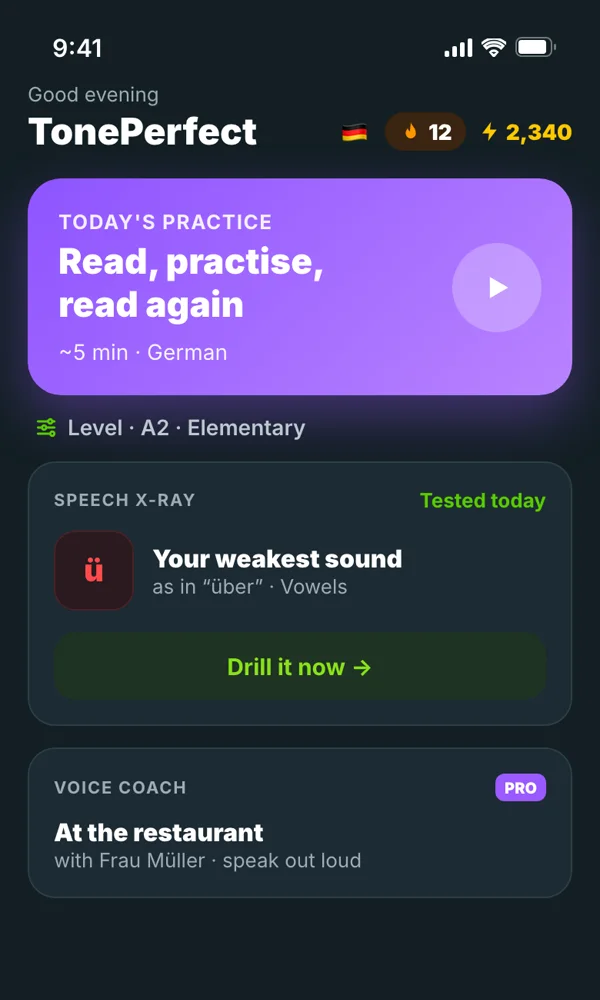
Five minutes a day
A short daily session built on the sounds you need most.
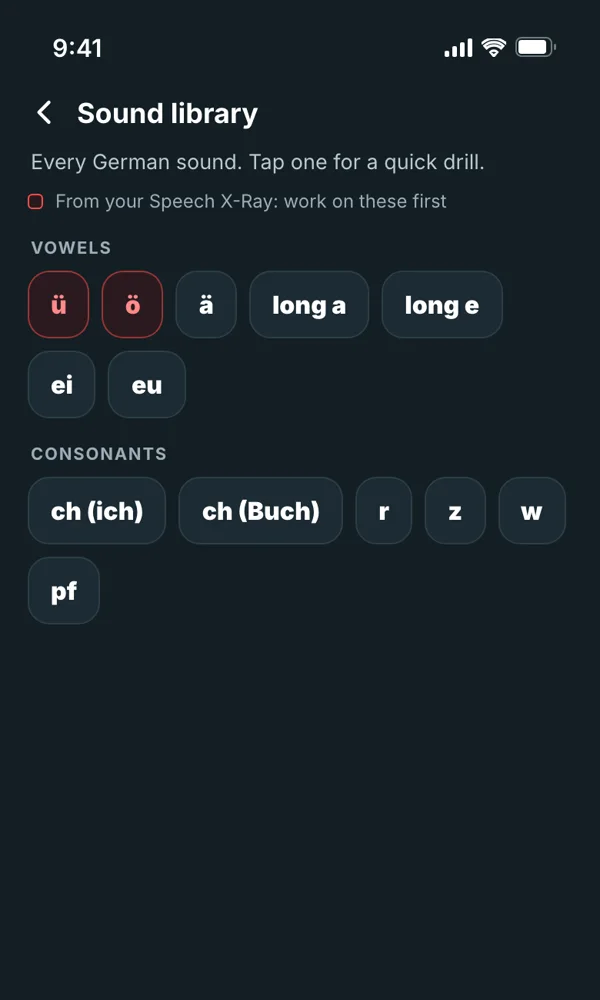
Drill any sound
A sound library for the whole language, with a one-tap drill for each sound.
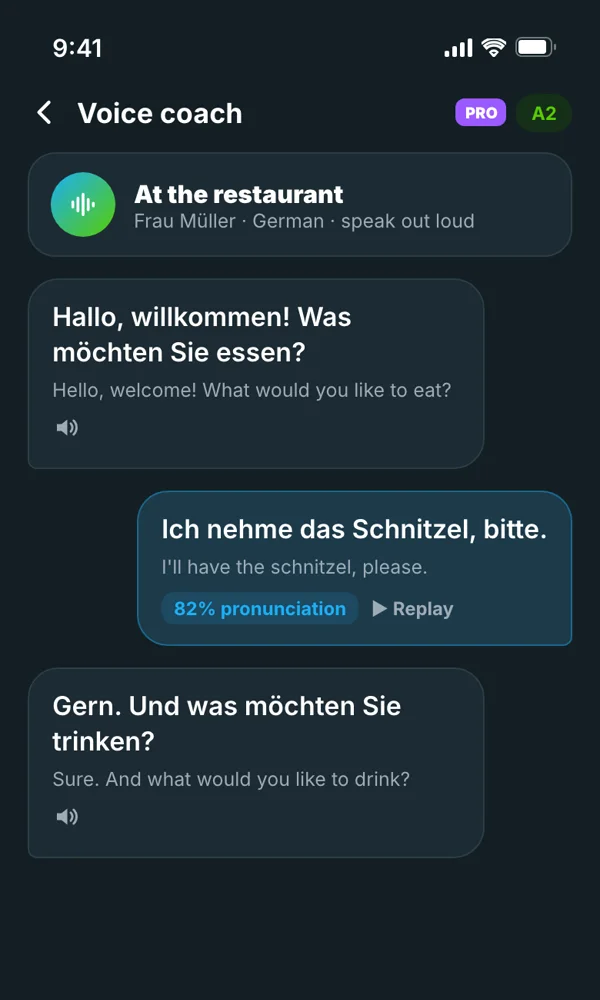
Speak in real situations
Role-play everyday situations out loud with an AI voice coach (Pro).
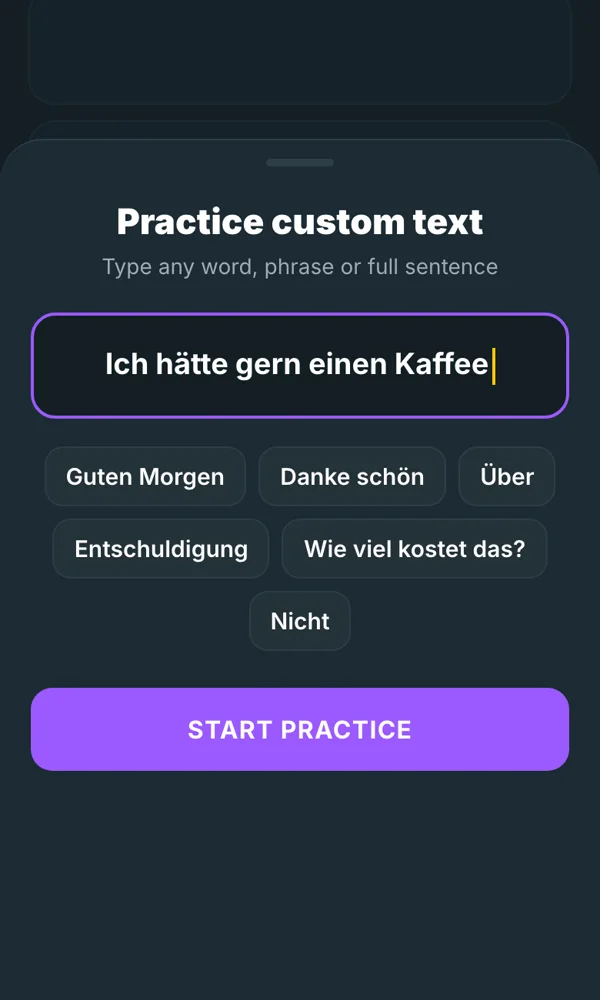
Practise any word or sentence
Type anything you want to say and get a score for every sound.
What an accent test measures
An accent is the sum of the sounds you substitute from your first language. The test listens to each sound in the five words, scores how close it is to a native model, and lists the ones that drift furthest. It is not a certificate and it does not grade grammar or vocabulary, only the sounds.
How it works
- 1
Record
Say five German words into your mic, right in the browser. No signup needed to try it.
- 2
Get scored
A speech-assessment engine scores each word and each sound in it against its reference model of standard German, in seconds.
- 3
Drill what scores lowest
Your results rank your sounds from strongest to weakest. Open the app to drill the weak ones with hand-written tips and hundreds of scored words per sound.
How the scores work: every sound in the word is scored out of 100, and you see all of them. The numbers are built for comparison — which of your sounds score lowest, and whether one climbs when you re-record it. They are built for comparison, so read a 72 as “weaker than your 91” rather than as a certified accuracy figure.
The sounds that decide your accent
The long ü (über)
Say the long 'ie' of 'Liebe' and, keeping the tongue exactly there, round the lips into a tight circle as for whistling: über, früh, Bücher.
The short ü (fünf)
Say the short 'i' of 'bitte' and round the lips while the tongue stays forward: fünf, müssen, Glück. Shorter and looser than the ü in 'über'.
The long ö (schön)
Say the long 'e' of 'gehen' and keep the tongue there while rounding the lips forward. Hold it long and steady: schön, hören.
The short ö (möchte)
Say the short 'e' of 'Bett' and, without moving the tongue, round the lips into a small circle. The lip rounding is what makes it ö.
The soft ch (nicht)
Say a long 'y' as in English 'yes' but push more air and switch the voice off: the middle of the tongue rises high near the front and the air hisses gently over it. Comes after e, i, ä, ö, ü and in the -ig ending.
The hard ch (Buch)
The back of the tongue rises toward the roof of the mouth — the 'k' place — but instead of blocking the air it lets it scrape through. Comes only after a, o, u, au.
Scores rank your own sounds against each other so you know what to drill first. They are not an accuracy certificate and not an exam grade.
Questions
How does the test work?+
You record five words in your browser. Each recording is scored by a speech-assessment engine, word by word and sound by sound, against its reference model of standard German. You see your results immediately.
What do my scores mean?+
Every sound in the word gets its own score out of 100, and all of them are shown. The useful reading is relative: which of your sounds score lowest, and whether a sound improves when you re-record it. Those numbers are built for comparison: they compare — they don’t certify.
Do I need an account or the app?+
No. The test runs free in the browser with no signup. To keep practicing after the test — full word library, per-sound drills, progress over time — you continue in the free TonePerfect app.
What do I need for it to work?+
A microphone and a quiet room. Allow mic access when the browser asks, speak at normal volume about a hand's width from the mic, and say only the word shown.
Practice German every day
The app drills the sounds this test flags, with thousands of words and instant feedback on every take.
Test your pronunciation
Free, with a score for every sound.