TonePerfect for Spanish
Free Spanish accent test
Record 5 words. Free, no signup — your browser does the recording, our engine does the listening.
perro
Flick the tongue tip against the ridge behind your upper teeth. For written rr, aim for a longer roll.
dog
Tap to record
Free Spanish pronunciation test →·Check any Spanish text →·Practice any Spanish text →
How strong is your accent in Spanish? Record five words and get a per-sound score in under a minute. The test is the same engine the app uses; it ranks your sounds against each other so you know what to fix first.
Get the mobile app
Scan with your phone to install
Everything you need to actually sound right
Short daily practice built around the sounds you personally get wrong.
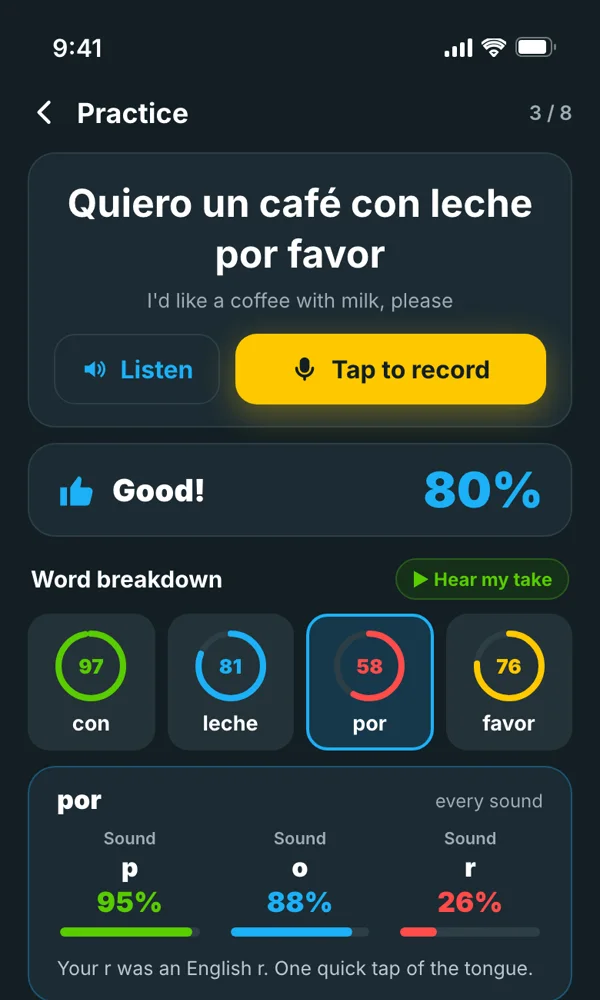
See every sound you get wrong
Each word is scored sound by sound, grouped by syllable, so you know exactly what to fix.
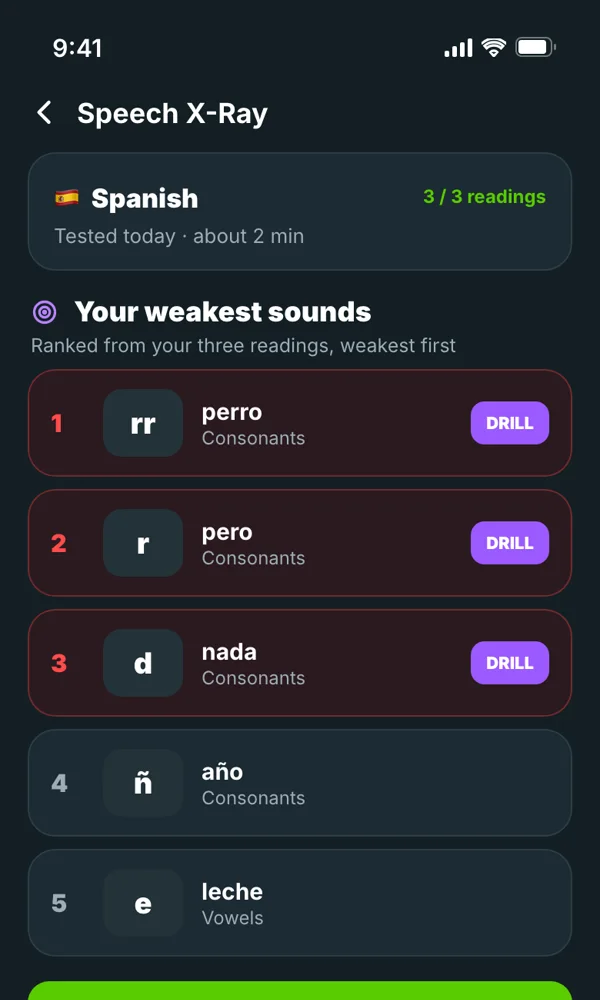
Find your weakest sounds in 2 minutes
A Speech X-Ray of three short readings ranks the sounds to fix first.
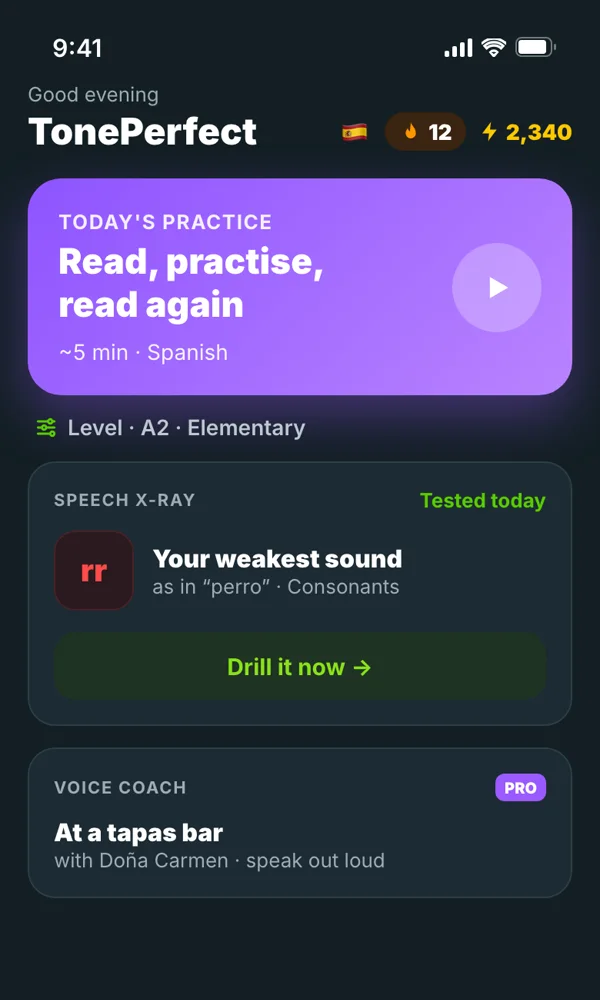
Five minutes a day
A short daily session built on the sounds you need most.
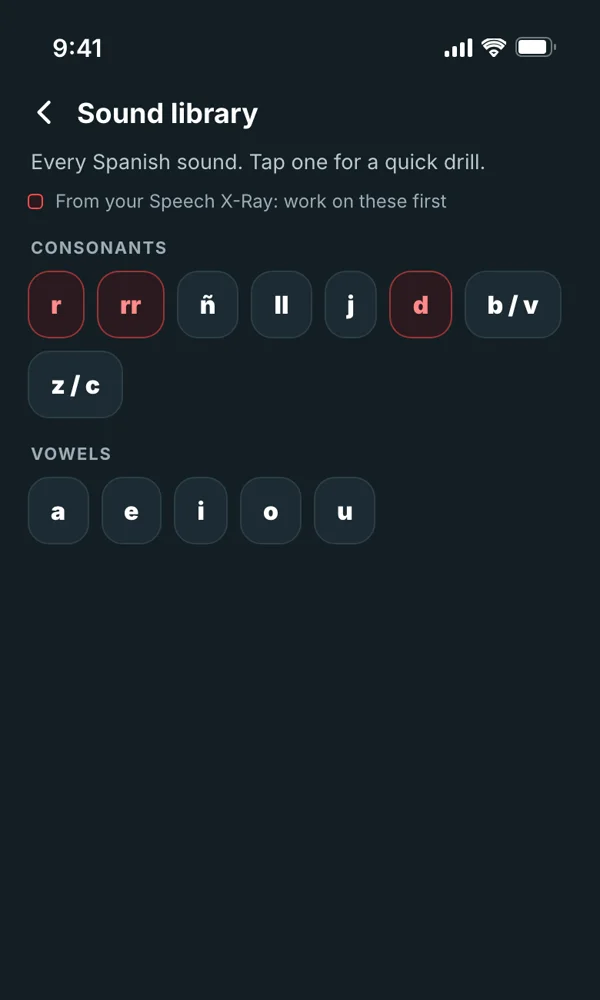
Drill any sound
A sound library for the whole language, with a one-tap drill for each sound.
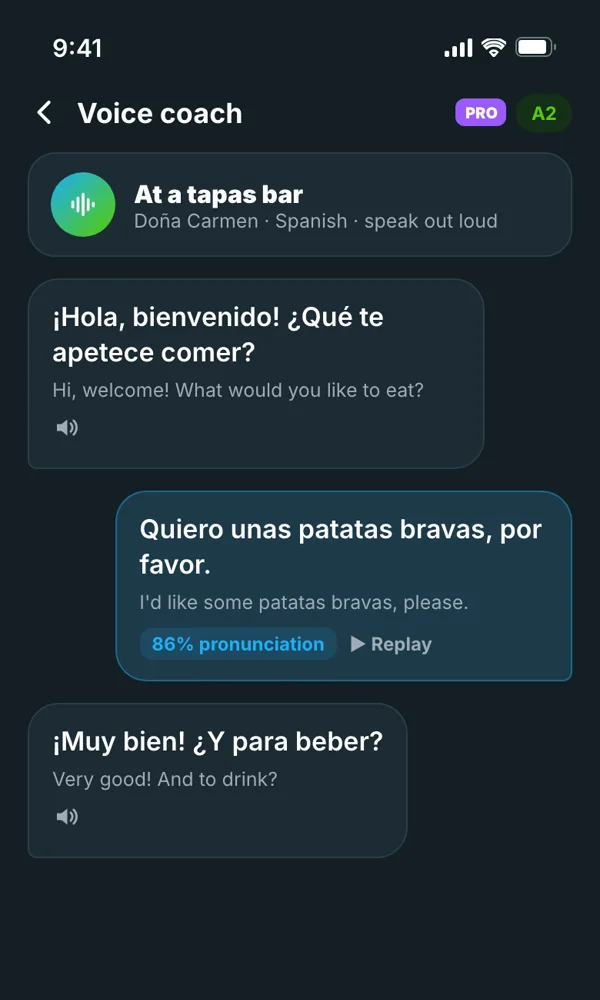
Speak in real situations
Role-play everyday situations out loud with an AI voice coach (Pro).
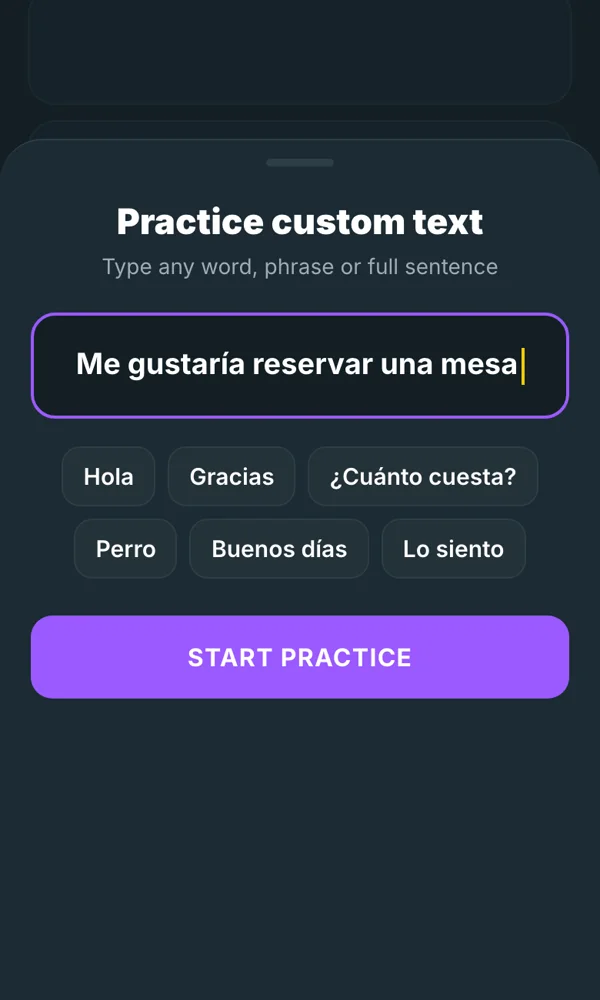
Practise any word or sentence
Type anything you want to say and get a score for every sound.
What an accent test measures
An accent is the sum of the sounds you substitute from your first language. The test listens to each sound in the five words, scores how close it is to a native model, and lists the ones that drift furthest. It is not a certificate and it does not grade grammar or vocabulary, only the sounds.
How it works
- 1
Record
Tap the mic and say the word. Your browser records a short clip — that's all it takes.
- 2
Get scored
A speech-assessment engine scores your recording word by word and sound by sound, in seconds.
- 3
Drill what's weakest
Your sounds come back ranked weakest-first. Pick the lowest one, read the articulation tip, record again. In the app, this loop runs across a full Spanish course.
How the scores work: every sound in the word is scored out of 100, you see all of them, and they are ranked weakest to strongest so you know what to drill next. What we won’t do is pretend to know which sound you said instead of the target — the engine returns scores, not a transcript.
The sounds that decide your accent
The tapped r (pero)
Flick the tongue tip once against the ridge behind the upper teeth — it is exactly the American 't' in 'water'. For written rr aim for a longer roll; the engine scores both here.
The r in clusters (tres)
The same quick tongue-tap when r sits next to another consonant or closes a syllable: tres, puerta, hablar. Keep it short — never the English curled-back r.
The ñ sound (niño)
Press the middle of the tongue against the roof of the mouth and say 'n' and 'y' at the same moment — like the 'ny' of 'canyon' fused into one sound.
The Spanish j sound (rojo)
A rough 'h' made by raising the back of the tongue until the air scrapes — stronger than English h; spelled j, or g before e/i.
The ll sound (calle)
An 'l' and a 'y' pressed into one sound with the middle of the tongue on the roof of the mouth. Most speakers today just say 'y' here (yeísmo) — that is accepted too.
The y sound (yo)
Like the 'y' in 'yes' but with a little friction — almost a gentle 'j' of 'jeep'; spelled y, or ll for most speakers.
Scores rank your own sounds against each other so you know what to drill first. They are not an accuracy certificate and not an exam grade.
Questions
How does the test work?+
You record five words — perro, año, rojo, calle, hola. A speech-assessment engine scores each word sound by sound, and the page shows you which of your sounds scored lowest, with an articulation tip for each one.
What do my scores mean?+
Treat them as a comparison, not a grade. Every sound in the word gets its own score out of 100 and you see all of them; the reliable signal is which of your sounds score lower than your others — that's your drill list. What we don't do is turn one into a pass/fail mark.
Should I use a Spain accent or a Latin American one?+
Either. The engine accepts both major variants: c/z as the Castilian 'th' or as 's' (Latin America), and ll as 'y' (yeísmo). Use the accent you're learning — the test doesn't take sides.
What happens after the test?+
You see your weakest sounds and a tip for each. If you want to keep going, the app picks up from there: 3,000+ Spanish words scored the same way, with practice built around drilling whatever scores lowest for you.
Practice Spanish every day
The app drills the sounds this test flags, with thousands of words and instant feedback on every take.
Test your pronunciation
Free, with a score for every sound.