TonePerfect for Japanese
Free Japanese accent test
Record 5 words. Free, no signup — your browser does the recording, our engine does the listening.
ひとり
For り, tap the tongue once, quickly, against the ridge behind the upper teeth — between an English l and r, close to the quick d in American "water".
one person; alone
Tap to record
Free Japanese pronunciation test →·Check any Japanese text →·Practice any Japanese text →
How strong is your accent in Japanese? Record five words and get a per-sound score in under a minute. The test is the same engine the app uses; it ranks your sounds against each other so you know what to fix first.
Get the mobile app
Scan with your phone to install
Everything you need to actually sound right
Short daily practice built around the sounds you personally get wrong.
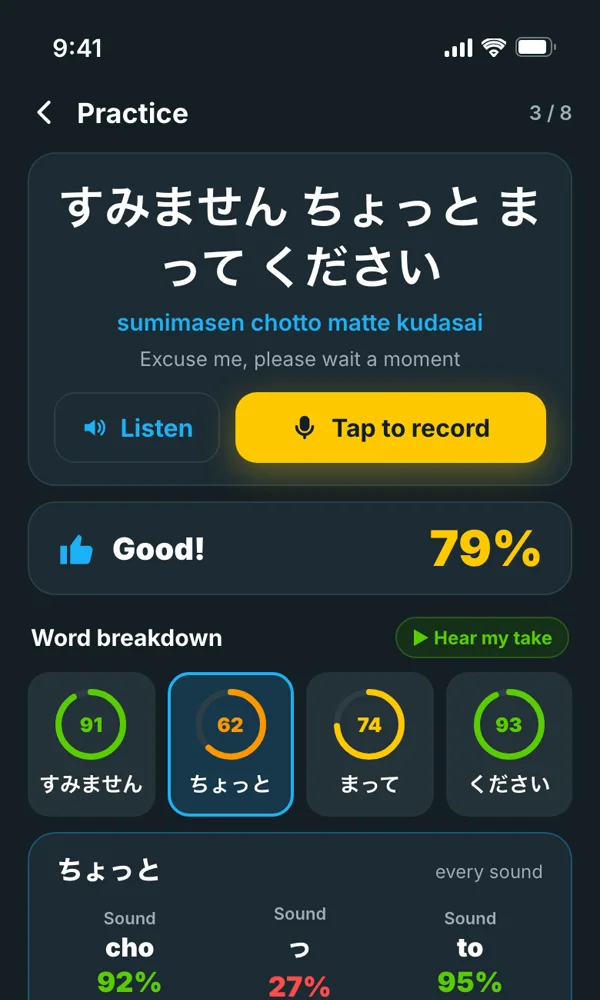
See every sound you get wrong
Each word is scored sound by sound, grouped by syllable, so you know exactly what to fix.
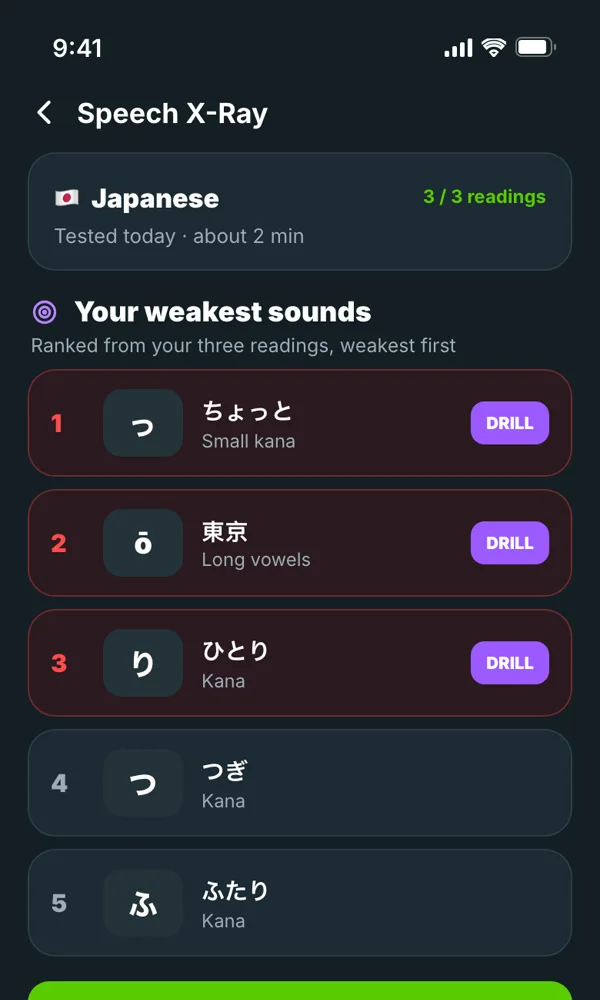
Find your weakest sounds in 2 minutes
A Speech X-Ray of three short readings ranks the sounds to fix first.
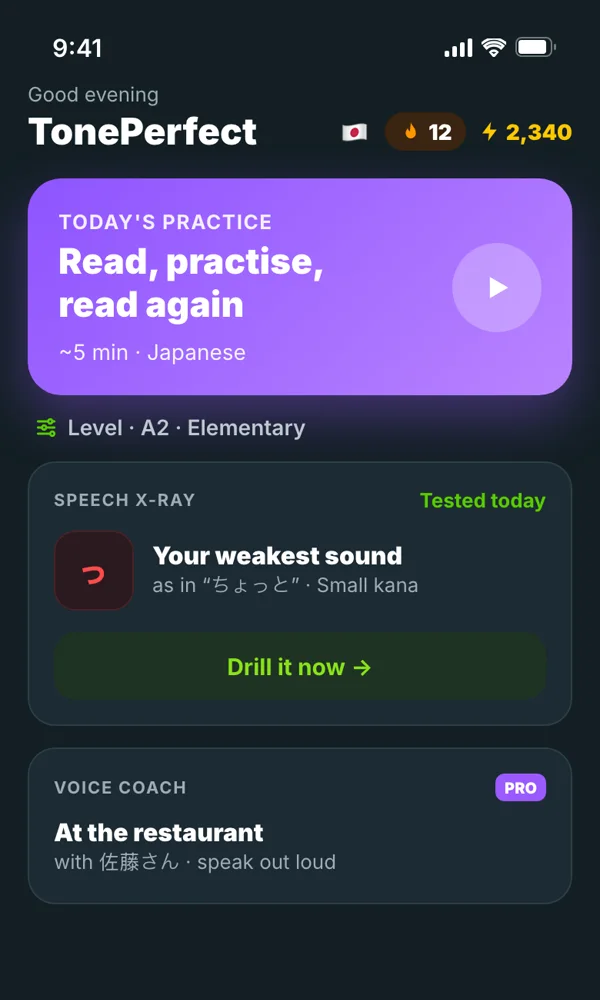
Five minutes a day
A short daily session built on the sounds you need most.
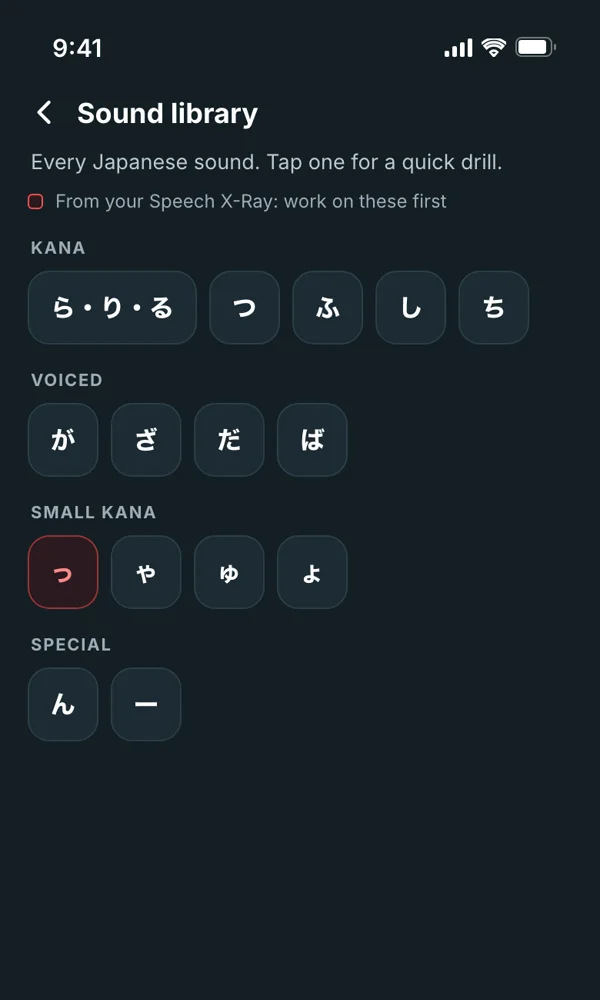
Drill any sound
A sound library for the whole language, with a one-tap drill for each sound.
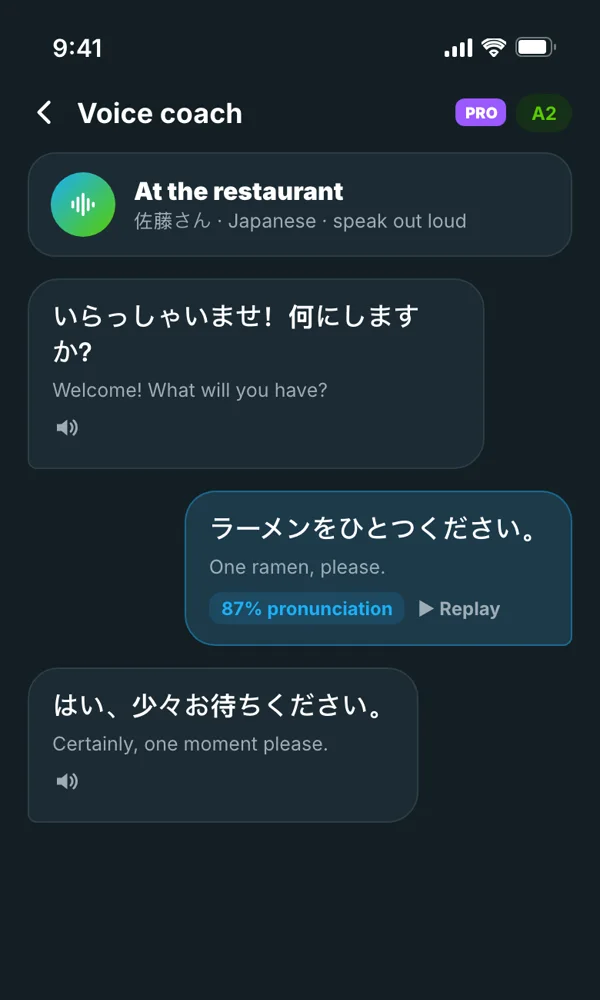
Speak in real situations
Role-play everyday situations out loud with an AI voice coach (Pro).
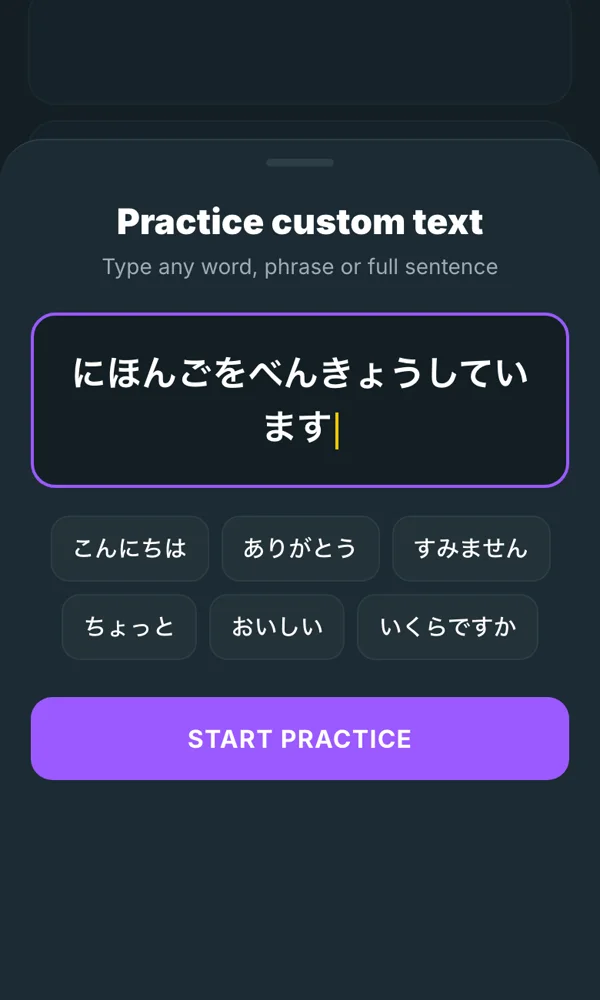
Practise any word or sentence
Type anything you want to say and get a score for every sound.
What an accent test measures
An accent is the sum of the sounds you substitute from your first language. The test listens to each sound in the five words, scores how close it is to a native model, and lists the ones that drift furthest. It is not a certificate and it does not grade grammar or vocabulary, only the sounds.
What makes a Japanese accent
Japanese has few sounds that are hard on their own; the accent comes from timing and from a handful of substitutions. Every mora takes about the same time, so a long vowel or a small っ is a full extra beat: おばさん (aunt) and おばあさん (grandmother) differ only in length, and so do きて and きって. Learners from stress-timed languages shorten the long beats and drop the held ones. The Japanese r is a quick flap, neither an English r nor an l. つ becomes "su" or "tsoo", ふ becomes an English f, and the u in です and した, which Japanese speakers whisper, gets said in full.
Pitch accent is the other part of a Japanese accent. This test scores the sounds and timing of five words; it does not give a separate pitch-accent grade. For pitch, a dedicated pitch-accent dictionary such as OJAD is the right tool, and the comparison page explains how the two fit together.
What each of the five words reveals
ひとり and ふたり carry the r-flap and the Japanese ふ, and ふたり often shows a devoiced u that learners pronounce in full. つぎ isolates つ. 東京 (とうきょう) is four morae with two long vowels — said as "toe-kyo" it loses two beats. ちょっと combines a small ょ with a small っ, the held beat that turns "chotto" into a three-mora word.
Read the result as a ranking: after the fifth word the test orders your words from weakest to strongest. The score is for the whole word, so a low word is a prompt to check its trouble spots — for 東京 and ちょっと that includes the timing: count the beats (と・う・きょ・う, ちょ・っ・と) and record again.
The accent your first language brings
English speakers: shortened long vowels, a missing っ beat, an English r or l for ら行, and full vowels where Japanese whispers them. Spanish and Italian speakers have clean vowels but tend to roll the r and to treat long vowels and っ as optional. Korean and Chinese speakers usually manage the timing better but may blur the voiced/voiceless pairs (か/が, た/だ) and turn つ into ち or ず into じゅ.
Each of these has its own page with audio and a tip, and the guides below cover the timing problems in depth.
How to pronounce the Japanese r →Long vs short vowels →Small っ and double consonants →All Japanese sounds →
How it works
- 1
Record 5 words
Tap the mic and read each word aloud. It runs in your browser — no download, no account.
- 2
Get scored mora by mora
A speech-assessment engine scores every word you say, mora by mora, in seconds.
- 3
See what to drill first
Your sounds come back ranked, lowest first. Take the weakest into the app and drill them with real words until the ranking moves.
How the scores work: every mora in the word is scored out of 100, you see all of them, and they are ranked weakest-first so you know what to drill. What we don’t do is turn them into a JLPT level, or tell you which sound you produced instead of the target — the engine returns scores, not a transcript.
The sounds that decide your accent
The r-flap: ら・り・る・れ・ろ
Tap the tongue once, quickly, against the ridge behind the upper teeth — between an English l and r, close to the quick d in American "water". Never roll it, never curl the tongue back.
つ (tsu)
A quick t that melts straight into "su" — the "ts" of "cats" at the START of a beat. Don't drop the t and don't say "su".
ふ (fu)
Blow air softly between almost-closed lips, like gently blowing out a candle. NOT an English f — the teeth never touch the lip.
Long vowels: おう・おお・ええ・いい
A long vowel is the same vowel held for one extra full beat — がっこう is ga-k-ko-o, four beats. Keep the vowel pure while you hold it; don't let お drift toward "ou".
Small っ (the held beat)
A held, silent beat: get your mouth ready for the NEXT consonant and hold it closed for one full beat — がっこう has a real beat of silence in the middle. For す/し it is a held hiss instead.
ん (the standalone n)
A full beat of nasal hum on its own. Before b, p or m it sounds like "m"; before k or g like "ng"; elsewhere like "n". Whatever the color, give it its whole beat.
Scores rank your own sounds against each other so you know what to drill first. They are not an accuracy certificate and not an exam grade.
Questions
How long does the test take?+
About a minute. Five words, one recording each, scored in seconds.
What exactly does my score mean?+
Each word is scored by a speech-assessment engine, mora by mora. Your results rank your sounds from weakest to strongest so you know what to drill first. It's a ranking, not a verdict — we don't map it to an accuracy percentage or a JLPT level.
Do I need to install anything?+
No. The test runs in your browser — just allow microphone access when asked. Use a quiet room and speak at normal volume; a phone mic is fine.
What happens after the test?+
You see your five scores and which sounds scored lowest. If you want to actually fix them, the app drills those exact sounds with real Japanese words and tracks whether your scores move. Free to try.
Practice Japanese every day
The app drills the sounds this test flags, with thousands of words and instant feedback on every take.
Test your pronunciation
Free, with a score for every sound.