TonePerfect for French·français
French pronunciation checker: find out what’s holding you back
Record 5 words. Our AI analyzes every sound you make and shows which ones score lowest — free, right in your browser.
Get the mobile app
Scan with your phone to install
Record 5 words. Free, no signup — your browser does the recording, our engine does the listening.
vous
voo
you (formal)
Tap to record
Free French pronunciation test·Free French accent test·Check any French text·Practice any French text
Everything you need to actually sound right
Short daily practice built around the sounds you personally get wrong.
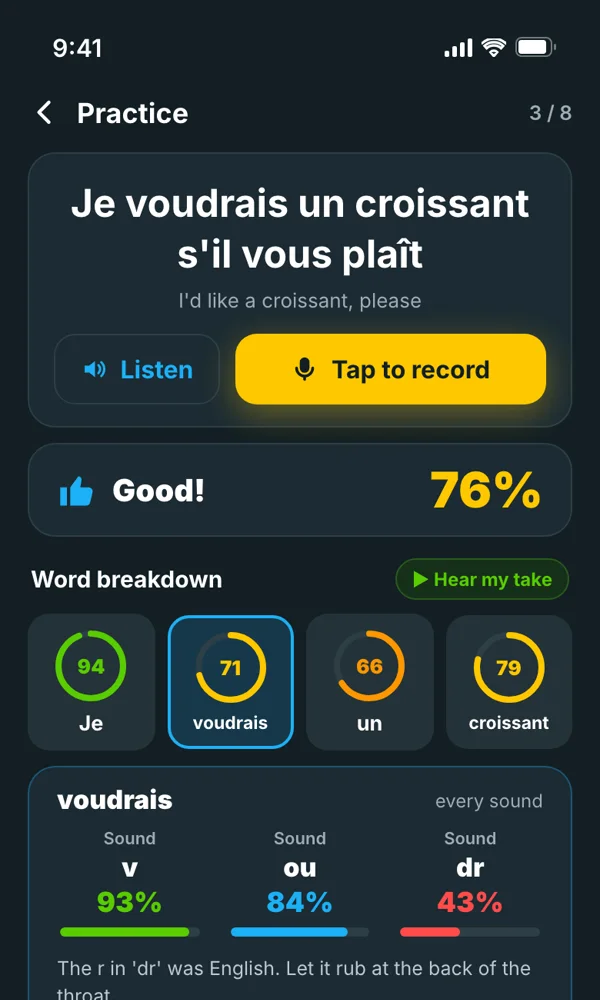
See every sound you get wrong
Each word is scored sound by sound, grouped by syllable, so you know exactly what to fix.
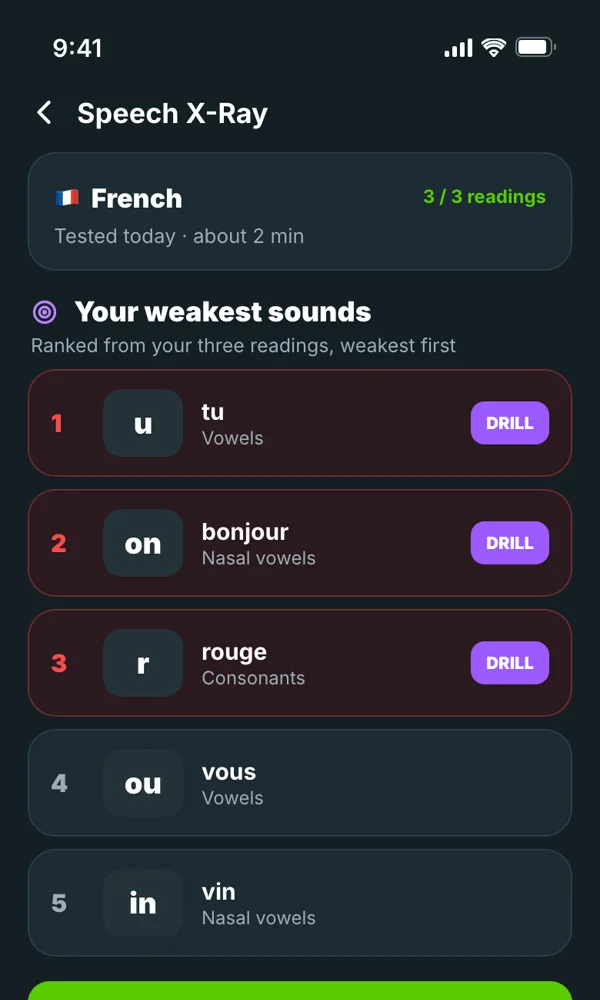
Find your weakest sounds in 2 minutes
A Speech X-Ray of three short readings ranks the sounds to fix first.
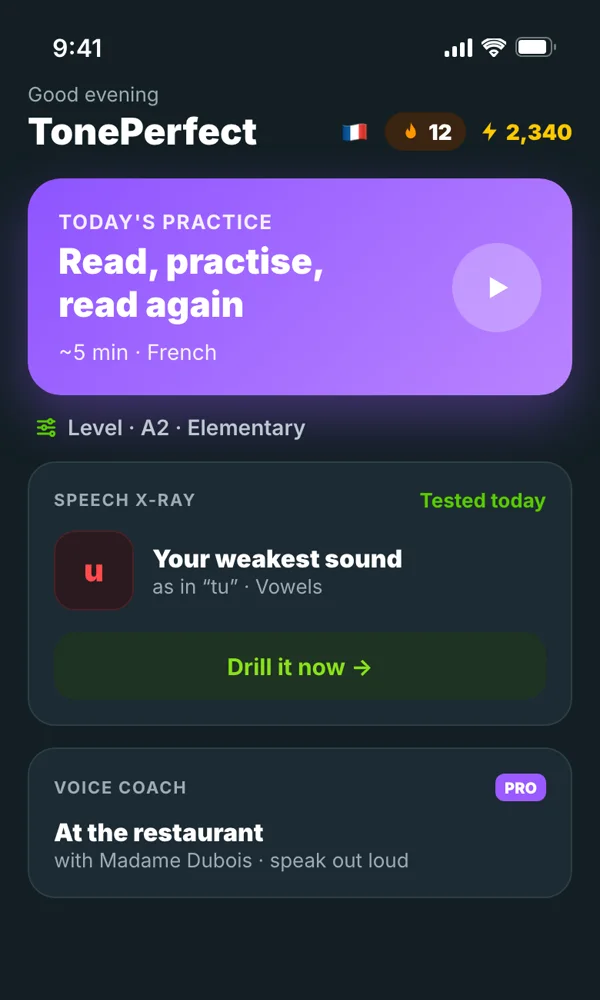
Five minutes a day
A short daily session built on the sounds you need most.
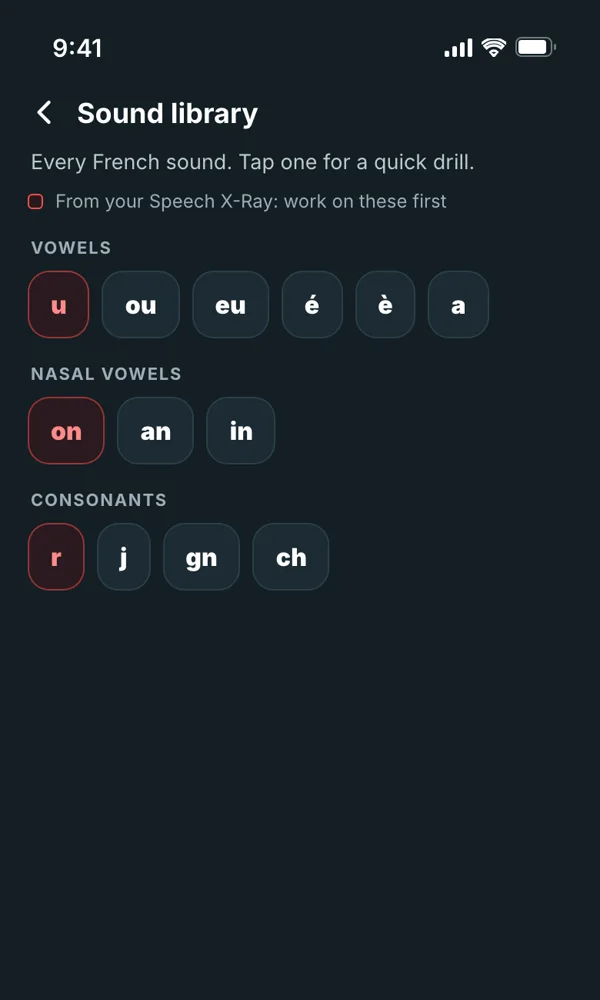
Drill any sound
A sound library for the whole language, with a one-tap drill for each sound.
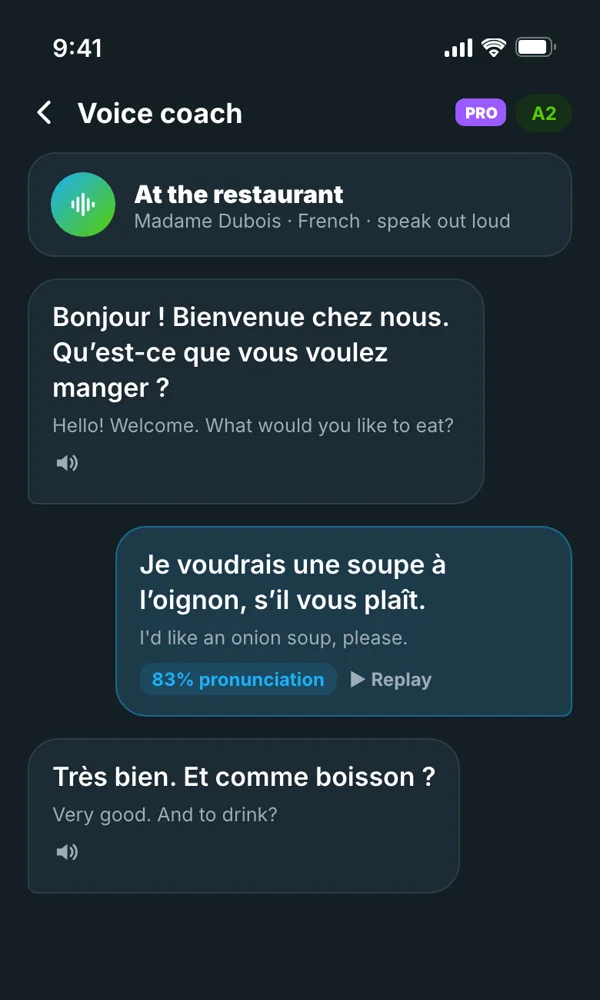
Speak in real situations
Role-play everyday situations out loud with an AI voice coach (Pro).
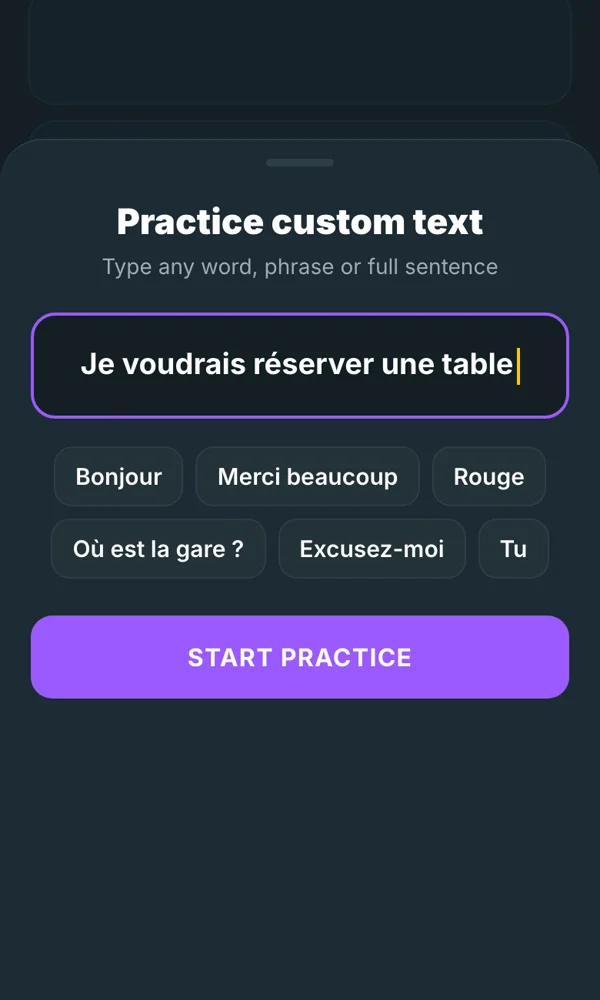
Practise any word or sentence
Type anything you want to say and get a score for every sound.
How it works
- 1
Record 5 French words in your browser — no download, no signup.
- 2
The AI breaks each word into its individual sounds and scores every one.
- 3
See which sounds rank lowest, then drill exactly those in the app.
Scoring runs on a commercial-grade speech-assessment engine that evaluates every sound in every word. French scores are relative: they rank your sounds against each other to locate your weak spots — no pass/fail bars and no invented accuracy percentages.
The sounds that decide your accent
Sound chart →the French 'r' sound (rouge)
Spelled r · rr
The back of the tongue rises toward the soft palate — where you say 'g' — and air rubs gently past it, like a very soft gargle. The tongue tip stays down and never taps or curls as in an English 'r'.
Common slip: You bunch or curl the tongue tip like an American 'r'; keep the tip down behind your lower teeth and let air rub at the soft palate instead.
Heard in
the French 'u' sound (tu)
Spelled u · û
Say 'ee' and keep your tongue exactly there while rounding your lips into a tight circle. If it sounds like 'ou' your tongue slid back — it must stay far forward.
Common slip: You let the tongue slide back and it comes out as 'ou'; say 'ee', freeze the tongue forward, and round only your lips into a tight circle.
Heard in
the 'ou' sound (vous)
Spelled ou · où · oû
Lips in a tight round circle, tongue pulled far back and high — deeper and tenser than the English 'oo' of 'food'.
Common slip: English 'oo' loosens the lips halfway through; hold them in one tight, unmoving circle with the tongue pulled far back for the whole vowel.
Heard in
the nasal 'an' sound (enfant)
Spelled an · en · am · em
Open your mouth wide as for 'ah' and send the air through your nose. Written an, en, am, em — and no 'n' is ever pronounced after it.
Common slip: You finish it with an English 'n', touching the tongue to the roof of your mouth; keep the mouth wide open on 'ah' and send everything through the nose.
Heard in
the nasal 'on' sound (bon)
Spelled on · om
Round your lips as for a deep 'o' and let the air flow through your nose at the same time. Your tongue must not touch anywhere — there is no 'n' consonant at the end of 'bon'.
Common slip: You slide it toward the English 'own' and close on an 'n'; keep the lips rounded and still, and never let the tongue touch the roof of your mouth.
Heard in
the nasal 'in' sound (vin)
Spelled in · ain · ein · im · un · um
Start from the open 'è' of 'mère', keep the mouth there, and let the air pass through your nose. Written in, ain, ein, and also un/um — keep it well apart from 'an' and 'on'. Words spelled with 'un' (un, brun, parfum) use this same sound.
Common slip: You reach for the 'ee' of 'seen' and tack on an 'n'; start from the open 'è' of 'mère', hold that mouth shape, and nasalize with no tongue contact.
Heard in
the closed 'eu' sound (deux)
Spelled eu · œu
Say 'é' and, without moving your tongue, round your lips as for 'o'. Tense and steady — the vowel of 'deux' and 'peu'.
Common slip: You unround it into the 'uh' of 'the' or the 'er' of 'her'; hold your tongue where it sits for 'é' and push your lips forward into a small circle.
Heard in
the open 'œu' sound (sœur)
Spelled eu · œu · ue
Say the open 'è' and round your lips at the same time. More open than the 'eu' of 'deux' — the vowel of 'sœur', 'peur', 'heure'.
Common slip: You add American r-coloring, pulling the tongue back as in 'burn'; drop the jaw a step below 'eu', keep the tongue forward, and round the lips.
Heard in
the 'ui' glide (nuit)
Spelled ui · uy
Start from the tight rounded 'u' of 'tu' and glide instantly into the next vowel. Lips stay rounded but the tongue is far forward — 'nuit' is not 'noo-ee', it is one quick syllable.
Common slip: You split it into 'noo-ee' with the tongue back; begin on the tight forward 'u' of 'tu' and glide straight into the next vowel in one syllable.
Heard in
the 'gn' sound (montagne)
Spelled gn · ign
Press the middle of the tongue against the hard palate (tip stays down behind the lower teeth) and hum through the nose — like the 'ny' in 'canyon' said as one sound.
Common slip: You break it into a hard 'g' plus 'n', or into two sounds like 'n-y'; press the middle of the tongue flat against the hard palate for one single sound.
Heard in
the closed 'é' sound (été)
Spelled é · er · ez · es · et
A crisp, tense 'ay' with no glide: tongue high-mid and forward, lips slightly spread, and hold the mouth frozen — English 'day' drifts, French 'é' does not.
Common slip: English 'ay' glides upward as the jaw closes; hold one frozen position, lips slightly spread, tongue high and forward, and stop before the vowel drifts.
Heard in
the 'j' sound (jour)
Spelled j · g · ge
Make the 'ch' of 'chat' and switch your voice on — a soft buzzing 'zh' as in 'vision'. French 'j' is never the English 'dj' of 'jump'.
Common slip: You start it with a 'd', turning 'jour' into 'djour'; begin with the voice already buzzing, as in the middle of 'vision' — no stop at the front.
Heard in
What usually goes wrong
The French R
It is made at the back of the mouth, near where you say 'g' — not with the tongue tip like the English R. Curling or tapping the tip is the single most recognizable giveaway of an English accent. The fix is physical: learn the new tongue position, then drill it in common words like 'pour', 'faire', and 'rouge'.
Three nasal vowels, three meanings
French sends air through the nose for 'an' (enfant), 'on' (bon), and 'in' (vin) — three distinct vowels that change word meaning. English speakers tend to collapse them into one nasal blur, or worse, pronounce an actual 'n' at the end. There is no 'n' consonant in 'bon': the tongue never touches.
u vs ou
'Tu' and 'tout', 'rue' and 'roue' — different words separated only by tongue position. The French 'u' keeps the tongue far forward (say 'ee', round your lips); 'ou' pulls it far back. If your tongue slides back on 'u', you have said a different word.
Silent letters and liaison
Most final consonants are written but not spoken — until the next word starts with a vowel and liaison brings one back: the 's' in 'les' is silent in 'les chats' but becomes a 'z' in 'les amis'. You cannot read French pronunciation letter by letter; you have to know which letters sound and when.
Vowels that refuse to glide
English vowels drift: 'day' ends in a little 'ee', 'go' ends in a little 'oo'. French vowels are frozen — 'é' and 'o' hold one position from start to finish. Letting them glide is subtle, but it is a large part of what makes an accent sound foreign.
Everything the French course gives you
French pronunciation drilled where it actually breaks: the R at the back of the mouth, the three nasal vowels, and the vowels that refuse to glide.
All 37 French sounds
Every take is scored across all 37 French sounds, so you can see which ones land lowest instead of guessing what gives your accent away.
The R and nasals
The back-of-the-mouth R and the three nasal vowels of enfant, bon and vin are drilled apart. English speakers collapse all three into one blur.
2,935 real words
2,935 French words taken from everyday speech rather than textbook lists, each with native audio to record against.
Review on a schedule
Words come back at intervals your own scores set. If the R sits at the bottom, rouge and pour return long before été does.
Weakest sounds first
Your daily set is ordered weakest first. If u and ou keep scoring lowest, tomorrow's words are the ones that carry them.
Five words, free
Say bonjour, rouge, tu, vous and vin in your browser. You get your French sounds ranked weakest to strongest before you install anything.
Practice anywhere, anytime
Available on every major platform. Your progress syncs seamlessly across all devices.
iOS App
Native iPhone and iPad experience.
Android App
Full-featured Android experience.
Web App
Practice instantly in your browser. No download needed.
Telegram Bot
Quick practice sessions right inside Telegram.
Simple, transparent pricing
Start free and upgrade when you're ready. No surprises.
Free
$0 forever
- At least one free guided practice session each day
- Daily workout
- Placement test
- Progress tracking
Premium
Most PopularCard prices above are for web checkout. App Store and Google Play prices may differ; your exact price and trial are shown before purchase.
- Unlimited assessments
- Spaced repetition reviews
- Custom text practice
- Advanced analytics
Questions
Is the French pronunciation test free?+
Yes. The 5-word browser test is free and needs no account. The TonePerfect app is also free to try; a premium subscription unlocks the full French course.
How does the AI scoring work?+
A speech-assessment engine breaks each word you record into its individual sounds — French has 37 in our model — and scores every one. For French we use those scores as a ranking: they show which of your sounds score lowest relative to the others, so you know what to drill first. We do not dress that up as an exam grade or a percentage of 'correct' sounds.
Can it actually help my accent?+
It gives you the two things accent work needs: knowing which sounds drag you down, and knowing how to make them. Every sound comes with a concrete articulation tip — where the tongue goes, what the lips do — and the app drills your weakest sounds across real words until the scores come up.
How does French compare to TonePerfect's other languages?+
TonePerfect started with Mandarin tones, where per-sound feedback matters most, and the same engine now covers 8 languages. The French model scores all 37 French sounds, including the three nasal vowels, the French R, the u/ou pair, and glides like the 'ui' of 'nuit'.
Do I need to install the app?+
Not for the test — it runs entirely in your browser. The full French course, targeted drills for your weak sounds, and progress tracking live in the app, which runs on iOS, Android, and the web.
How is this different from Duolingo or other language apps?+
General apps teach vocabulary and grammar, and their speech exercises typically pass you if a recognizer understood the word at all. TonePerfect only does pronunciation: it scores every individual sound you make, shows which ones are weakest, and tells you how to fix them. It is a specialist tool, and it works alongside whatever else you use.
Practice French every day
The app drills the sounds this test flags, with thousands of words and instant feedback on every take.
Learning Chinese? That's where TonePerfect started — see the full Mandarin course. Chinese pronunciation
Test your pronunciation
Free, with a score for every sound.